- Chairman Warsh Stands Tall
- Financial Conditions Are Easy
- The Land of the Setting Yen
- Cleveland, Washington DC and Dragon Errors
The FOMC raised rates by 25 basis points. So, what did we learn? As it turns out a great deal and it’s very important. Couple that with what is happening in Japan and long rates in general around the world, not to mention the geopolitical complications and energy, and there is a great deal to talk about.
I have long been critical, for decades, of the fact that 12 people sit around a table and set the price for arguably the most important commodity in the world: US short-term interest rates. How can 12 people know more than the market? We can simply look at all of the errors they have made over the past century and determine that they get it wrong as often as they get it right, at least if you are judging by price stability.
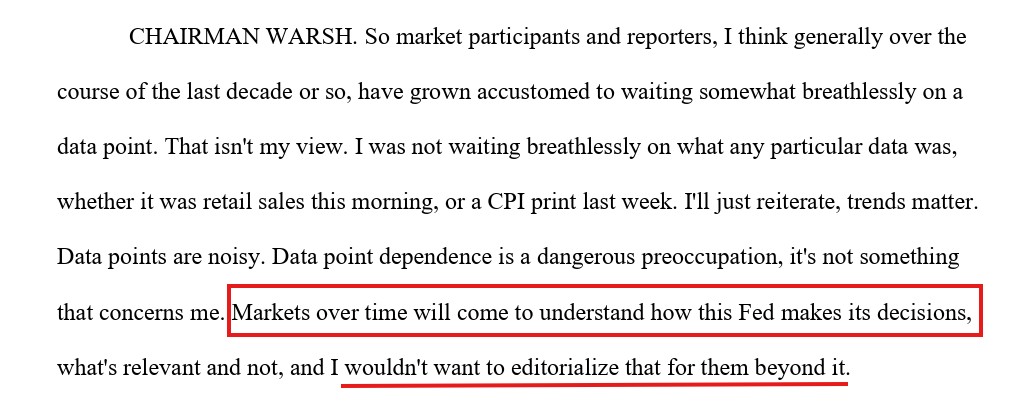
Federal Reserve Chairman Kevin Warsh has changed that dynamic as much as it is possible to. What he is doing was simply unimaginable a few years ago. Not to mention anything like it for the last 40 years. While we will never get rid of the FOMC, the chairman is changing the cadence of how they make their decisions. He was very clear in his press conference after the meeting (read this twice):
(H/T to Rene Aninao, simply the best observer and analyst of Federal Reserve policy I know, whose thinking has helped shape this letter which I with permission borrow shamelessly from.)
For decades “the market” has looked to the Fed to determine the direction of interest rates. They waited breathlessly on any speech, any indication of what the Fed would do to try to position themselves ahead of any particular meeting.
Warsh has been clear that he thinks this is backwards. He believes the market should determine the rates and that the Fed should respond to market conditions without trying to insert itself into the equation.
And that is exactly what happened. I was concerned last week that the chairman would have difficulty getting a 9-3 vote because of the known doves on the committee. The vote instead came in at 12-0. I’m not certain which is a bigger factor, but the Jackson Hole speech and subsequent conversations clearly influenced a number of the committee to go along with a rate hike.
And then the second influence: the market itself. For all intents and purposes, the market tightened prior to the meeting and the Fed was simply following along with what the market had already done. To vote against what the market had already done should be embarrassing, and no FOMC member wants to be embarrassed.
We are never going to get rid of the FOMC for political and practical reasons. For those of us who would like to see the market set rates without an FOMC intervening, this is as good as it’s going to get.
For at least the next four years, the Fed will be following the lead of the market and not vice versa. It is going to take some time for the market to adapt. They have been spoon-fed by the Fed (pardon the pun) and now they have to put on their big boy pants without “Daddy” looking over their shoulder and telling them what to do. And you know what? The market is perfectly capable of doing just that.
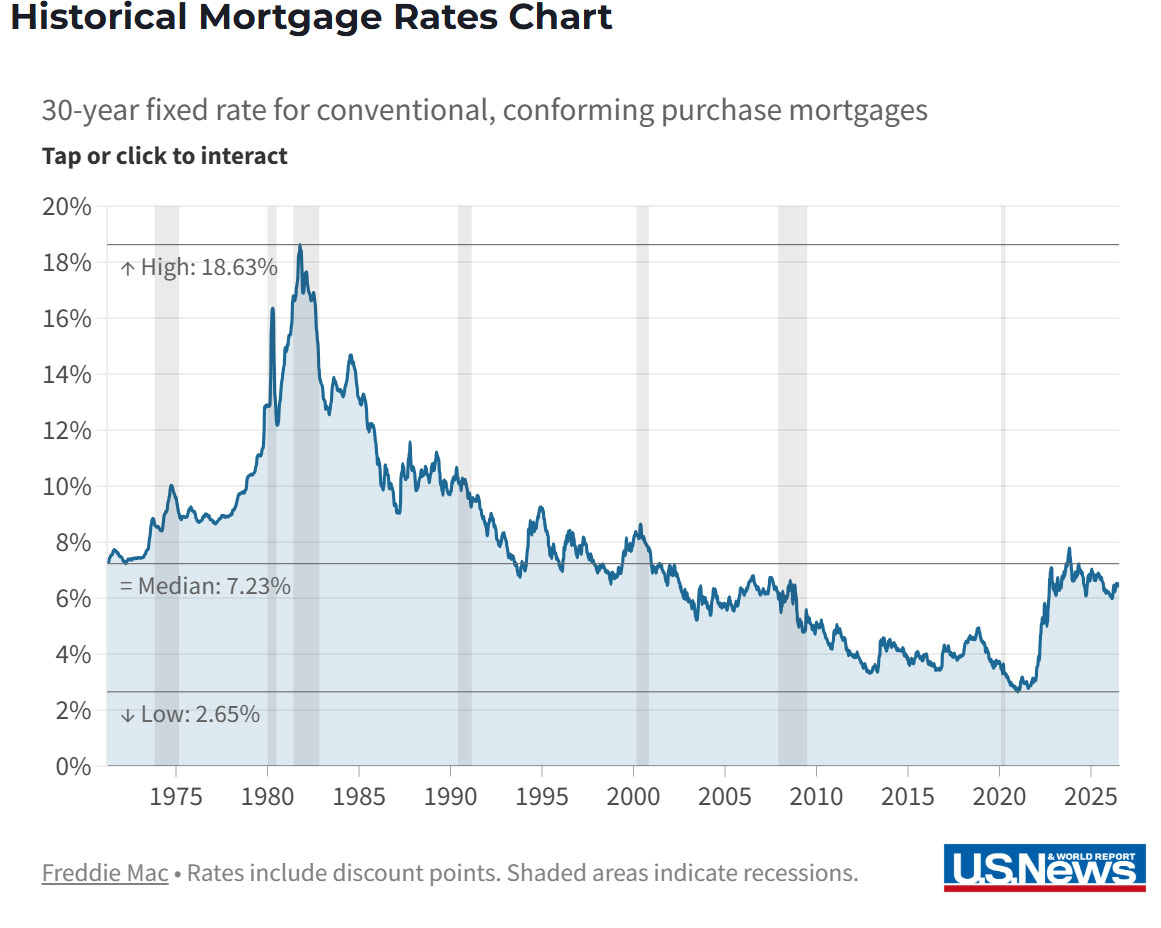
The economy is simply getting stronger, except for two main areas: the obvious energy problems that are not a function of Fed policy but of geopolitics. Admittedly, energy is a big deal. The second is the housing market which is likely going to be in a prolonged period of higher mortgage rates. Which is to say that the mortgage rates are now much closer to their historical average than the heavily manipulated low mortgage rates of the past 18 years. That manipulation resulted in asset price inflation, which we all love - and inflation, which we all hate.
Source: U.S. News
(Yes, I know there are nuances and we could argue cause and effect all day.)
Chairman Warsh Stands Tall
I should point out that the chairman successfully pushed through a rate hike. He also left open the possibility of another rate hike at the October meeting, six days before the election. We will see. Quoting a few comments from René’s latest missive:
-
The Chairman also decisively pushed through a rate hike before the election -- while rather skillfully managing the President -- going a long way towards ending any charges of being politically compromised or lacking independence etc.
-
The Chairman’s answers during the post-meeting presser were mostly intended towards a broader audience of domestic laymen and global stakeholders -- not the professional “Fed watcher chattering class” -- and in a stark contrast to his Administration colleagues, made notable “last adult in the room”-style remarks explaining that the policy adjustment would benefit “the least well-off among us” elongating the cycle and bolstering the Fed’s global responsibilities
-
Ultimately, building credibility takes time and, as we’re often fond of noting, is “earned, not inherited” -- e.g. even Greenspan did not become “Maestro” in 4 months -- but yesterday’s presser was clearly a significant down payment on the credibility building process
A side, but important, point. At the beginning of rate-hike cycles, markets are generally underestimating how high rates will go, and they typically go much further than market participants thought at the beginning. Will that be the case this time?
I see that as a high possibility. While energy is a smaller component of the overall CPI, it feeds incrementally into almost everything, so the impact of energy gets measured in hundreds of indirect ways as it feeds into the CPI.
Further, housing is a major component, and the housing market is tight at current prices and rates will tend to be higher than we would like over time. The supply/demand equation is going to have to be settled on the price of the house, not the price of the mortgage. Or homebuyers are going to have to adapt to higher rates. Just as we did in the 70s.
Couple those with the clear trend of the Producer Price Index to significantly surprise on the upside, which feeds into many of the components of CPI over time, and price pressures bubbling up the manufacturing chain are again a large factor.
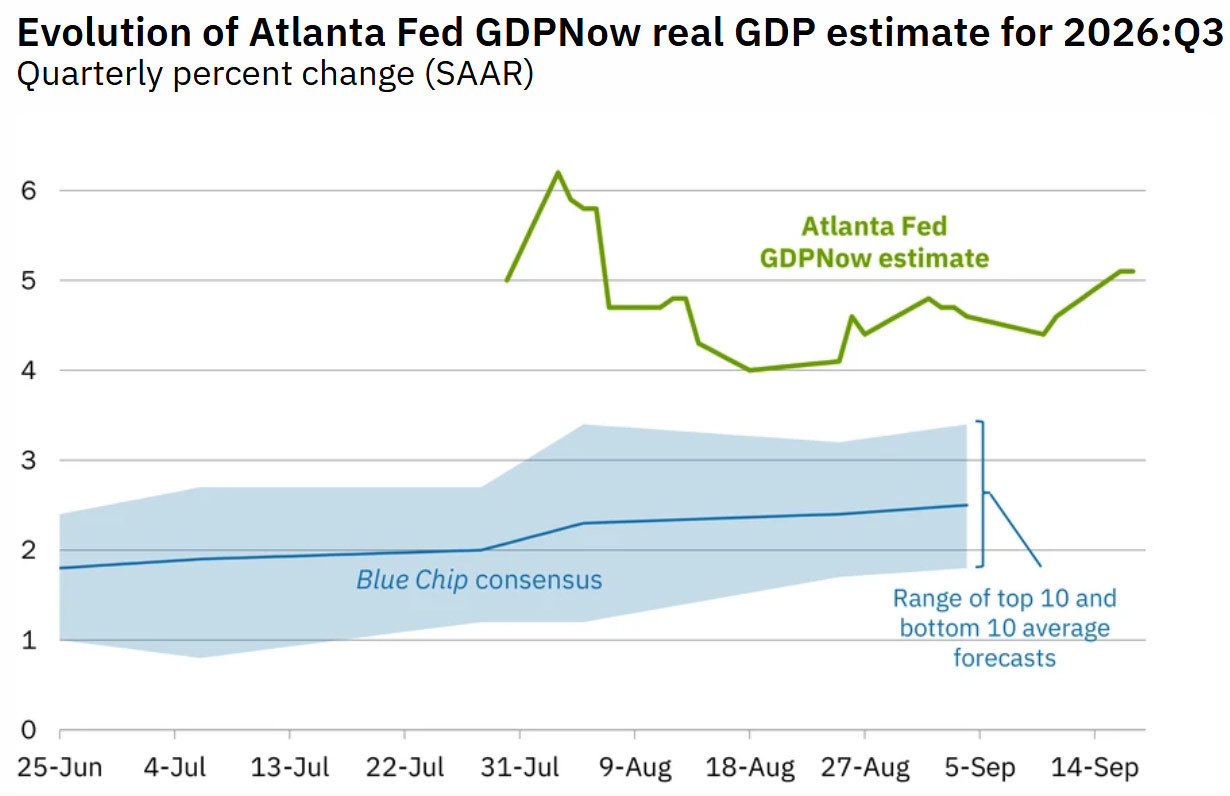
These three facts do not bode well for containing inflation and getting it to the 2% target. And make no mistake, the Warsh Fed sees inflation as job number one. And the economy in general is giving them some room to run. Look at the latest chart from the Atlanta Fed GDPNow. With the release of the rather strong consumer spending numbers this week, the Atlanta Fed’s data suggests that GDP should be closer to 5%. There are two weeks left of this quarter, and this number is of course always revised, but the economy appears to be relatively strong in spite of energy and housing.
Source: AtlantaFED
Financial Conditions Are Easy
Further, financial conditions are easy. Maybe not in your world, especially if you are in the real estate business (I’m looking at you, Jim Tosti, a good friend, real estate developer and whom I communicate with), but the Bloomberg financial conditions index has been “green” for the past 2+ years, coinciding with the bull market, and is actually improving. From Alexander Ineichen, who does the most fabulous charts on multiple scores of topics,
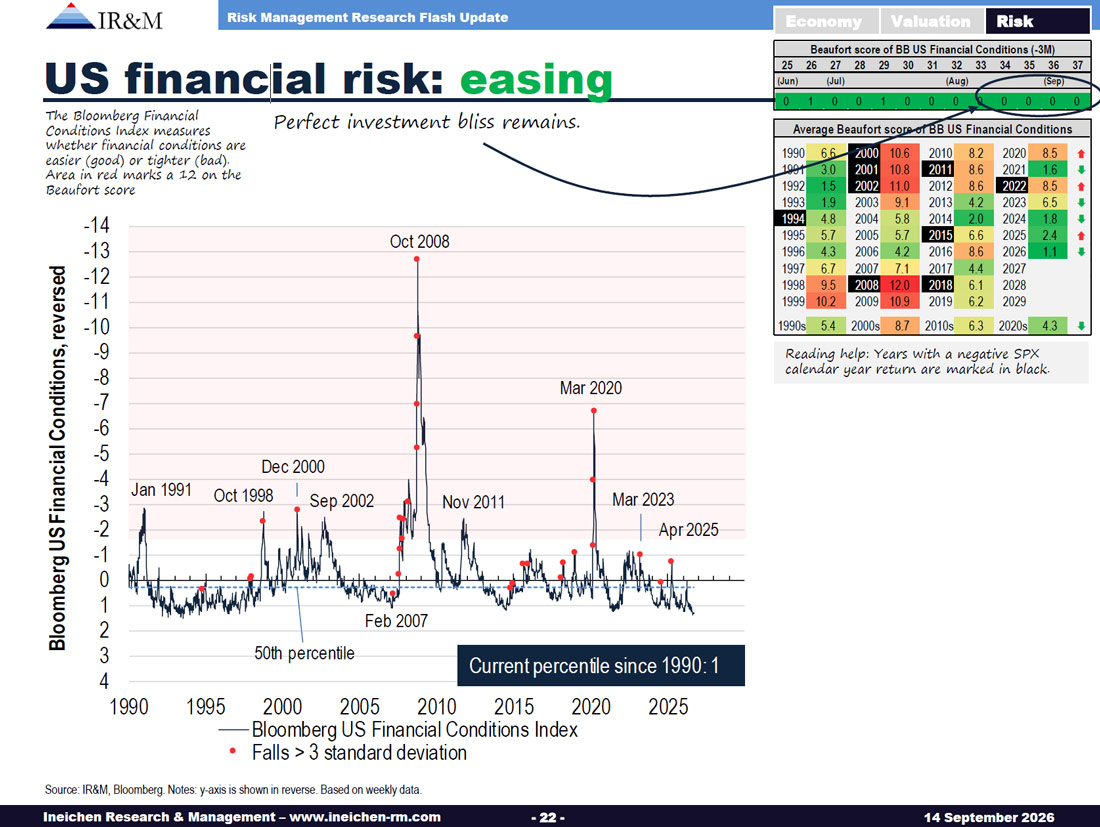
Source: alexanderineichen
Yes, I know that the yield on 10-year bonds, which influences mortgage rates, is basically unchanged since the Fed meeting. I would point out that two days does not a trend make. Let’s see what happens in 3-6 months. Right now, the bond market is doing the tightening for the Fed, which is the way it should be. Will it be enough to cause them to have an October rate increase? Maybe. The market sets the odds at 44%, but it’s too early to make a prediction.
A few final thoughts on the FOMC press conference.
Johan Gustaf Knut Wicksell, a Swedish economist, developed a very important economic theory called the “natural rate of interest” concept and the cumulative process in Interest and Prices, linking interest rates to price stability. (He also contributed numerous other ideas.) Modern Keynesians have taken this concept to the, I don’t want to say extreme, but to the point where they feel they can calculate what that natural rate of interest is. Warsh specifically downplayed that notion. Again, quoting from René (I have added some emphasis here and there):
-
In a watershed moment in Federal Reserve history, the Chairman rebuked the notion of the “neutral” or real equilibrium rate as false precision, with “no operational effect” on the setting of monetary policy -- and then replaced it with a predominantly financial conditions impulse [JM: something we will explore in later letters.]
-
Which means that in the coming months and years, when market participants want to know “when policy is restrictive” -- ie, when the hiking cycle is complete -- you will probably know the direction, and maybe even the magnitude or “zone”…
-
…But you’ll only know “when it’s over” -- when the Chairman tells you, if ever
If you want to understand the Chairman’s thinking, go back to his Jackson Hole speech. He lays out a very different view of how Federal Reserve policy should be. Frankly, I thought there would be some pushback from the neo-Keynesian members of the FOMC, as he is explicitly walking away from many of those concepts.
That he got a 12-0 vote should tell you that this Fed is not going to be like anything we’d seen for at least 20 years, if not longer. Now let’s turn to the other major central bank, the Bank of Japan and its rate hike and what it means for the world.
The Land of the Setting Yen
For decades, the yen carry trade has been a significant factor in global money flows in investing. Basically, you borrow at extraordinarily low rates in yen, hedge the currency risk if you want to, and then invest in whatever instrument you want wherever in the world you want. Further, because of the restrictive interest-rate regime in Japan, Japanese investors, one of the largest pools of savings in the world, have been very comfortable investing internationally, seeking higher yields and willing to either take the currency risk or reduce the returns by hedging.
This decades-long trade began to unwind earlier this year, and it is having a major impact on interest rates all over the world. Let’s turn to my good friend Dr. Ed Yardeni and his take on the Japanese carry trade and its implication for the world that hit my inbox late last night.
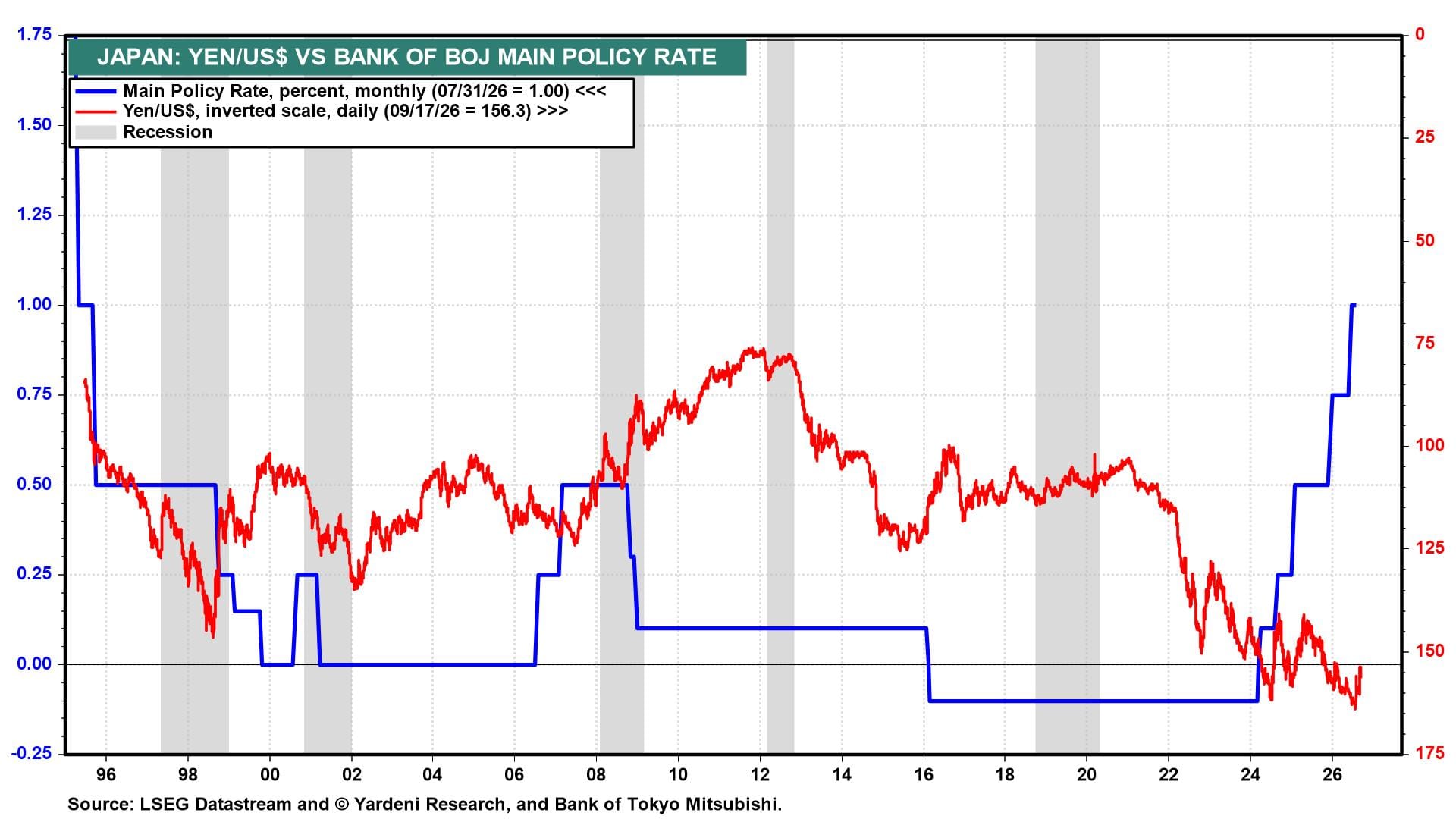
First, like the Federal Reserve, but even more so, the Bank of Japan is seriously behind the curve. They have kept rates artificially low for so long that it is finally beginning to show up in the price of their currency. Something I predicted 15 years ago, and was obviously, and personally painfully (as I hedged my mortgage in yen), early.
The yen has been in a 14-year slide. It really began to get worse when the Bank of Japan went to negative rates. And while they have started a rate hiking cycle and are back (!) to a 1% equivalent to the Fed funds rate, if they want to protect the price of the yen, they are going to have to do a great deal more. Inflation is getting to the 2% range (their target) but there is no reason that it cannot go higher as a falling yen is inflationary in Japan. (All charts below are from Ed Yardeni. (Ed and his team are worth their subscription cost. Try him.)
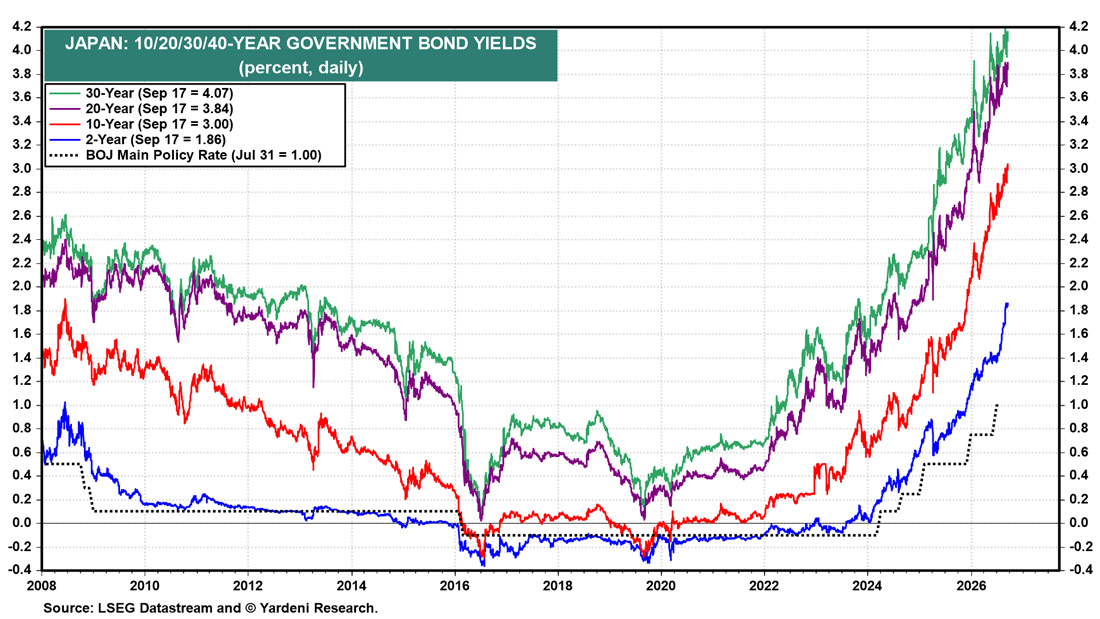
The Japanese 10-year rate is an even 3%. For what it’s worth, their 30-year bond is at 4.07. Quoting Ed:
“Japan’s bond market confirms the BOJ has more tightening to do. JGB yields have risen sharply alongside the policy rate but remain well above it across the curve (chart). Japan’s Bond Vigilantes are signaling that monetary policy remains too accommodative. Higher Japanese bond yields also encourage Japanese bond investors to return home and reduce their exposure to foreign bonds, especially if the yen continues to rally.”
This repatriation of yen is important. It is affecting global government bond yields everywhere. Which means that it is feeding into corporate and business yields. Look at how the rising rates in Japan are affecting bond yields in the major developed countries:
Let’s take that most treasured of international investors, Mrs. Watanabe. I haven’t checked recently, but for decades Japanese household investors were very active overnight and influenced markets. They did that because they had no yield to speak of in the Japanese bond markets, and stocks were moribund. That has changed.
They can now get 3% from the Japanese 10-year bond. If you want to make sure that you are not subject to currency risk, which has become increasingly the case, you have to hedge your currency exposure. The cost of hedging is about half the actual target yield. So that would mean that a Japanese investor would need something north of 4% in order to justify investing if they want to be hedged for longer than a few days (depending on the target). It is now getting difficult to find enough yield in government bonds to warrant the hedging expense.
That means that the Japanese are moving more into higher yielding corporate bonds and US equities. Aside from government bond yields, if corporate bonds want to attract Japanese investors, they have to rise as well. The slow demise of the yen carry trade is pushing up interest rates on longer-term bonds everywhere. And that then influences interest rates in global markets all over the world.
Further, what cash inflows from the rest of the world into the US are being invested in is mostly US equities.
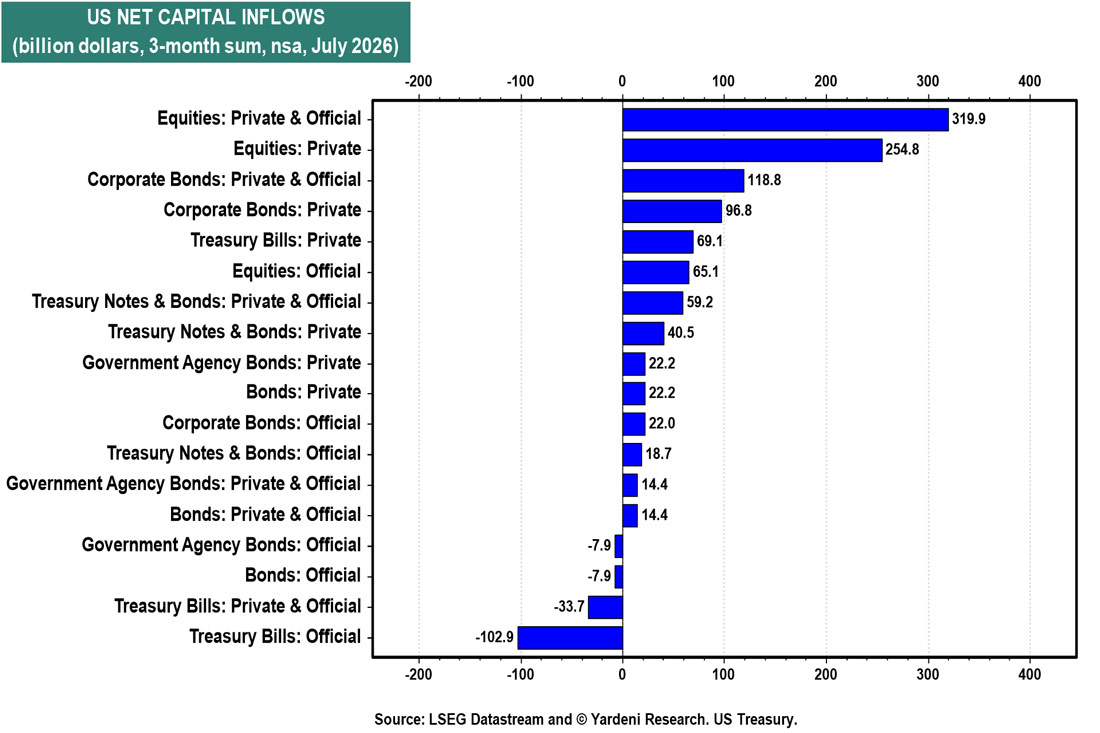
I don’t expect this trend to stop. The Bank of Japan is going to continue to raise rates in an effort to try to get ahead of inflation, catch up with their own bond market which is telling them (maybe shouting at them as more accurate) that conditions are too easy and that they need to protect the yen. This is going to be a major shift in global capital markets. I really don’t have historical analogy to compare this with.
What this means is that foreign investors, and especially central banks, are scaling back their percentage of their holdings in US dollars.
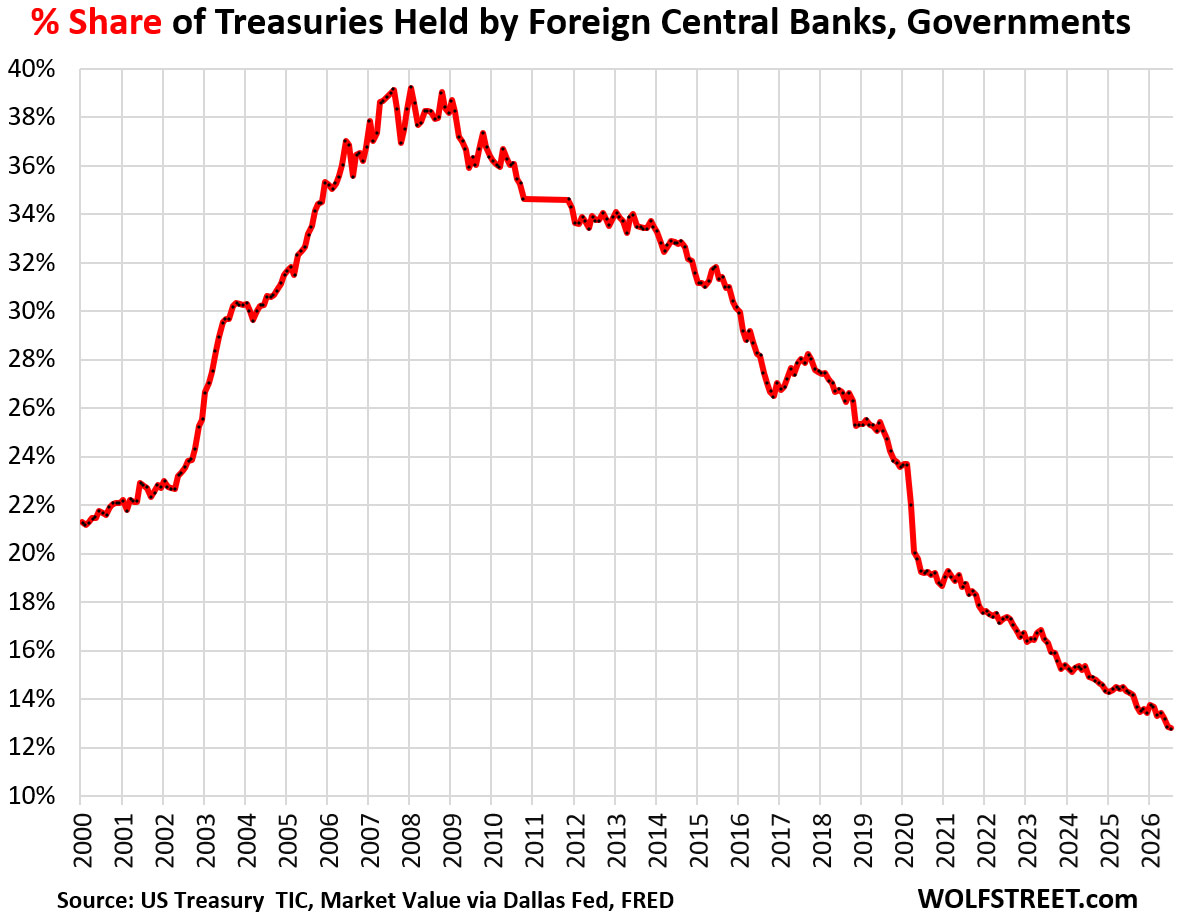
Source: wolfstreet.com
But that’s not the whole story. Private “foreign” investors have picked up the difference. But it comes with a nuance.
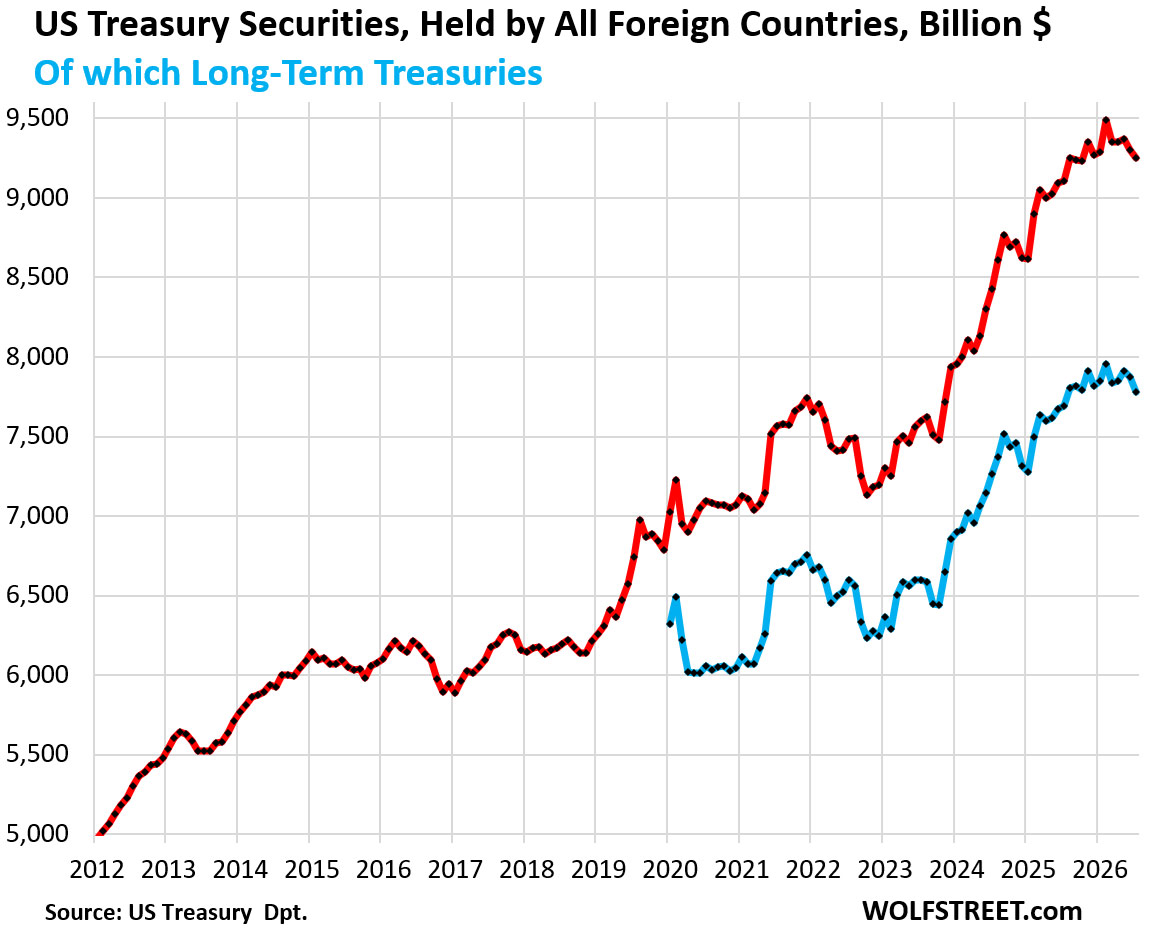
Source: wolfstreet.com
“These private foreign holdings are not purely “foreign.” They include large amounts from US hedge funds that are domiciled in foreign financial centers, such as the Cayman Islands, a big favorite for hedge funds engaged in the highly leveraged Treasury basis trade that buy Treasuries, estimated at close to $2 trillion, and sell Treasury futures against them. This is the hot money in Treasuries, and back in March 2020, it caused the Treasury market to seize, an event that the Fed keeps nervously talking about. Only now, it’s a lot bigger.” (Wolf Richter)
A few key takeaways:
-
US short-term interest rates are going to rise. The two-year bond yield is already signaling another rate hike or two. And sooner, rather than later.
-
The Fed, and especially Warsh, believes they are a long way from even an imprecise “neutral rate.”
-
Government bond rates around the world are going to continue to rise as the Bank of Japan and Mrs. Watanabe change their decades-long positions.
There is a lot more to say but we are at 2,500 words. All that material on my editing room floor will have to wait till next week. Stay tuned…
Cleveland, Washington DC and Dragon Errors
I turn 77 in two weeks (October 4). The next weekend Shane and I will be in Cleveland attending Drs. Mike and Nancy Roizen’s combined 80th birthday party. I also hope that I can get a little laser surgery on my right eye to correct some of the cloudiness, which we did very successfully a few years ago on my left eye. Then my next planned trip is back to Cleveland where my daughter Abbi will be having brain surgery November 5. I will be there for her and like to get a few tests and treatments of my own. Just getting old and all. Then on Sunday I will fly to Washington DC where the Inner Circle will be meeting for a few days. We already have a fabulous lineup.
I use the software dictation program called Clarion DragonSpeak, and have for a decade. It is quite subject to dictation errors, which sometimes slip through editors. And then there was last week. Ed looked at my prose and thought it was another Dragon error. He noted that he thought it was the best Dragon Error he had ever seen, and he almost left it in. I wrote (edit highlighted):
“Messing with the bond market is a magnitude more difficult and far less likely to succeed than trying to intervene in the yen market. The problem is not the bond market, it is the incontinence of Congress and its inability to control spending.”
Ed assumed I meant incompetence. No, I wrote back, I really did mean incontinence, but it was too late to leave it in.
I am going to experiment with a new speech recognition software in the next few weeks that is supposedly much better. Microsoft bought Clarion and has not really improved the software in five years, at least from my experience. I will let you know.
And with that, I will hit the send button. You have a great week!
Your trying to see the big picture analyst,
John Mauldin
Co-Founder, Mauldin Economics
About the author
