
If you follow our banking work, you know that we have been covering shadow banking extensively in our articles, and our view was, and still is, that this is one of the major risks for the banking system.
Bank exposure to the shadow-banking system has exploded over the past decade. According to the latest FDIC data, lending to shadow banks has been growing at a striking 22%+ CAGR over the 2010-2025 period, which is more than three times the growth rate of the next-fastest-growing major loan category. The majority of these loans were granted by the largest US banks.
For banks with more than $250B of assets, loans to shadow banks increased from only around 6-8% of Tier 1 capital in 2010 to roughly 60% in 2024 and more than 76% in 2025. In other words, what was once a relatively immaterial exposure has become equivalent to more than three-quarters of the capital base of the largest banks. And this exposure is even higher if we include off-balance-sheet commitments.
So far, the key risks have been the opacity of this lending and high leverage. However, in recent months a new trend has emerged - credit quality across the private-credit part of the shadow-banking system has started to deteriorate. Obviously, it was only a matter of time before such an opaque and highly leveraged sector started showing asset-quality issues. However, timing is always difficult to predict, and now the hard data are finally showing that credit quality in this segment is starting to crack.
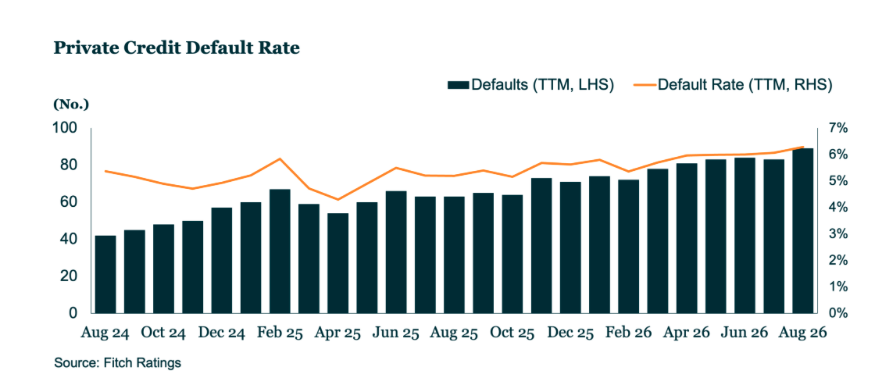
First, Fitch's US private-credit default rate reached a record 6.3% in August 2026, up from 6.1% in July, with 89 unique defaulters and 109 default events over the trailing twelve months. August alone produced a record 14 default events. Notably, in some sectors the situation is even uglier - healthcare providers and industrial/manufacturing both have default rates of 9.9%. For comparison, healthcare was at 6.9% only one year earlier, while industrial/manufacturing was almost twice as low at 5.2%.
Second, Houlihan Lokey found that among private-credit borrowers with less than $20MM of EBITDA, loans trading or marked below 90 cents on the dollar increased from roughly 1% in 2023 to 12% today. That is more than a tenfold increase. Stress is now also spreading upward into borrowers with $20MM-$100MM of EBITDA after several years of relative stability.
The Boston Fed has also recently published a study on payment-in-kind (PIK) interest. Instead of paying interest in cash, the borrower adds the interest to principal. Boston Fed analysis of 168 BDCs found the proportion of loans using PIK rising from 5.4% in 1Q22 to 9.8% in 1Q26, nearly doubling. PIK interest does not necessarily suggest credit issues. But rising PIK is a very concerning signal given elevated interest rates and rising default rates.
Finally, needless to say, the recent increase in Treasury yields is very likely to put additional refinancing pressure on shadow-banking borrowers. And even though the data above have not yet captured the full impact of this latest spike in yields, the numbers are already showing that this massive and opaque credit segment is starting to show meaningful cracks. Given how deeply the largest US banks are now connected to shadow lenders, further deterioration could eventually become a much broader financial-stability risk.
Bottom line
Believe it or not, there are more major issues on the larger bank balance sheets as compared to smaller banks, which we have covered in past articles. Moreover, consider that there was one major issue which caused the GFC back in 2008, whereas today, we currently have many more large issues on bank balance sheets. These risk factors include major issues in commercial real estate, rising risks in consumer debt (approaching 2007 levels), underwater long-term securities, over-the-counter derivatives, high-risk shadow banking (the lending for which has exploded), and elevated default risk in commercial and industrial (C&I) lending. So, in our opinion, the current banking environment presents even greater risks than what we have seen during the 2008 GFC.
Almost all the banks that we have recommended to our clients are community banks, which do not have any of the issues we have been outlining over the last several years. Of course, we're not saying that all community banks are good. There are a lot of small community banks that are much weaker than larger banks. That’s why it's absolutely imperative to engage in thorough due diligence to find a safer bank for your hard-earned money. And what we have found is that there are still some very solid and safe community banks with conservative business models.
So, I want to take this opportunity to remind you that we have reviewed many larger banks in our public articles. But I must warn you: The substance of that analysis is not looking too good for the future of the larger banks in the United States, and you can read about them in the prior articles we have written.
Moreover, if you believe that the banking issues have been addressed, I think that New York Community Bank is reminding us that we have likely only seen the tip of the iceberg. We were also able to identify the exact reasons in a public article which caused SVB to fail. And I can assure you that they have not been resolved. It's now only a matter of time before the rest of the market begins to take notice. By then, it will likely be too late for many bank deposit holders.
At the end of the day, we're speaking of protecting your hard-earned money. Therefore, it behooves you to engage in due diligence regarding the banks which currently house your money.
You have a responsibility to yourself and your family to make sure your money resides in only the safest of institutions. And if you're relying on the FDIC, I suggest you read our prior articles, which outline why such reliance will not be as prudent as you may believe in the coming years, with one of the main reasons being the banking industry’s desired move towards bail-ins. (And, if you do not know what a bail-in is, I suggest you read our prior articles.)
It's time for you to do a deep dive on the banks that house your hard-earned money in order to determine whether your bank is truly solid or not. You can feel free to review our due diligence methodology here.
About the author
