
Last week, the NY Fed published its household credit report for the third quarter, which raises some serious questions about the US consumer and, more importantly, what happens to banks’ balance sheets and the quality of their loans when the credit cycle eventually turns negative.
The economy is still growing, unemployment remains relatively low, and there is no crisis in financial markets. Yet credit problems are already widespread, with delinquencies at elevated levels (and some already above GFC levels) across several major lending categories. This is very concerning because credit quality should theoretically be much, much stronger at this stage of the economic and credit cycle.
According to the NY Fed, 5.0% of outstanding household debt is now in some stage of delinquency, compared with 4.7% in 2Q26 and 3.1% at the end of 2023.
One of the most alarming findings is the persistently weak credit card quality. Approximately 13% of credit card balances are now at least 90 days delinquent, just a tad below the GFC peak. That is a striking number for an economy that is supposedly in reasonably good shape. Importantly, the NY Fed noted that credit problems have been particularly severe among borrowers in lower-income neighborhoods.
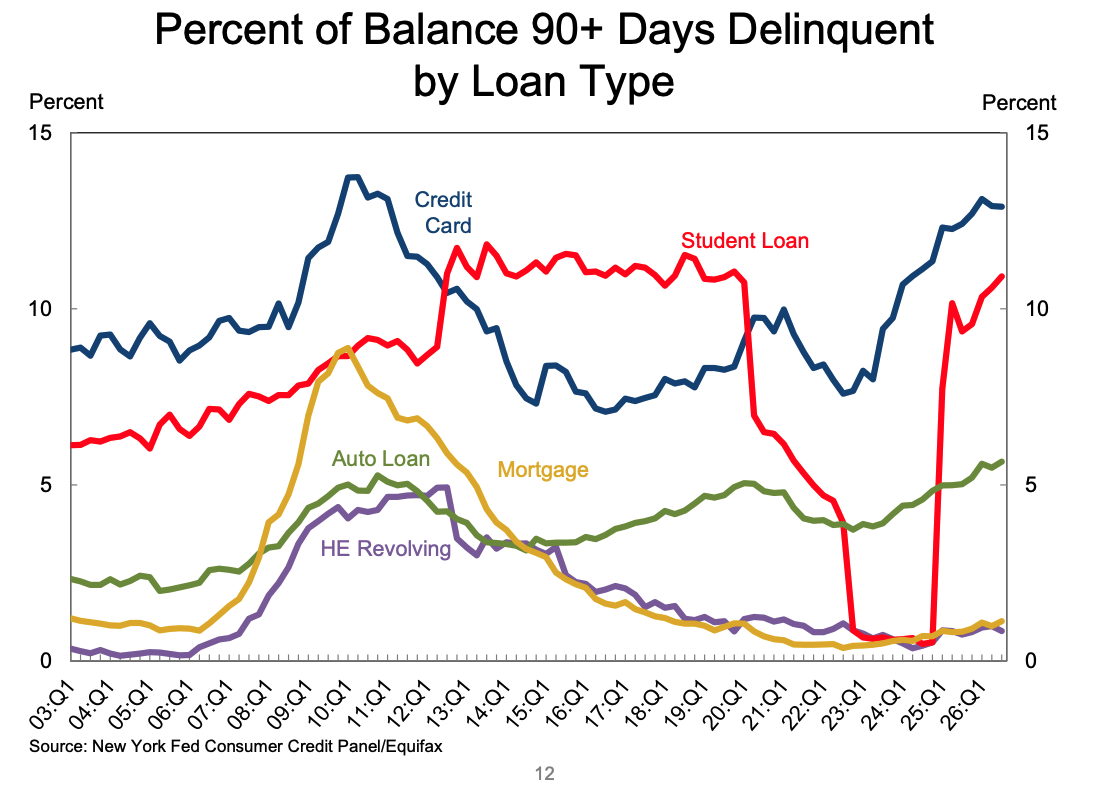
As the chart above shows, the situation with auto loans is arguably even worse: the share of balances at least 90 days delinquent has risen to more than 5.5%, already above its GFC peak. Importantly, the transition into early delinquency continues to increase, suggesting that pressure on borrowers remains very significant.
Finally, another important finding is that even mortgages, which have been the strongest part of household lending for much of the post-GFC era, are now showing signs of deterioration. The annualized transition rate into serious mortgage delinquency increased from 1.28% in 3Q25 to 1.60% in 3Q26, an increase of 25% in just one year.
Admittedly, mortgage delinquency remains low by historical standards. But a bank focused on residential mortgages is not automatically safe just because it lends against homes. If you are familiar with our analysis of the Top-15 safest banks, you know that we carefully examine the borrower profiles of mortgage-focused banks. This is becoming much more important, as weaker-quality borrowers are starting to show cracks and mortgage books could come under further pressure if the economy slows.
To sum up, the most troubling aspect of this report is not simply that household delinquencies have increased. It is that credit quality remains under significant pressure despite a relatively benign macroeconomic environment. With household credit already showing so much stress, banks do not need another 2008-style financial crisis for credit losses to become a major problem for capital. Even a modest deterioration in economic conditions could lead to serious issues, particularly for lenders with weaker borrower profiles.
Bottom line
Believe it or not, there are more major issues on the larger bank balance sheets as compared to smaller banks, which we have covered in past articles. Moreover, consider that there was one major issue which caused the GFC back in 2008, whereas today, we currently have many more large issues on bank balance sheets. These risk factors include major issues in commercial real estate, rising risks in consumer debt (approaching 2007 levels), underwater long-term securities, over-the-counter derivatives, high-risk shadow banking (the lending for which has exploded), and elevated default risk in commercial and industrial (C&I) lending. So, in our opinion, the current banking environment presents even greater risks than what we have seen during the 2008 GFC.
Almost all the banks that we have recommended to our clients are community banks, which do not have any of the issues we have been outlining over the last several years. Of course, we're not saying that all community banks are good. There are a lot of small community banks that are much weaker than larger banks. That’s why it's absolutely imperative to engage in a thorough due diligence to find a safer bank for your hard-earned money. And what we have found is that there are still some very solid and safe community banks with conservative business models.
So, I want to take this opportunity to remind you that we have reviewed many larger banks in our public articles. But I must warn you: The substance of that analysis is not looking too good for the future of the larger banks in the United States, and you can read about them in the prior articles we have written.
Moreover, if you believe that the banking issues have been addressed, I think that New York Community Bank is reminding us that we have likely only seen the tip of the iceberg. We were also able to identify the exact reasons in a public article which caused SVB to fail. And I can assure you that they have not been resolved. It's now only a matter of time before the rest of the market begins to take notice. By then, it will likely be too late for many bank deposit holders.
At the end of the day, we're speaking of protecting your hard-earned money. Therefore, it behooves you to engage in due diligence regarding the banks which currently house your money.
You have a responsibility to yourself and your family to make sure your money resides in only the safest of institutions. And if you're relying on the FDIC, I suggest you read our prior articles, which outline why such reliance will not be as prudent as you may believe in the coming years, with one of the main reasons being the banking industry’s desired move towards bail-ins. (And, if you do not know what a bail-in is, I suggest you read our prior articles.)
It's time for you to do a deep dive on the banks that house your hard-earned money in order to determine whether your bank is truly solid or not. You can feel free to review our due diligence methodology here.
About the author
