While my series of predictions were, in their totality, the most extreme I’ve ever made for a single year, it is the “in total” part that causes me to believe they will most likely ALL become our new reality. Granted, some could take a little longer to play out than I think, but the really important part of those predictions behind the paywall was the simple connections by which they all will play off of each other. It’s the fact that so many things are already starting to slide that all affect each other that makes it actually more likely they will all go down … together. (See: “2027 PREDICTIONS: 2027 Brings the Everything Bubble Bust, and Here is What that Will Look Like”)
What happened recently provides an interesting example. One prediction I wanted to place earlier in my list of problems than where I did was my prediction about what would happen to banks in the coming year. I won’t give it all away, since that was for paying subscribers, but maybe I should have actually moved it up as I considered. I mean, look at the news on banking.
I came across some postings from Catherine Austin Fitts. (See the headlines section below.) She shows two major bank indices in the stock markets of the world that have been on a long plunge already, which is a major warning for the stock market. She names some of the largest banks in the world that have already lost a quarter of their value. Of course, they are also the banks that are typically first among the big boys to look troubled because they have done some dumb stuff in the past. They are the repeat offenders in the stupid-risks department.
I placed banks toward the end of the order on my list because of all the things that will be impacting them, to show that all those things would eventually be more than some of the major banks can handle. Then I indicated how far that would go. In my view, banks will be slow to join the party because banks did make changes in how they are capitalized, etc., after the big banking bust of 2008-2012. The news makes me wonder a little if I gave them too much time. Maybe I extended too much credit to banks.
In spite of being better capitalized, the value of their reserves as a shield in bad times is being seriously cut into by the rise in Treasury rates. More so than at other times. Most of their reserves are banked in the form of Treasuries, but they don’t have to mark those down to market as their value falls IF they have designated that they intend to hold them to maturity. That, however, doesn’t help them at all if they actually do have to sell in order to start paying out on a bank run. Suddenly, those Treasuries are not only worth a lot less, but they do have to be marked down to market, making the bank’s situation on paper rapidly more perilous, so its credit ratings take another hit.
I’m staying with the timeframe I gave for bank troubles, but look at the news:
The KBW Nasdaq Bank Index, which tracks 24 of the largest U.S. lenders, has fallen for six straight weeks — its longest losing run since July 2008. It slipped another 1.1% on Monday, putting it on track for a seventh.
That is quite a number of very large banks that haven’t done this bad since the last time big banks went bust. And the latest of the slips was not a small fall. It was a BIGGER fall that really does send us back to 2008 to find anything remotely like it:
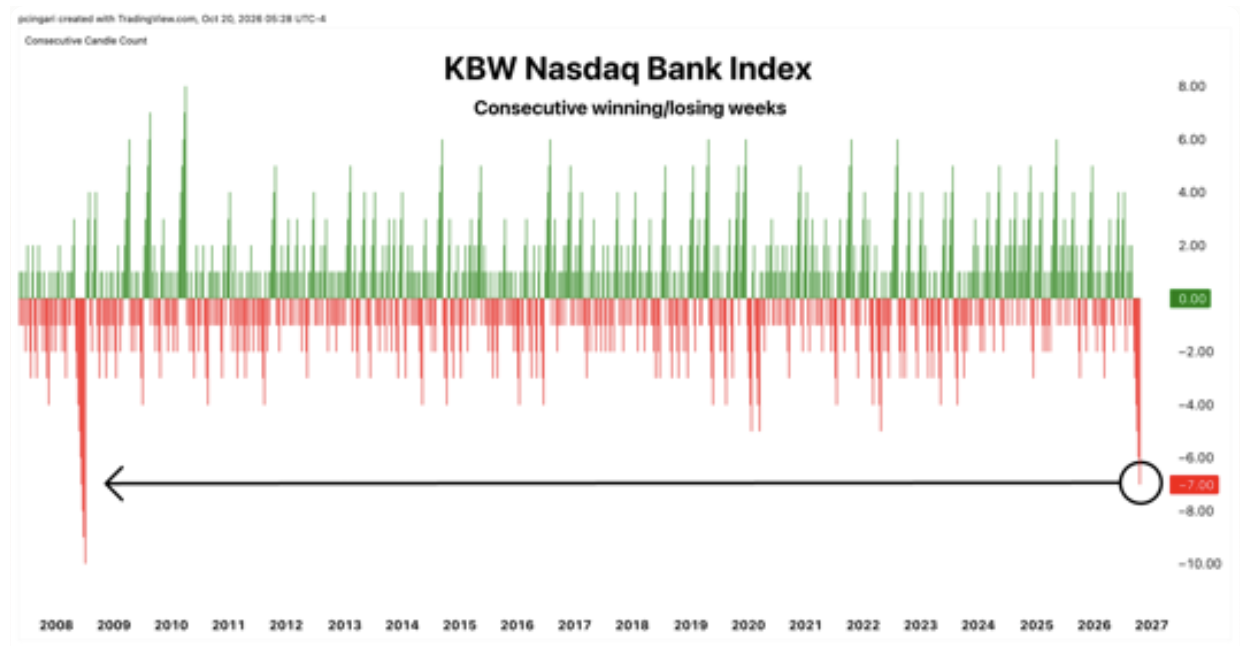
If anything, the timing I gave for my prediction about what is coming for banks may have been too delayed!
The last time things looked this bad was this:
In the spring and summer of 2008, U.S. bank stocks fell for 10 weeks in a row. Bear Stearns had already been rescued. Lehman Brothers would file for bankruptcy two months after the streak ended.
In the 18 years since, bank stocks have never lost more than five weeks in a row. That record has now been broken.
Less than another month, if this continues, we could be in big trouble based on what happened last time, and there is plenty likelihood that there is more trouble to come: We are just at the start of a new Fed tightening cycle, and bond traders rule the day in bonds now, even if the Fed backs down on its tightening. No one can stop bond traders from demanding higher interest if inflation keeps climbing, and that is the underpinning force of my whole framework: Inflation forces interest up. Rising interest forces all kinds of business out, and rising yields on bonds rapidly decollateralize/decapitalize banks by reducing their reserves right as businesses and unemployed people are defaulting on loans.
Some will point to the obvious upside to banks that comes from higher interest rates, but there are downsides in a situation like the present that are quite dangerous:
Higher rates can help banks earn more on loans [the upside]. When they rise quickly, however, they cut the value of the bonds banks already own and raise the risk that borrowers fall behind on payments.
Investors appear to be trading bank stocks against the direction of rates, treating a rapid climb as a clear negative, according to a Bank of America Global Research report
This is a very rapid climb, and the sell-off in bank stocks by itself can take banks down. So, the value of their reserves is plummeting, even if it not forced to be realized on paper on any of the bonds they plan to hold to maturity. It IS being marked down on all the bonds they have not designated for holding to maturity. And those they are not forced to mark down will be marked down rapidly if they ever have to be actually used. And, as the article points out, default risk rises when interest is on a tear, and interest really is on a tear. The article names some of the big banks already showing some early signs of distress.
One of the most dangerous rises in interest for banks is the time bomb of 2008—adjustable-rate mortgages. About 5.6% of mortgages now are ARMs while 10% of new loans are, and guess what has just happened to ARMs?
Hundreds of thousands of homeowners are about to discover the sting in a mortgage deal that once looked like a clever way to save money.
Around 150,000 borrowers with adjustable-rate mortgages (ARMs) should see their first interest rate adjustment later this year, according to data from ICE Mortgage Technology.
Homebuyers choose this exotic mortgage because it offers a cheaper up-front period that lasts several years, after which the rate resets and is recalculated every month, quarter or year, depending on the type of ARM.
That’s the trap, and now the trap has sprung:
With tens of thousands of ARMs resetting later this year, some borrowers could see their monthly payments soar by more than $1,000, turning what seemed like a bargain into a major budget headache.
Another 186,000 borrowers are scheduled for their first ARM rate reset in 2027, followed by 155,000 in 2028 - with nearly half a million American homeowners on the hook for an expensive financial reckoning over the next three years.
Tell me that isn’t going to be a massive washout, given that mortgages are impacted largely by the interest rate on the 10YR Treasury. When those loan payments leap up by that much, many default. Guess what happens next to banks. Just look at recent news on the 10YR:
The magic 5%-line for the 10-year Treasury yield seems to be the new floor, after being the ceiling it couldn’t break through for three years.
Nothing now seems to be able to hammer interest on the 10YR down below 5% even though it couldn’t get above that under the old regime. We have now just entered a Fed interest-raising regime where, as I’ve written, high inflation due to energy prices from the Trump-Iran War is going to keep jack hammering those rates higher, even if the Fed doesn’t make any moves. The Fed is just playing catchup to what the bond market is already doing on its own.
That was a lot of volatility for the 10-year Treasury yield in the four-day week, driven by hot inflation data on one hand, and a scare about the mania in AI stocks and bonds that triggered a safe-haven trade on the other hand. After everything was said and done, it was the biggest weekly rally of the 10-year Treasury maturities since mid-February (prices rose, yields fell).
The troubles I predicted for AI stocks actually helped the 10YR, as I’ve said would happen because there are no straight lines to anywhere. And, when money moves out of stocks, it usually pumps up bond prices (lowers bond yields) by flowing in that direction. When AI stocks found a reason to dive, some of that money ran to Old Faithful—the 10YR—for safety. However, even that could not get the rate to touch down to the topside of 5%. It still remained above 5.1%. That is the thing to note here.
So, the old ceiling is the new floor, while inflation is just starting to price through from the war. Imagine what happens when we actually start seeing major shortages like they are seeing in Italy in today’s news as truckers strike because of high fuel prices (which isn’t really something their government can do anything about because it is caused by Iran and Ukraine wiping out oil and fuel production and transport).
It’s when shortages hit that prices really go through the roof. As go prices, so go bonds. As go bonds, so go mortgages. As go mortgages, so go banks. Those adjustments on those ARMS could easily wind up actually being higher by the time the ARM kicks in to become a leap well above an additional monthly thousand dollars!
Many families are living with no cushion right now; so, for many, another $1,000 per month would be a lethal blow.
That same inflation that is driving the bond vigilantes to demand more yield if they are going to buy up a rapidly increasing supply of US Treasuries (where the increase in supply is also making it harder to keep yields down) is what I call the “inflation trap.” It keeps the Fed from being able to rescue anything because a rescue by the Fed will only create more of the inflation that is causing all the problems:
Inflation is out of the bottle and has been accelerating for over a year, while the Fed has cut its policy rate last fall into this accelerating inflation. This is concerning because a purposefully lax Fed, that allows or encourages inflation to fester, is a nightmare for bondholders. Inflation eats up the purchasing power of bonds, and investors want to be compensated for that, plus some, with yield. A lax Fed is a reason to not hold bonds unless yields are high enough to compensate for those risks.
If the Fed tried to go back to easing right now, it would give investors more reason to avoid bonds. If it does anything to create more cash in bank reserves to help out their reserves, it will send bond holders all the higher in their reach for interest, compounding the whole problem. The Fed has nothing to put on the fire but gasoline. It is caught in the very catch-22 that I have always said will be its final trap where it cannot move without making things worse.
If it tries quantitative easing to soak up all the Treasury bonds in order to take the bond vigilantes completely out of the picture by leaving them nothing left to buy, it creates hyperinflation that soaks up all the economy. If it tries to lower interest rates, the bond vigilantes will hold its feet to the fire and do the opposite, showing the Fed to be powerless in the present situation, and then fear will make the banking situation worse.
We remember what happened with inflation when the Fed kept doing QE and kept trying to hold interest rates down when inflation was rising and the Fed kept arguing, in order to justify its moves, not to worry: the inflation was transitory. The inflation became so permanent they never were able to get rid of all of it. And now inflation is back and rising quickly, especially on the producer side, which, as I always say, eventually prices over to the consumer side:
Inflation in prices that businesses pay each other and charge each other – tracked by the Producer Price Index (PPI) – accelerated to 6.3% year-over-year in September, the worst inflation in the realm of businesses since December 2022
And 2022 was a very bad year for business inflation because that was back when the Fed was running far too lax.
The PPI looks like this: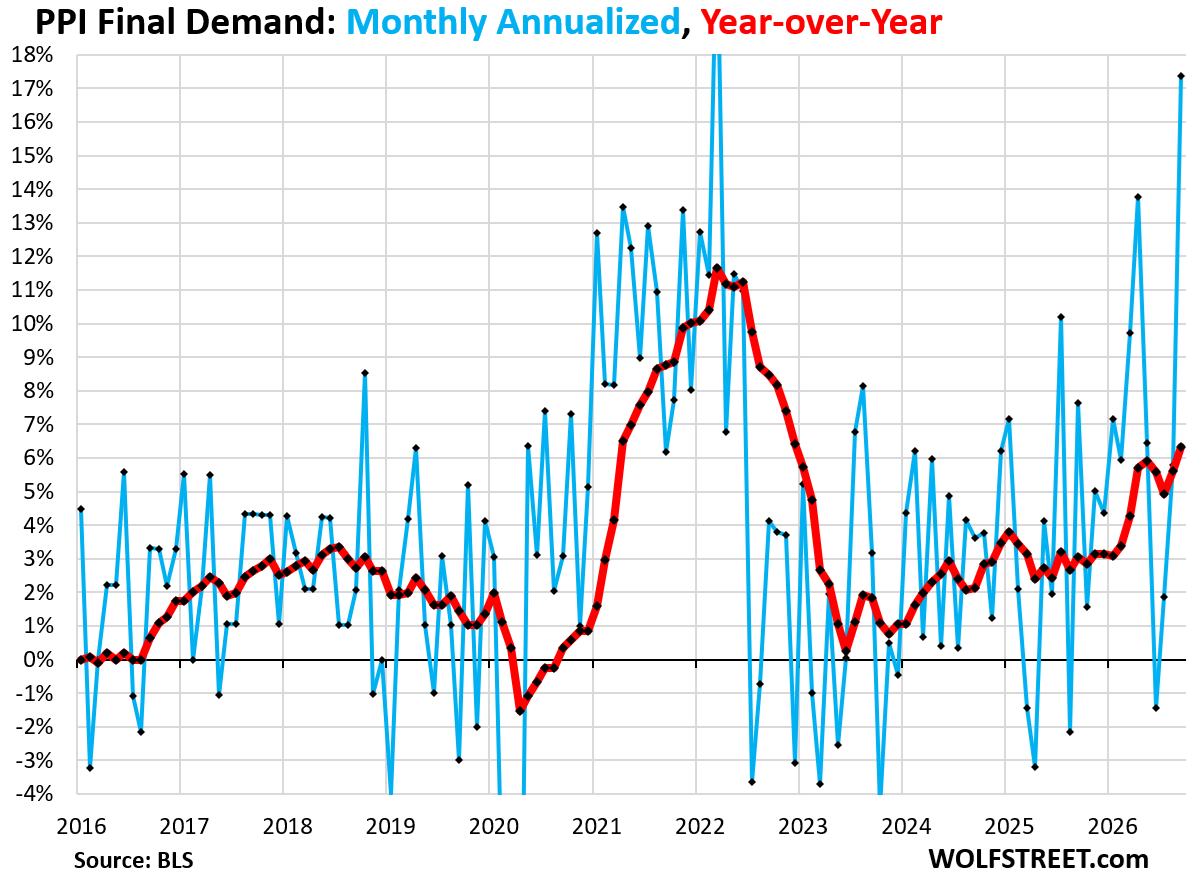
I don’t see any sign in that long and steepening climb that a reduction in inflationary forces is coming down the pipe from producers toward consumers. That’s a true pipe dream. Meanwhile, no one is coming to the rescue this time. In fact, the man at the top is doing his best to make inflation worse just to get his team re-elected:
Then there are the fiscal issues of the US government that cannot get its deficit to come down from the 6%-of-GDP nightmare level, even during a growing economy. Congress isn’t even talking about it. Bessent is talking about it, but he doesn’t control the purse strings, Congress does. And Trump is out there trying to buy votes come hell or high water, thereby making the fiscal mess worse. That’s a scary combination for potential bond buyers.
There is nothing like throwing free money around to create an accelerant to the fires of inflation!
Rising yields are a huge risk for existing bondholders. When yields rise further, market prices of bonds fall, and existing bondholders can see big price declines. The 30-year Treasury bonds that were sold at the auctions in the summer of 2020 with yields of just over 1% are trading at around 50 cents on the dollar now. So the threat of higher inflation, bigger deficits, and more supply of new bonds to finance those deficits point to higher yields in the future – and that’s a scary thought for bond buyers. Do they really want to expose themselves to that risk? The answer is yes, if the yield is high enough.
What happens to banks when almost no one wants to take out mortgages at these higher prices. Loan “sales” fall, as they have. AI investments, which some banks are heavily into, are not likely to help at this time either. IPOs may go by the wayside, especially in AI. In fact, AI may just add to the number of defaults that banks have to struggle with. One major expert in that area, Ken Griffin, CEO of Citadel, says in today’s news there is almost no doubt that AI is a major stock bubble.
In other words, the best-paid man in the room thinks the room is in a bubble, and he is fine saying so out loud.
The Fed cannot step in without making inflation worse, causing more pressure on yields. Reserves are rapidly being devalued in actuality, even if not entirely on paper. So, the problems are rapidly piling up, and the Fed appears to be boxed in by inflation that it already helped establish … with a lot more on the way due to the war on oil and gas.
At the same time, one interview with a banking expert below says banks are far from out. I’ll let the interview speak for itself. Banks are tough, I admit, which is why I placed their troubles further out a bit on my timeline to try to be conservative, but the forces assailing them are, in my opinion, tougher still, especially since they are all just getting started. We may find out sooner than later who is swimming without swimming trunks because the tide is rapidly running out on interest rates.
Griffin’s timing was impeccable, maybe a little too impeccable. Hours earlier, the WSJ reviewed a fresh draft of Anthropic’s S-1…. The short version: Anthropic booked $16.3 billion in revenue in the first half of 2026, posted an $80.7 billion GAAP net loss (about $72 billion of which is a non-cash revaluation of financing instruments, leaving a still-hefty ~$8.7 billion underlying loss), and has signed more than $600 billion of mostly noncancelable compute contracts, with talks under way for another $150 billion. That would take the tab to as much as $750 billion.
Is that not what I have been warning about with AI—that the earnings are largely a mirage? The revenue quickly evaporates away, leaving only their earnings from their stock investments in other AI corporations, which are now also flying apart. This is a bubble blown out of gasoline mixed with soap, and people are now throwing matches at the bubble. That means putting together IPOs is not going to help investment banks either. It’s going to trouble them very soon.
Look at Anthropic’s MINUSCULE revenue stream from AI compared to all of the expenses it has already committed to by contract:
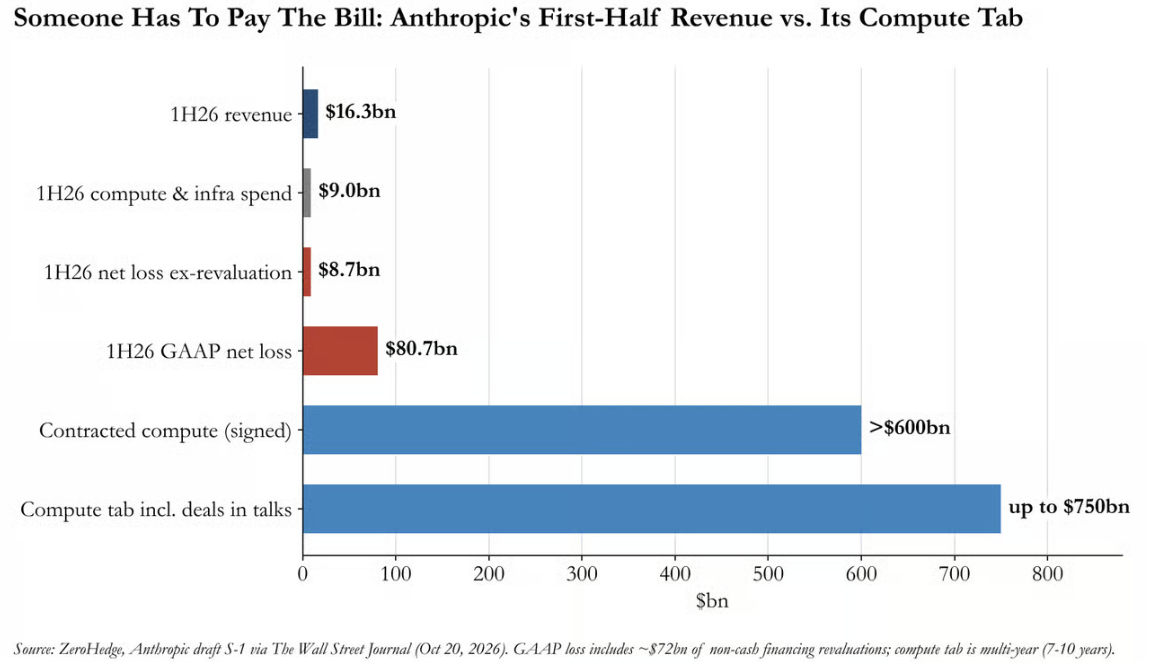
Tell me that is not a disaster waiting to happen, and you have to wonder how much of that trouble banks own and which banks are invested in it.
Meanwhile, here is what has happened to the prices Anthropic is able to charge to its customers for its services:
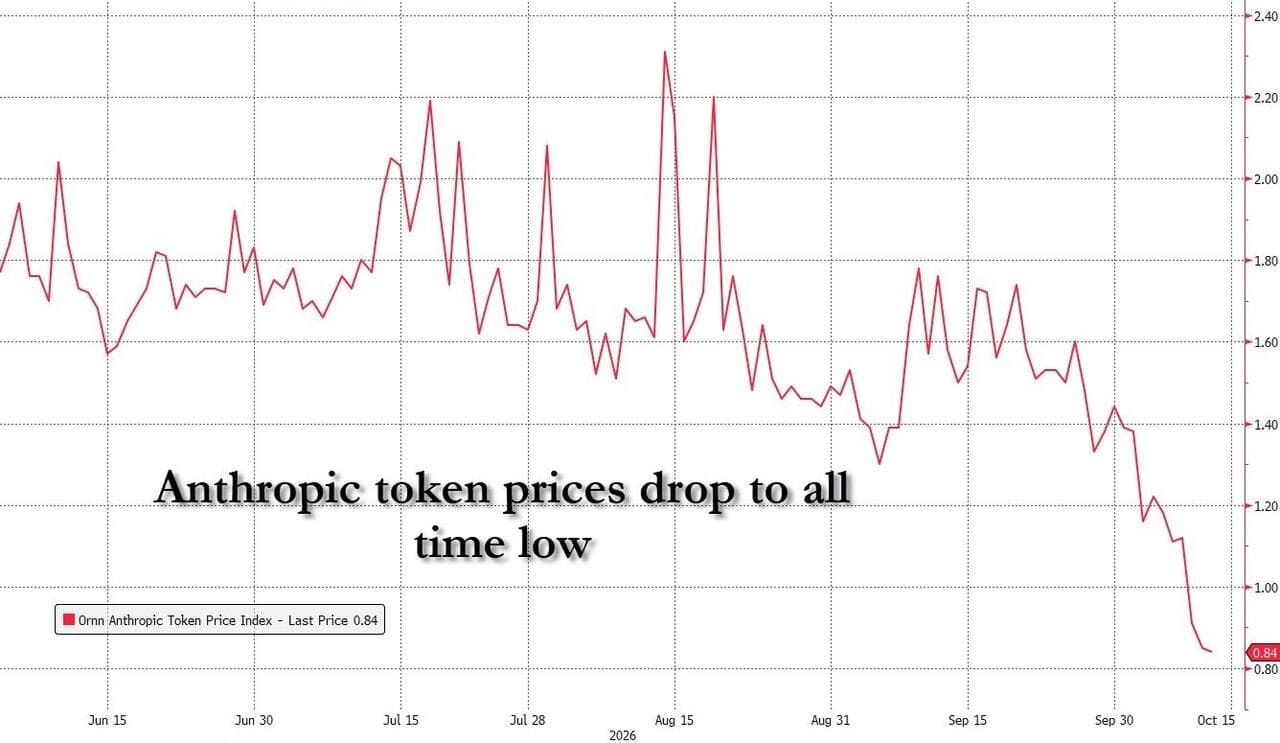
Ooops!
Did someone in a bank somewhere shout, “Run!”
(Not a word you want to hear inside of a bank.)
Meanwhile breadth (percentage of winning stocks v losing stocks) in the S&P looks eerily familiar:
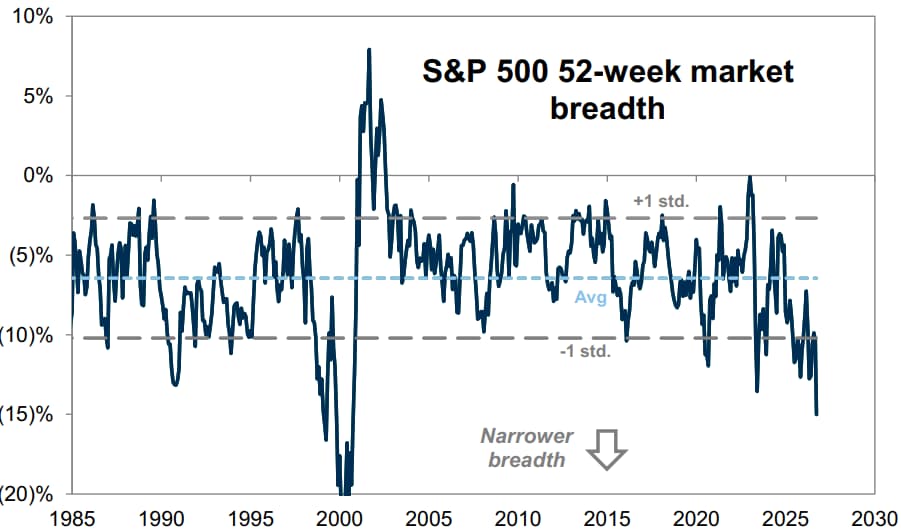
Don’t like being down in that basement.
Can’t win for losing
Now, remember how I said there are no straight lines to anywhere in economics, well one headline starts out today,
“Mortgage rates drop for the first time in 2 months”
Sounds lie a win for the housing markeet. You might think that would have me suddenly worrying and rethinking my predictions about the housing market as well as about how that market will impact banks, BUT the rest of the headline continues:
“but demand still falls further”
It didn’t make a dent in the demand for mortgages; and, since there are no straight Iines to anywhere in economics (at least, not for long), it did not surprise me or concern me in terms of my own predictions in the least. I expected to see headlines like that the day after I made my predictions. (I often do.) Since there were many strong predictions made in yesterday’s article, there are bound to be some things that dip in the other direction the next day.
The dip in mortgage rates did not even interest the people who are out shopping for mortgages.
Applications for a mortgage to purchase a home fell a steeper 7% for the week and were 18% lower from the year before.
People can dream the cavalry is coming to save the banks, but where will it come from? The Fed’s rescue plans almost always create inflationary pressures. In the past they could do that because there was no underlying inflationary pressure. In fact, they could barely make inflation rise to hit their target. Today their moves would hose gasoline onto the inflationary fire. The government has not even started to think about the problem, so it will only arrive when the whole house is on fire. And the president is already promising to dump gasoline all over everything with $5,000 freebies on the company credit card FOR EVERYONE.
Enjoy the ride. It’s going to be a thrill...
About the author

David Haggith is the publisher/editor-in-chief of The Daily Doom.
Economic, Social and Political News of Our Troubled Times -- a non-partisan daily collection of the most consequential stories about our complex times from multiple sources around the world plus daily editorials like the one you read here.
Liked it? Take a second to support David Haggith by subscribing on Substack!