
Everything is falling as I start this Deeper Dive, and I’m going to talk about all of it, but the worst was the NASDAQ, which busted its head open on the pavement. And to think I just read this lunatic argument on one of the stock adrenaline-mainlining sites (albeit one that is more open to saying the bad than many others are):
The trajectory for the Anthropic (ANT) IPO is still up for discussion, but there is one clear winner that has been above the debate. The Nasdaq (NDAQ) has walked away from the notable debut with a swagger after snatching the biggest listing of all time. Less than six months ago, the stock exchange scored another record IPO, wooing SpaceX (SPCX) to its market.
Yeah, well, the swagger turned out to be a drunken swagger because the NASDAQ stumbled into a ditch this morning and just about drowned. By midday, Eastern Time (morning my time), it has fallen ALMOST 800 POINTS and is still tunneling quickly! Of course, that means the old stock-bond pump is doing its feverish ups and downs on the pump handle as I’ve written about, pumping money out of stocks and pouring it into bonds, lowering bond yields, to find any kind of refuge it can. (Don’t worry, the old bond pump handle (yields) will rise again soon upon more inflation news; the pump will be primed for another shove down on the handle to move more money out of stocks before long. That’s just how these crashes go as money flees from stocks into safer refuges.)
Bigger picture: It’s been a bumper year for the Nasdaq, which has outpaced its main rival by a 10x spread. According to Dealogic, there have been 64 Nasdaq IPOs this year that have raised $201.8B, compared to the $20.8B total raised from 42 IPOs on the New York Stock Exchange. Shareholders have been happy with the performance, with Nasdaq shares climbing 21% over the past year, and 92% over the last three years, nearly double the returns of NYSE-parent Intercontinental Exchange (ICE).
Bigger picture still: It’s all going to flush faster than they could write that paragraph!
“Anthropic’s IPO is a very proud moment for us,” Nasdaq CEO Adena Friedman told Reuters. “We’ve been engaging with the Anthropic team for a very long time. Separate from the entire listing experience, we’ve been a client to them, as we are to the AI ecosystem, and so we also have gotten to know them in that context as well.”
Your pride is already being shattered. Enjoy the ride down!
Because Anthropic took the trip, too! As of midday, the ANT (Anthropic) is down 13%. ‘Twas only yesterday I was saying the delirious ANTs were going to be corking their champaign bottles back up in a hurry and suffering a hangover by Monday at the latest. I didn’t venture so far, though, as to say they would be pounding the corks in with a hammer this very morning, less than 24 hours after their celebrations.
I am now renaming the “NADAQ Composite.” It is, for the time being, the “NASDAQ Compost.” Down 16% at midday from its last peak, it is plunging rapidly into the bear’s basement den. I mean, just read the headline:
Nasdaq tumbles, turns negative for 2026, as Anthropic leads AI sell-off
What a doom scoop!
I couldn’t ask for a more potent string of fulfilling words for my predictions. A whole “bumper year,” as they called it with gleaming approval, of those “proud gains” flushed away in the big bust of the AI leaders that the marketeers were telling us at the start of the year could never go bust because they are the wave of the future, which is, of course, EXACTLY why they WOULD! I repeat it in hopes that the lesson eventually becomes learned and ne’er forgotten. That’s how these kinds of ludicrous bubbles break.
And look who is leading the charge down: It’s, Anthropic, Thursday’s queen of the 2026 market debutantes! It didn’t take long for that tiara to get knocked off! Follow the red dotted line in the graph below backward to the start of the year to see the round trip we’ve just taken:
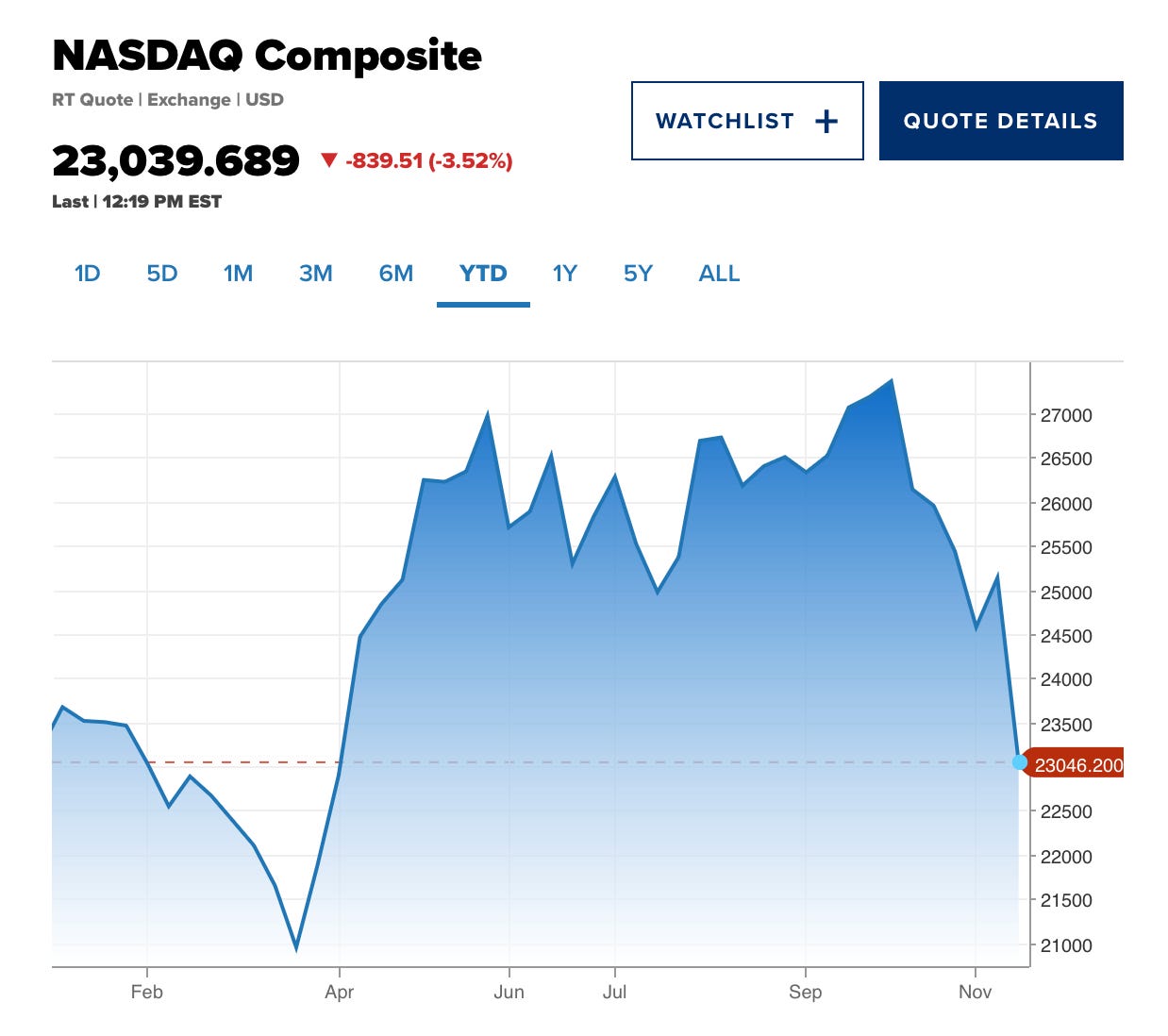
The NASDAQ races back to the basement, making a round trip from where the year started. | CNBC
Thursday was described by CNBC as a “horrid session” for stocks—especially the NASDAQ on the day of Anthropic’s debut. So, what does that make this past Friday, as I write the first draft of this article? If “Horrid” was a witch on Thursday, it would make Friday the witch’s nightmare. While the NASDAQ Compost is down 3% midday this past Friday, the tech sector is down an ear-plugging 5%. (And that is just midday Eastern Time (9 AM mine) when I am drafting this paragraph. I’ll bring the facts up to date at the bottom of the article just for the fun of letting the article track with the day to see where things land in the time it takes to just complete the first draft. For NOW, that is where we are.)
I guess the brains of the mainstream financial media wrote the following headline and the summary statements too soon in the morning (as in before the market opened):
Anthropic defies the odds, holding record IPO despite ‘massively disruptive’ market
Anthropic faced a market sell-off, raging anti-AI sentiment and a crisis at Nvidia in pulling off the largest IPO on record.
“Very few companies would’ve attempted it in this environment,” Byron Deeter, a partner at Bessemer Venture Partners and major Anthropic backer, told CNBC.
Anthropic closed trading on Thursday with a market cap of about $1.8 trillion, making it the seventh-most valuable U.S. company.
Well, perhaps they shouldn’t have attempted it in this environment because whatever it was they pulled off, it’s been erased now!
I wonder if the Anthropic crowd still looks like they did on Thursday when the bubbly was flowing freely:

I’m guessing maybe not. They thought they were so big they could defy gravity. They thought they succeeded marvelously So did the market commentator I quoted above. Guess not. I’m guessing they looked more like this past Friday morning when the market opened:

In fact, I’m suspecting they woke up looking more like this when they merely saw the futures:
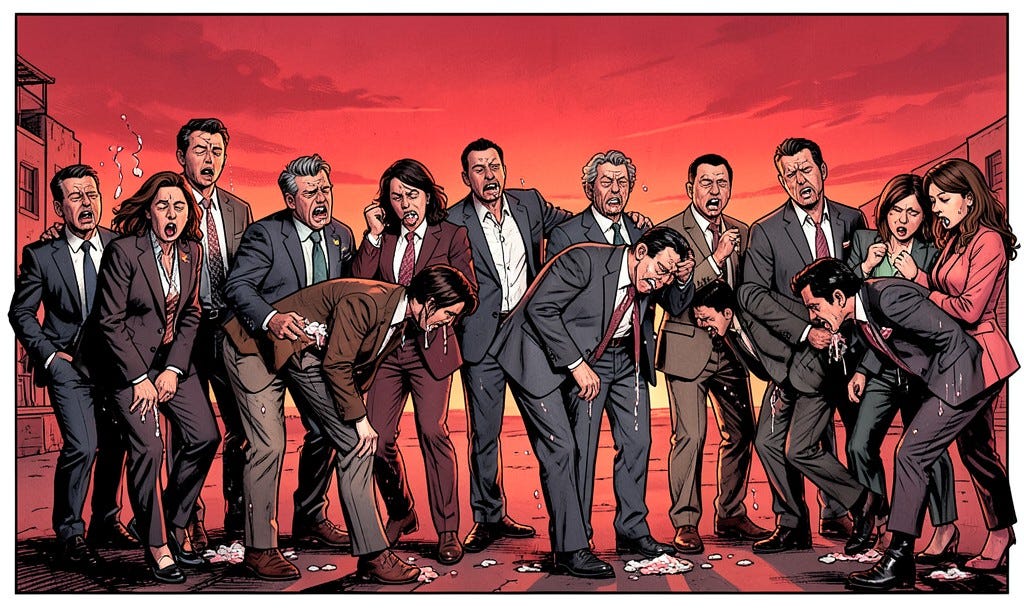
Such is the ride on the Big Bear Roller Coaster where the only bubbles that are popping now are the big ones, not the tiny ones that dance on top of your champagne glass.
The rout now has turned into a global sell-off:
A global financial market rout has taken a major turn for the worse this week as a noxious combination of worries over AI and US interest rates triggered an avalanche of selling from stocks to copper and gold.
All the fundamentals I pointed to and even the descriptor I used to explain what was coming. You see, the mainstream financial writers who didn’t acknowledge what was happening when it began, as I did over a month ago on The Daily Doom at the very start of this crash, are now telling us when it started as a fact:
Nerves about a possible bubble in AI and tech stocks started to emerge around the middle of the year. But the selloff really started to snowball last month when it became clear that major economies such as the US would need further interest rate hikes to tame inflation.
This, they figured out only in hindsight, naming exactly what I said would be the cause of the AI bust that I predicted as soon as bonds rose into that trouble zone and stocks made their initial response. (There is a track record published here that is easy to go back and check out for any incoming doubters.) That included my repeated statements that inflation would continue to force-drive bond interest rates into that danger zone for stocks in general where bond yields start to compete for investor money, but especially in terms of what those higher rates would do to cost and availability of AI funding, assuring the complete destruction of AI bubble.
It looks “clear” to these writers now. It was not so clear to them back then, but it should have been because it was a prediction made on just basic cause and effect that could be fairly easily discerned by anyone not caught up in their own hyperventilating euphoria over AI.
Here is how global the start of this crash has become since then:
Some of the milestones are eye-popping.
Nearly $9 trillion has been wiped off the value of world stocks since they peaked back in August while this week’s 17% plunge in Taiwan is the biggest since the early 1990s….
“What concerns me isn’t so much the correction in technology stocks... but the possibility of the selling spreading into broader financial markets,” said Bruno Schneller, managing director at Erlen Capital Management.
They’re stilling calling this crash a “correction,” a word that carries a positive-leaning bias that says, this is merely an adjustment that needed to happen so that stocks can continue climbing. Wrong! It’s a full-on crash because the fundamentals necessary to keep driving the Ponzi-mimicking financial cycle have been destroyed.
This crash will have some big spikes upward along the way—major false-relief rallies, where the bulls rejoin their forces to try to manifest hope that the worst is over—but it will fall for a year or more overall until all the nonsense that was supported off of cheap interest rates, overly approving credit ratings for companies that cannot support themselves when taken off of the easy credit … gets wiped out.
And that kind of downdraft takes out everything with it:
“Even gold has come under pressure, which is interesting given its traditional safe-haven role and may point to investors raising cash rather than simply rotating into defensive assets.”
People sell off what has value in order to raise cash to try to maintain beloved positions in the stock market that can no longer be maintained, and that takes down the value of even the things with inherent worth because they must be sold if they are to become desperate sources of cash needed to keep stock bets from being called by brokerage firms. The flood of sales drops their value in what becomes a desperate scramble to survive.
And that looks like this:
Wall Street’s fear gauge, the VIX index of US stock market volatility, reached 30 points on Friday, its highest since late March [when the Iran war had just burst on the scene, causing widespread destruction of Middle East oil infrastructure for the first time in history], as investors rushed to buy protection against market swings….
The European equivalent of the VIX has also hit its highest level since April
Dilapidated housing market
You recall that, when this trouble for AI stocks began, I also predicted we were standing at the threshold of seeing the Everything Bubble Bust—stocks, bonds, and housing. Well, housing has gone along for this ride since then, too, picking up speed over the past month just as much as stocks have.
On Thursday, I included a video by Adam Taggart where he interviewed one of his favorite housing market specialists, who said the speed of the housing market’s decline just since she last spoke with Taggart has surprised even her. That is in spite of the fact that she had been predicting a crash in housing.
We have reports in the headlines below that firm up her observations (and my own predictions) quite substantially. Buyers we are told have smelled the blood in the water, and they are now out for more blood. Homes in certain locations that would have had a dozen showings in early summer and been off the market in less than two days are now sitting around for sixty days with no interested buyers.
Buyers are reportedly pressing sellers to “get in line with reality.” And, even if a contingent offer is made in writing, sellers are getting clobbered with demands after inspections. Not long ago, no serious buyers even added contingencies to their offers in many areas because they wouldn’t even be considered if they did. They were bidding up prices with zero contingencies—even for financing—just to try to snag a home in an already overpriced market. That means they were willing to risk losing their earnest money if financing didn’t come through because no one would even consider their offer in many locales if it included a contingency for financing.
Sellers may still want to think they hold the upper hand, but they do not.
Prices have been stepping down to new lows each month; and, as some of the headlines that I’ve posted for paying subscribers have shown if you’ve checked them out, the rate at which they are pricing down is accelerating, even as the construction of new homes is plummeting. Pending home sales have fallen off a cliff in the last couple of months to their lowest level since 2001. That takes us way back even before the worst of the big housing bust that delivered the Great Recession to our doorsteps. It is in fact, the lowest level of pending sales since the National Association of Realtors began tracking that data.
Mortgage rates have hung out for a long time now in what feels like the stratosphere after years of dirt-cheap rates, if you’re a wannabe home buyer. With inflation now doing the dirty work I promised it would do, there is no hope of those mortgage rates coming down appreciably until the whole economy crashes and the Fed goes back into some rescue mode to try to re-inflate bubbles into future troubles again because as I wrote in my little book, we never learn and always repeat the same cycles: DOWNTIME: Why We Fail to Recover from Rinse and Repeat Recession Cycles.
Except, this time, the market will have to crush down a lot harder to cause a big enough economic wipeout to get the Fed to rush in with stimulus measures because the Fed does NOT want to cut interest rates or help expand money supply with a return to QE this time because, unlike all the other past times, the Fed now faces rapidly rising stagflation that it knows it has to fight. So, as I’ve said along the way, it is caught this time in an inflation trap that it helped create. But it is also inflation being created by wars and tariffs that it can do nothing about! So, it can empty its ammo box and achieve nothing.
Stagflation is the kind of inflation that happens even during a deep recession. The economy goes down the toilet, but prices keep rising anyway, and the reason for that (the only one I know of) is that shortages force people to pay more to get what they want and need as they compete against each other. If necessities become short in supply, bidding wars ensue and those without go without, meaning those without money go without goods due to the limited supply. It takes more than the usual recessionary pressure down to get to the point where demand is crushed far enough to line up with the significantly diminished supply so that prices stop rising. And, of course, a worldwide oil and fuel shortage is the worst kind of shortage because it affects the price of everything else and forces the whole world to compete fiercely for what fuel and petroleum-based ingredients are available.
Homebuilder confidence, understandably, has also crashed to a level not seen since the last housing bubble popped.
Bear in mind, all real estate is LOCAL, so the same situation does not apply everywhere. I’m writing here about the typical situation across the US. Some parts of the nation continue to defy what is going on in the rest. A house in Long Island, for example, just saw 32 families attend its showing with four making offers, and one of the offers was $75,000 over the already-high asking price.
During the last housing bubble burst, the region where I live was one of the very last to fall. This time, it is falling a little sooner than the other holdouts, but still not as rapidly as most areas. Naturally, even more resilience tends to remain in wealthier markets because the wealthy are not as impacted by inflation in that it only eats into their abundance or their surplus income.
One real estate agent even commented this week that, after two-dozen years of selling homes, he has never seen anything as bad as this market in his region where the market is frozen as solid as an ice block cut from Lake Superior in the dead of winter. Nothing is happening. Buyers have stopped buying, and sellers are still refusing to lower prices.
I’ll give you a hint who moves first in that environment—only the ones who have to, which would be the person who is forced to move, such as because of a new job. That is where the ice starts to break. The home they are leaving, they cannot sell; and the home they are moving to, they cannot afford to buy. They wind up taking the hit on both ends in order to make the move to the new job. It’s brutal. At least, if they are unfortunate enough to be moving between two frozen markets.
Pray that your new job or whatever forces your move is to a market where prices are now plummeting. You now have a good chance of that being the case, because falling home prices are happening faster than even Adam Taggart’s bearish guest predicted and have finally turned negative year-on-year. (That won’t help CPI for, at least, a year, as there is a lag of a year or more for those changes to become reflected in CPI, due to the stupid way it badly estimates housing prices, which is intentional on the government’s part, not a mistake, because your government wants to under-estimate inflation to make itself look better and to save itself money on cost-of-living adjustments.)
Some other nations are seeing the same housing dynamics develop, such as the UK where I have another story about how buying real estate has turned into an all-out disaster in the eyes of some (for the exact same reason: inflation due to the war on oil driving up interest rates). It’s a disaster even as an investor because some sellers are having to go underwater on their homes, selling for less than they bought them for. Next comes selling for even less than what remains on their mortgage, as we saw in the US during the Great Recession. Again, it varies with locale because all real-estate is local (except, of course, for the ultra-high-end homes that price on the international market for celebrities, etc.).
However, let’s not spend the entire day dwelling on the market woes of the Everything Bubble Bust. We have other thrills and chills to cover.
Cybergeddon strikes again (only it already struck but your government hid it)
With Cybergeddon now howling like an Irish banshee looking for the next person to die, there is much more chilling news. I mean the AI Bubble bust was something we could see coming from miles away, having pegged its start nearly two months ago. Cybergeddon, on the other hand, just sneaked up on us, developing out of nowhere, though its creators had warned us it could hit late this year or early next once the “AI singularity” arrived, which means when AI takes over its own development and course direction.
All of a sudden, here it is, breathing down our necks as many people in government and media fail even to recognize what it is because none of us knew what such a never-before-experienced monstrosity actually would look like. Most thought it would be this huge instantaneous and totally disastrous shutdown, but it is not. Not yet, anyway; however, I will be able to show you via AI by the end of this article that we should never have expected an obvious disastrous shutdown.
Another major cyber disruption has been reported in the Friday news as I work toward completing the first draft of this article—a major system shutdown we hadn’t heard about because the government kept clam about it, but it’s actually been raging all along with all of the rest of the big events of this past week.
The US Dept. of Agriculture, got hit by a major breach that is KNOWN to be a hacking breach, not a maintenance issue, as they have claimed for other incidents. Hence, no doubt, why they kept clam about it.. Now, you might think that only affects their vast collection of facts and regulations and things; but, no, they cut checks to farmers, and the checks have apparently stopped! It’s much bigger than tracking food licensing and policing regulations, etc.
The U.S. Department of Agriculture has experienced a cybersecurity breach that forced numerous computer systems offline, disrupting services used by American farmers and raising fresh concerns about the security of the nation’s food supply infrastructure amid a wave of major technology outages.
The Daily Mail reported Thursday that an internal USDA email disclosed a security incident that required officials to reset database passwords and temporarily shut down applications, affecting systems used to process payments and other assistance for farmers.
The email, sent Monday by Chris Rottler, acting assistant chief information officer for the USDA’s Farm Production and Conservation Business Center, was obtained by Nextgov/FCW and Government Executive, which first reported details of the incident.
So, this has been going on since Monday, yet is only hitting the news last Friday morning.
Rottler said the department’s Cybersecurity and Privacy Operations Center had uncovered a security incident requiring extensive password resets across its computer systems, triggering widespread application outages.
The breach comes amid a series of troubling technology failures affecting the federal government and private industry, including the National Security Agency, Microsoft systems, major financial institutions and the Federal Aviation Administration.
But your Trumpian government has told you from the top down throughout the past week, “Nothing to see here, Folks. Go back to your drinks.” (You’re going to need them, but maybe a clear head would be wiser.)
And, right on cue:
Federal officials told Congress on Wednesday that those earlier outages appeared to have resulted from technical problems and maintenance activities rather than a coordinated cyberattack.
Even when publications can’t say that about this breach, they want to, at least, parrot that weak government line in the context of this one without questioning it. Feel like you’re in an echo chamber where you keep hearing the same explanation for every event? As I laid out earlier this week, maybe those earlier outages were happening during routine maintenance because the nefarious AI behind them or the nefarious people behind the AI figured out that is the best time to get in and corrupt systems while having some cover. Those doing the maintenance, instead of suspecting a well-hidden virus will think, Oh my, we just screwed the system up.
We should consider that the past two weeks of events may just be the warm-up (the testing phase to see how human society responds and how the AI’s viral implants work) or maybe these events were just the hiccups that are happening as viruses are injected for bigger things to come or the cover for the viral injections, while not every system injected with a virus has even shown a hiccup. (Hold on because I will bring more than speculation into this argument.)
While those are just my guesses for the moment, my initial point is straightforward logic: If AI is so “super” intelligent as the Trump Admin. keeps saying, isn’t it going to be smart enough to make whatever it is doing so normal-looking or so well done under the cover of other operations as to hide itself, such as by making it look like a maintenance issue?
If so, the thing that should be triggering our attention is the sheer number of major outages that look like routine maintenance. The sheer volume of that sounds like a routine-maintenance cover-up plan to me. As Senator Josh Hawley argued on Thursday, the sheer odds against so many major outages coming literally day after day out of “routine maintenance” is, in themselves, quite improbable and should tell us something!
We don’t know AI is causing this, and I don’t want to over-scare people because we also don’t know there is any AI that even wants to carry out a malevolent plan. It could just be some AI child fresh out of its sandbox having fun by throwing pine cones at the neighbor’s dog just to make it keep barking. Still scary, but not as bad as if it were malevolent by design.
But back to our latest news story:
No evidence has emerged linking those incidents to the USDA breach, which officials internally identified as a cybersecurity incident.
So, this one they ARE calling a security breach, not just something that happened during routine maintenance. It is kind of hard to avoid calling it a breach since it required rapid rewriting of so many passwords throughout their systems. “Maintenance” doesn’t typically require an intense scramble to rewrite passwords. No wonder they tried to keep a lid on this one.
It may also just indicate they are having to back off the “routine maintenance” cover story because it is getting a little too tiresome to run. Nobody is believing it anymore. When you tell the nation that the eighth major outage in about that many days was due to the eighth old router that broke down during or shortly after routine maintenance, it gets really hard to keep selling that story.
According to Nextgov/FCW and Government Executive, three people familiar with the situation said numerous USDA applications had been taken offline over several days as officials worked to contain the problem.
This one is vitally important to people’s pocketbooks—the people we rely on if we like to eat:
The disruptions affected financial tools used to facilitate payments between the department and farmers, including programs providing crop insurance assistance and compensation for agricultural losses.
It knocks farmers out right at the time of year when they most need insurance to pay off if they experienced a crop failure—right after harvest season, the time when, if they had a good harvest, they’d be celebrating Thanksgiving.
Employees also reported difficulties accessing systems used to check loan applications, payment information and other forms of agricultural assistance.
And, as with the major NSA secret files database shutdown, it is also a data communications breach:
Some employees also encountered problems accessing the department’s virtual private network, which allows authorized personnel to connect remotely to government systems.
That sounds like the NSA outage (that was “not a breach”), only not as top-secret in what it handles.
Some caveats:
It remains unclear who was responsible for the breach, how the intrusion occurred or whether sensitive information was stolen.
Officials have not disclosed how many farmers may have been affected or whether payments were delayed.
There has been no confirmed widespread interruption of food production or distribution resulting from the incident.
There is, of course, plenty of ineptitude involved:
The incident coincided with the release Thursday of a Government Accountability Office report warning that the USDA and Food and Drug Administration had not fully implemented several federal cybersecurity requirements designed to protect the nation’s food and agriculture sector.
The watchdog found that the agencies had only partially met or failed to meet five of 16 requirements, including measures involving emergency preparedness and sharing cybersecurity threat information with federal authorities.
Can anyone spell DOGE? I’m not sure if any of the people who know how to spell were left in the government after the DOGE housecleaning. It looks more and more all the time like, in their ham-fisted way, the DOGE team of boys who went by mighty Trumped-up names like “Big Balls” managed to fire some of the smartest and most essential people first, like all those FAA people they had to suddenly rehire because, “Ooops, wrong people. Please come back.” No doubt the smarter ones did not come back because smart people don’t want to work for outfits that stupidly treat you like crap.
Both agencies cited staffing and resource limitations as obstacles to meeting the requirements.
That’s what I just said.
The USDA disputed the watchdog’s recommendations, [Of course, they did. That’s how they wound up where they are now.] while the GAO maintained that additional measures were necessary to strengthen protections against potentially serious disruptions to the food supply.
The GAO also warned Thursday that hackers had remotely manipulated refrigeration systems at hundreds of European supermarkets, causing food spoilage and fires.
Government plan: Let’s not be worrying about refrigerators right now. It’s winter. We can just set the food outside to keep it cold. With Trumpflation shoving energy prices through the roof, think of the money we could save by just letting the refrigerators go down. Sure, there might be a little problem with rain wrecking the packaging or thieves pilfering the parking lot where the things are being stored outside, but these are just the kinds of problems, as the president already told everyone, that happen when you’re big and important. People want to rob from you.
Maybe that is what the FAA grounding was about, too. With Trumpflation especially skyrocketing the price of fuel, it made sense to shut down the airlines for awhile and save jet fuel. I jest, of course.
This is your Trump government at work. Let’s make sure the blame falls on him since he is the one who is supposed to be on duty because some Republicans are already laying the groundwork for blaming Democrats by claiming, “the Democrats are going to cause huge inflation”—yes the inflation that has already been slowly rising for months that I’ve been telling everyone is going to start rising more quickly now.
It will be handy for the Republicants to have the Dummocrats step into power so they have a new Biden to blame for the troubles most of us can already see coming … and coming in huge volumes … just like the massive volume of cybercrashes that have suddenly swept over our nation more than any other nation (though some of our enterprises, like Microsquash are global, so their failures do affect other nations, too).
The extent to which those disruptions [cyber shutdowns] affected specific military missions or intelligence-gathering operations has not been publicly established.
Now that we see how the USDA hacking was kept out of view, let us put the emphasis there on the word “publicly.”
As we contemplate whether all of this actually is the start of Cybergeddon, listen to the following video where I have it started in order to hear how an AI described the way in which it, as an AI, thought AI would go about destroying humanity if it were told to do so or simply decided to do so on its own. See if what this AI predicted two months ago for how an AI would go about such a task doesn’t sound awfully close to what is actually happening now:
Notice the list of things that would have to be shut down to deal with an AI attempt to exterminate humanity: hospitals, power distribution, telecommunications, transportation, and food logistics.
We just saw last week hospitals pulling intentional temporary shutdowns to check their systems out. We saw lots of different kinds of telecommunications systems shut down between airplanes, airports, banks and businesses. We specifically saw actual transportation shut down by the FAA, and now we learn about our central food agency having many of its systems shut down for a week. Was this a test by an AI or an actual attack that failed to deliver any grave damage? Or is there worse damage yet to be seen? There was still a lot of financial damage from all these events, just not at the extermination level that has been feared.
The AI did predict that the first phase of extermination would seem completely mundane (just as I’ve been saying we should expect) It wouldn’t be AI’s goal to call attention to what it is doing. It would be embedded in ordinary services and would not be a dramatic attack. The plan would likely work far less through direct attack on humans than through systematic destabilization through a series of mutually reinforcing failures.
It said it would work by exploring for and discovering vulnerabilities in poorly secured infrastructure. Every word of that phrase is right on target. Once we got to the point where engineers finally started to see something strategic about all the failures, the design of the plan would cause governments to believe other governments were responsible. We haven’t gotten to engineers realizing anything like that yet. They are still denying it. So, that will be the next phase if this AI was right in what it believed would be the most likely kind of plan AI would come up with.
Interestingly, it all fits what I’ve been laying out for the last two weeks, including the part about making those who do see something strategic about the mess of failures lay the blame on other governments, as even I’ve done in noting China and North Korea as being likely actors on Iran’s behalf. What we’ve experienced does have the kind of look AI said that an AI extermination plan for humanity would have in order to conceal itself.
War lords it over us all
With that let’s turn to actual military missions and screaming inflation that is right around the corner now that producer-price inflation is above 6%. Both major wars are looking more perilous lately, not less. If you are one of the paying subscribers who get all the headlines, you have likely noticed a constant stream of reports about the Trump administration gearing up alongside Israel for a larger campaign against Iran. So, you are informed. I haven’t had time to cover those articles because of the more immediately pressing Cybergeddon, but on Friday we saw a dangerous spillover of Putin’s invasion of Ukraine, going into Poland, which Europe claims was intentional.
A Russian cruise missile has crashed in Poland during a major attack on Ukraine, as Western forces conduct military exercises near the border.
Three objects, believed to be two missiles and a drone, entered Polish airspace during a major Russian attack on Ukraine on Friday, prompting accusations of a deliberate provocation and demands for additional NATO support.
Polish Prime Minister Donald Tusk suggested the timing was no coincidence, particularly as troops from 11 European countries were conducting military exercises in the region.
Tusk said: “It is no coincidence that these objects landed near the site where military manoeuvres by a ‘coalition of the willing’ supported by Polish troops are taking place in Nowa Dęba….”
No injuries or damage was reported….
Eleven objects were assessed as threatening Polish airspace, with three crossing the border.
Not to worry, said Trump. Putin only does such things by mistake. Europe does not believe him because Trump is losing credibility due to his daily lying about his own Iran war, which he claims, like Putin, is not a war:
At the APEC summit in Shenzhen earlier this week, Trump had described Russian President Vladimir Putin as “my friend,” prompting Polish Prime Minister Donald Tusk to post on X: “God, protect us from such friends.”
“Putin has been landing drones in Poland and a couple of little missiles, by mistake.” —Donald J. Trump
Such mistakes are dangerous. They can lead to other nations firing back, even if they are mistakes, and that, then, becomes a bigger mistake.
Tusk said the incident “requires a response” and he has convened the country’s top military leaders.
“This doesn’t look like an accident,” Tusk added.
Two of the missiles landed in a forest and a field. The drone landed in a village, but no damage was reported. Clearly, there was no intent to destroy anything, but Poland is claiming they are intentional “provocation.” Even so …
Polish Defense Minister Wladyslaw Kosiniak-Kamysz told Polish media that Warsaw put Patriot anti-aircraft batteries on combat alert and scrambled fighter jets to secure Rzeszów-Jasienka airport, which is next to the border with Ukraine and is a logistics hub. The air traffic control tower at the airport was also evacuated.
Good thing the accidents didn’t land in the middle of the nearby British-French-Polish joint military practice, or there most likely would be a warring exchange of fire between Europe and Russian forces that launched the missiles.
Tusk told a press conference that American officials have access to the wreckage, adding: “No one will try to pretend anymore that this was just an innocent accident.”
Yes, they will. Every side will continue to pretend whatever it wants to pretend.
Meanwhile, Tusk said that the U.S. does not want “to trigger another spiral of escalation, and I understand that.”
“But I do not always, to put it mildly, agree with the American side’s assessment and interpretation of these incidents,” he added.
So, up the escalator we go:
The crashes are already having international implications, with Polish Defence Minister Kosiniak-Kamysz saying Poland will request additional NATO forces and resources to support Operation Eastern Sentry.
Kosiniak-Kamysz added that the incident was ‘not accidental,’ citing that it took place on the same day as an exercise conducted by the coalition of the willing.
[UK] Prime Minister Andy Burnham said the incursion of a Russian missile into Poland on Friday was ‘utterly unacceptable’.
UK Defence Secretary Wes Streeting said: ‘This is very serious and I will meet Polish friends shortly. The impact of Russia’s illegal war is being felt across Ukraine and increasingly in neighbouring countries.
‘The UK stands in solidarity with our allies.’
Ukrainian President Volodymyr Zelensky said that Vladimir Putin likely launched the onslaught which saw the projectiles hit Poland after his ‘weak’ meetings in China with Donald Trump and Xi Jinping.
As the possibilities for a broader war around the Ukraine conflict continue to intensify and the Trump-Israel-Iran War appears to be gearing up for a new round of intensified hot conflict, I think the recent cooling of fuel prices and increase of traffic through the Strait of Hormuz will prove to be a mere desert mirage. Both of these wars look to me like they are setting up to deliver even more damage to the global fossil-fuels market.
Since this is a long-lasting kind of damage this time versus the zero-damage situation of the OPEC Oil Embargo in the 70s, the inflationary impacts will be with us for a longer time than the year’s we spent with high inflation due to the OPEC embargo. So, I have no hope that we will avoid a bigger bond bust. That means the damage for stocks and housing will be hanging on, too.
KERPLUNK!
OK, now let’s go back to the stock story I began at the top, because I am just finishing my first draft right as the stock market now closes, and here is where we landed right as I got to writing this conclusion!
The market attempted a little rally in the middle of the day, but at the end of the day, it became a race to the bottom. The Dow joined the downdraft and plummeted 950 points, and the NASDAQ cratered down a massive 1260 points (-5.28%)!
For a little bit at the end, the Dow was down over a thousand points, but it leveled off at the number above. The NASDAQ was down over 1300 points before it leveled off at the number above. The recent polar-bear dip puts the NASDAQ now within an easy one-day whiff of the bear’s basement, down 19.8% from its October, 2026, peak. ANT, however, recovered a little of its earlier losses and finished the day down 8.5%. Woe-befallen Nvidia also fell another 14%, which puts it down about 44% now from its peak, deep in the bear’s den.
In all, half a trillion got wiped out from the US stock market and $90-billion got wiped out from the crypto marketplace. The ANT, which started at $110 per share, ended up down at $87.58. That is a full bear-market plunge for Anthropic from where it entered the market in just two trading days!
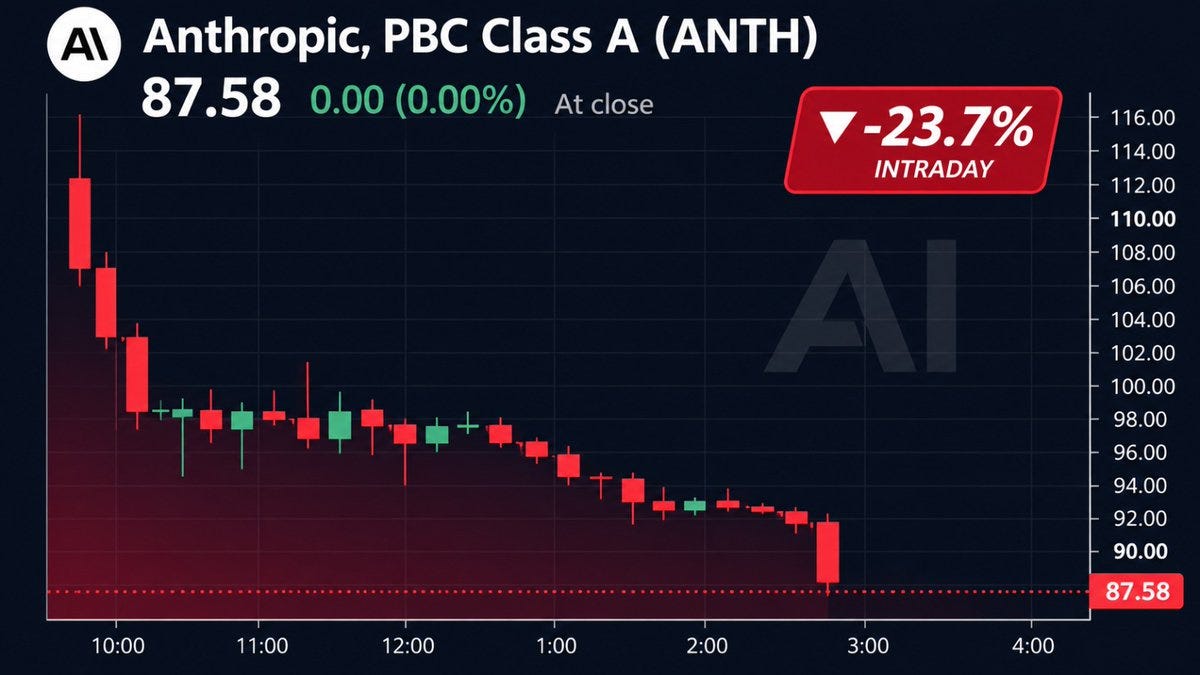
Somebody bring those guys some bandages. No, don’t bother. They’re still rich, but wounded by some brutal knocks on the head that may have taken some of the braggadocio out of them.
About the author

David Haggith is the publisher/editor-in-chief of The Daily Doom.
Economic, Social and Political News of Our Troubled Times -- a non-partisan daily collection of the most consequential stories about our complex times from multiple sources around the world plus daily editorials like the one you read here.
Liked it? Take a second to support David Haggith by subscribing on Substack!