
The last time a CIA director flew to Moscow (that we know of) was when then-director William Burns warned Russia not to invade Ukraine. That was November 2021. We know how that turned out.
John Ratcliffe made the trip last week, reportedly to meet with the heads of Russian intelligence. The war he’s trying to talk about has become the one thing in the world nobody can price.
The Situation
CIA Director John Ratcliffe’s visit to Moscow last week comes in the context of considerable and unpredictable escalation in the Russia-Ukraine war. US intelligence has warned that Russia might attack a NATO country in the future. Russia has increased “gray-zone” attacks like drone incursions, cyberattacks, and acts of sabotage throughout Europe in recent months (when I suggested in this column that there were external forces that benefited from the migrant invasion at Ceuta, Russia was the country I had in mind).
Russia has increased its attacks in the Black Sea, striking ports, vessels, and trucks; the subsequent drop in grain exports has seen wheat and corn prices rise ~13% over the last six weeks and injected significant uncertainty into the sunflower market. The combination of Russian aggression and the intermittent closure of the Strait of Hormuz has sent European natural gas prices to their highest since early 2023… and winter is coming.
Equal and Opposite
It has been a difficult year for Russia. I wrote in June that the Russian economy was buckling. Ukraine flipped the narrative on the battlefield, using drone strikes on everything from Russian oil refineries to warehouses for Russia’s version of Amazon (Wildberries) to bring the costs of the war home to the elites of Moscow and St. Petersburg. But to every action there is an equal and opposite reaction, and Russia is fighting back. As Ukrainian attacks have increased, so have Russian retaliations, with Russia’s Defense Ministry warning that it is planning “massive strikes” on Ukraine’s energy infrastructure in the coming days.
Part of the success of Russia’s attacks on Ukraine in August have been due to critical shortages of Patriot interceptors, which Ukraine uses to shoot down Russian ballistic missiles. (The Pentagon denies these shortages despite all evidence to the contrary.) Ukrainian President Volodymyr Zelenskyy is facing threats to his legitimacy after firing his popular defense minister, Mykhailo Fedorov, mass protests, calls for elections, and corruption scandals that involve officials high up in his government. Over the weekend, Turkey summoned Ukraine’s ambassador due to attacks on Turkish-operated vessels in the Black Sea, putting Ukraine at odds with a powerful force in the region.
Both sides are losing this war. Neither can see a clear path to its strategic objectives. Even so, the pressure has shifted in recent months to Russian President Vladimir Putin, which has created plenty of stories about the potential use of nuclear weapons or incursions into NATO countries. NATO may be feckless and strategically adrift, but an assault on a member state would pull European countries into the fray. And if mutually assured destruction doesn’t hold, we all have bigger problems than whether I’m right.
A Slow, Grinding Conflict
What is more likely is that Putin is fighting the same war he’s been fighting since his blitzkrieg to Kyiv in 2022 failed: a slow, grinding conflict, one where Russia makes the economics of the war impossible for Ukraine and exhausting for Europe so that a settlement is reached under his maximalist terms. Russian history is littered with enemies who simply could not outsuffer Russia on Eurasian turf, and Putin is betting on that formula once more.
The aforementioned Fedorov agrees. Credited with being the brainchild behind Ukraine’s innovative and effective use of drones to attack Russia, Fedorov told the Financial Timesearlier this week that Ukraine is “gradually, slowing losing the war.” This is the same Fedorov who, as defense minister, declared Ukraine had the upper hand. But wars are dynamic, and Russia is surely studying Ukraine’s tactics… with far greater resources than Ukraine possesses.
Fedorov is reportedly drumming up investor interest in a defense technology fund to “write a new history of the war.” The three areas he believes Ukraine must dominate next: battlefield robotics (Kyiv has limited and inferior manpower relative to Russia), cheap high-speed interceptor drones, and similarly cheap AI-enabled missiles. The PGMs of the 21st century will have brains, apparently. That is also the only way Ukraine can hope to “win” the war, and the only tactic that has ever beaten Russia’s ability to suffer. The US won the Cold War because it out-innovated the Soviets even as the latter were willing to outsuffer the consumer-drunk Americans.
Zero-Sum
The Russia-Ukraine war has reached a dynamic and unpredictable moment. This is not like the ongoing US-Iran war in the Middle East, which is becoming a farce. The US is running out of munitions, and the price of oil and its impact on inflation limits the extent and magnitude of US strikes. Iran used the Strait of Hormuz as leverage and, in so doing, set off a race to build infrastructure around it—and a global race to source alternate supply. The war will keep moving markets, but its impacts are rangebound and the scenarios are clear: Iran will control a Strait that matters less every year and will suffer only ships from countries friendly to Iran to pass. The multipolar world of discrete spheres of influence made manifest.
Where the Russia-Ukraine war goes from here is far less certain, and its potential impacts are not priced in because they are impossible to see as clearly. If Turkey can secure a grain deal 2.0 and Ratcliffe’s warnings are heeded, perhaps agricultural commodities pull back and the Black Sea becomes quiet (relatively) once more. Or maybe Moscow and Kyiv are stuck in an escalatory ladder, which, on top of a super El Niño and the ongoing Hormuz drama, will continue to make prices of everything from oil to food rise with nothing the Fed or the director of the CIA or anyone else can do about it. (The Turkish Chamber of Shipping are worried that Turkish shipping companies might go bankrupt if the situation continues.)
The US and Iran and their respective regimes will still exist whenever the two sides decide it is time to stop fighting; the squabble now is over the details. The Russia-Ukraine war is zero-sum. Stalemate is not an option. Russia and Ukraine can accept each other’s survival only on terms the other cannot give. So, they will go on trying to outsuffer and out-innovate each other, and while it is the everyday Russian and Ukrainian that bears the greatest cost, the cost to the rest of the world—at the pump, the grocery store, the heating bill—will be felt for as many more winters as it takes.
Map/Chart of the Week:

Blind Spot:
Last Friday, the US announced what President Trump called “the biggest oil deal in the world.” This past Monday, the White House followed up with details: the creation of a company called North American Blue Energy Partners, in which the US Department of War will take a 35% equity stake. Though the scheme is of questionable legality, for now, the Trump Administration has effectively seized control of 65 billion barrels of Venezuela’s proven oil reserves.
This is good old-fashioned imperialism: a great power seizing control of an asset because it wants it and because it can. Separately but related, Venezuela is reportedly considering whether to quit OPEC, which is especially ironic for anyone who knows the history. OPEC was the brainchild of a Venezuelan official who modeled the idea after the Texas Railroad Commission, which controlled how much oil producers were allowed to pump until 1972, when US energy demands exceeded supply.
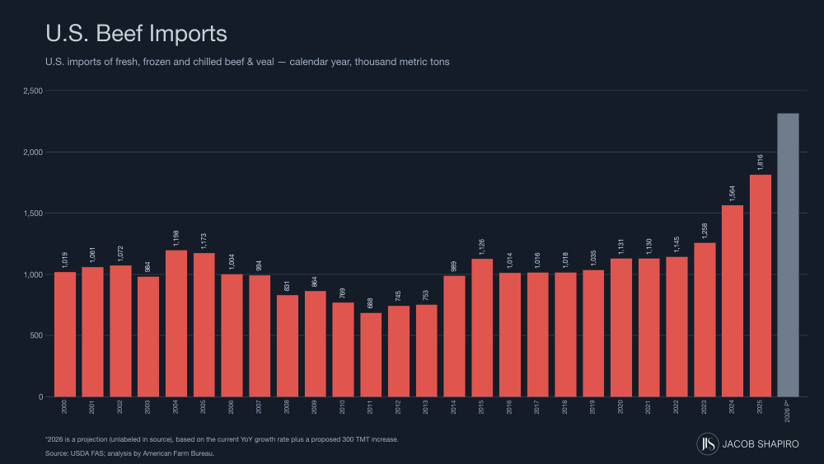
Also this past Monday, Reuters reported that the US EPA will approve an expanded volume of exemptions for US oil refiners from biofuel blending requirements, i.e., they will be allowed to refine more product without blending in as much corn-based ethanol, theoretically lowering gasoline prices while undercutting demand for US corn. If it happens, it’ll be the second major slap in the face to US farmers who overwhelmingly backed the president in the last election, as the White House said it was quadrupling beef imports from Argentina.
The US government is understandably trying to get a hold on consumer prices going into the November midterms: That’s what good populists do. Bread and circuses. Keep the price of food and fuel down. Gladiatorial UFC matches on the White House lawn. Football season is nigh. Never mind that Venezuelan oil can’t fill the gap anytime soon, or the legality (or lack thereof) behind such a move, or the parts of the electorate that will suffer to keep those prices low.
Treasury Secretary Scott Bessent’s interventions in the bond market are of a similar nature, Sisyphean and at best temporary moves to keep prices down. The tone of the Fed’s meetings in Jackson Hole was one of relative hawkishness, but the economy is booming because of data centers, not because the US consumer is healthy, and not because affordability is getting any better. This is one of those takes I hope I am wrong about, because the political consequences of being right will not be pleasant.
About the author