
The United States has been an independent republic for 250 years. For 164 of them, its most serious geopolitical threat was Canada.
The fledgling republic initiated the War of 1812 against British-controlled Canada to conquer it (and failed). As recently as 1935, the US was still drawing up war plans against its polite northern neighbor. (War Plan Red is worth a read.)
Today, the US worries about other threats—China, Russia, Iran—but none are as serious as the threat that once sat across the longest international land border in the world.
The Situation
It is easy to forget because, for the last 86 years, the US and Canada have enjoyed a close alliance, a relationship defined by deep economic integration.
In 2025, roughly $2.4 billion in goods and services crossed the border every day, underpinned by interlocked supply chains in energy, autos, and agriculture. Total two-way trade reached roughly $877 billion, making Canada the United States’ largest export market and its second-largest source of imports. Canada also supplies 64% of US crude oil imports, up from 41% a decade ago.
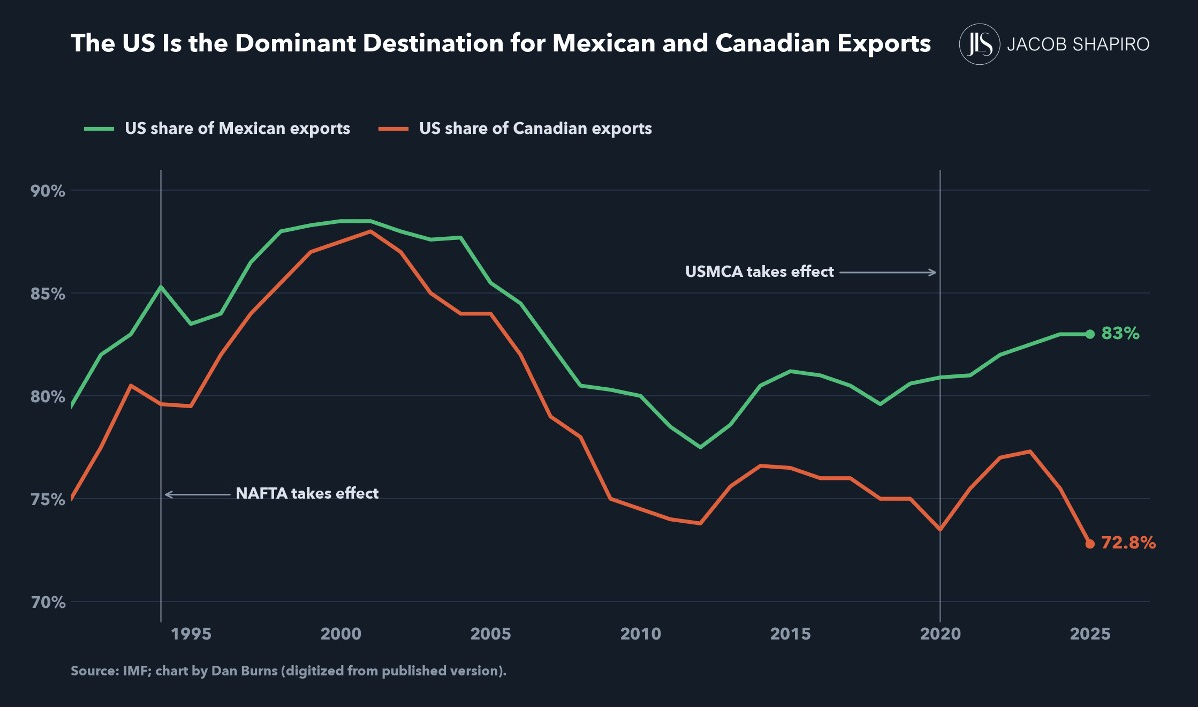
The dependence is asymmetric when looked at in terms of share of imports and exports: In 2025, 73% of Canadian exports went to the US and 46% of its imports came from the US. By comparison, Canada accounted for 15% of total US exports and 11% of US imports last year. We’ll come back to that asymmetry in a moment.
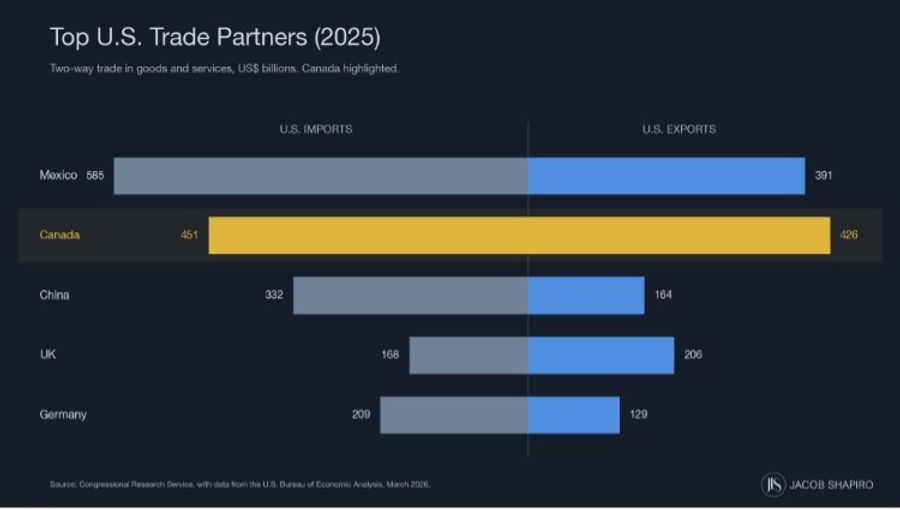 The relationship is structured by trade agreements, but its real foundation is physical: pipelines, factories, farms, and logistics networks that span the border and cannot be cheaply replicated. In good times, these linkages deliver connectivity, efficiency, and security. In times of trade tension, they mostly hurt Canada.
As Louis Gave noted in his excellent research note on the investment consequences of the trade spat, Canada’s comparative advantage is in getting things out of the ground—oil, natural gas, gold, wheat, potash—but geography forces its producers to sell at a discount to a single buyer. Canada accepted that willingly, on the strength of the postwar relationship. That choice is now blowing up in Canada’s face, as an aggressive US government rewrites the terms of trade in its own favor… and claims a de facto veto over Canadian trade with anyone else. That veto is reportedly one of the sticking points behind the weekend’s breakdown in negotiations.
Broken Forecast
At the start of the year, I predicted the US-Canada trade soap opera would be loud and melodramatic but end in a successful USMCA renegotiation. It is officially time to admit that forecast is broken. On July 1, the US declined to renew the USMCA in its current form, over Mexican and Canadian objections. That did not kill the agreement, but it opened it to annual review and permanent renegotiation.
That uncertainty is chilling for trade and investment, but until this past weekend, I took it for negotiating posture. It could still be—Canadian retaliatory tariffs do not take effect until September 1, and the US government is mercurial enough to reverse course before you finish reading this. But Prime Minister Mark Carney’s rhetoric and policies suggest Canada is moving forward on a war footing. Carney declared that US promises are “written in pencil” and that Canada has found reliable partners around the world “except in the US and Russia.” Ottawa has also unveiled a $7.5 billion package to protect Canadian businesses and workers from the tariffs.
A True Break in US-Canada Relations
It has been a busy year: the capture and removal of Nicolás Maduro, the US/Israel-Iran war, the worst Ebola outbreak on record, a grinding war in Ukraine…
But a true break in US-Canada relations would be the most important geopolitical event of the year and a massive failure of the Trump administration’s professed hemispheric policy, the updated Monroe Doctrine it peddled earlier this year as the “Trump Corollary.”
Since 1940, the US has not had to worry about its northern border. Canadian troops served alongside American troops in World War II, the Korean War, the First Gulf War, and Afghanistan. The North American Aerospace Defense Command (NORAD) blunted the Soviet threat to North America for the length of the Cold War. There is no way to price what it has meant for the US to not worry about the country that, for most of its history, posed the biggest threat.
All of which are reasons to think this spat eventually resolves itself, as is the fact that some of the proposed tariffs are nonsensical. A 50% tariff on cars imported from Canada, which carry substantial US content, would be a major cost to the US economy and hand the opening to Korean, Japanese, and European makers, currently tariffed at 15%.
Still, a good analyst must admit that what makes strategic sense to him does not govern the agency of the actors involved. The Trump administration believes Canada discriminates against US commerce, reads the goods deficit as a sign of weakness, and assumes its overwhelming leverage should end with Canada agreeing to whatever the US wants.
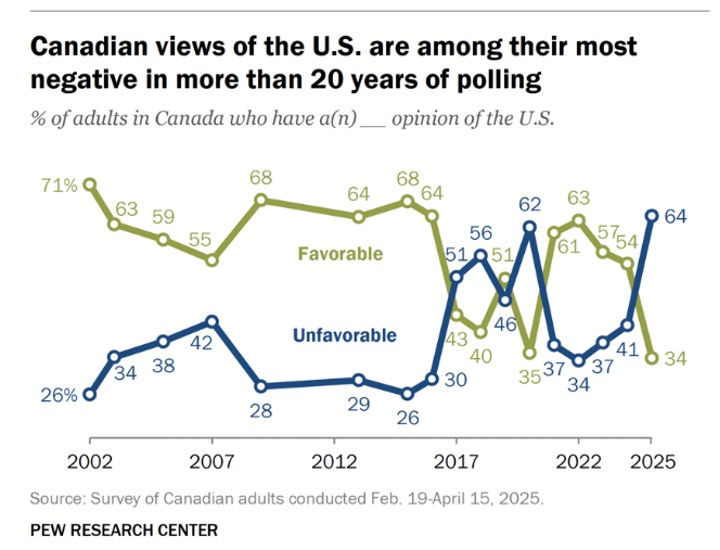 Source: Pew Research
Whose Threshold Is Higher?
To be frank, a plain reading of the asymmetry does suggest that. But politics is about more than numbers. The key to what happens next is simple to name and hard to measure: Pain tolerance. Carney has played a weak hand masterfully, whipping up Canadian patriotic sentiment to support the extremely painful choices a true break requires. (To be fair, President Trump is giving him much to work with.) For Canada, this is an existential issue: The US is assaulting its sovereignty because it thinks it can, and 76% of Canadians said in a recent poll that they supported ending the negotiations without a deal.
By comparison, almost 60% of Americans oppose tariffs on Canada, and 80% retain a favorable view of their northern neighbor. And remember that tariffs are a euphemism for taxes. Americans have record-low trust in their political institutions and deal daily with failing infrastructure and rising prices, while data centers go up in their backyards and billionaires flip $10 billion sports franchises. Inflation is already in an uptrend, prices are going to rise more due to the ongoing intermittent closure of the Strait of Hormuz and El Niño, and now tariffs on Canada will push consumer prices higher still.
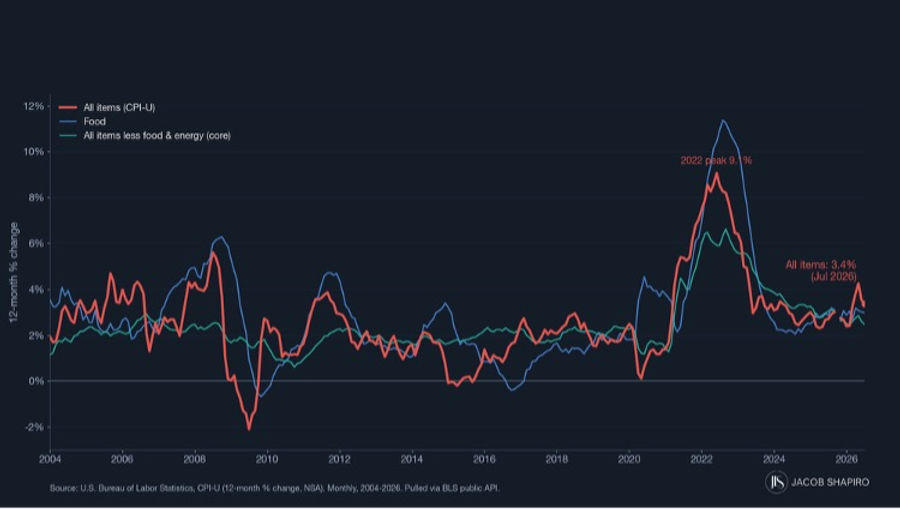 Carney is making a high-stakes gamble. He is betting the house on Canadians rallying around him—not just rhetorically but with what they buy, where they spend, and what they build.
Ironically, the more the US tries to bring Carney to heel, the more it buttresses his support at home. He is betting that Canada’s tolerance for the pain of a prolonged trade spat (and make no mistake, the damage will be significant) will outlast that of the median US voter, who punishes Trump and his acolytes at the ballot box and forces a concession—all while Carney spends to reduce Canadian dependence on the US.
It is a bold attempt to defy Canada’s constraints. But the US should know better than anyone that ideas outrun trade statistics; it owes its existence to one. It took 250 years, but perhaps the American Revolution has finally landed in Ottawa.
Map/Chart of the Week:
 Blind Spot:
Shoutout to the boys and girls at International Intrigue, whose daily newsletter is a must-read. They picked up a story I missed last week: Israel claimed responsibility for striking an abandoned Assad-era airbase near Aleppo. Israel says the strike answered Syria’s willingness to let Turkey deploy troops there, in violation of previous Israeli-Syrian understandings. In recent decades Israel has focused myopically on Iran, a country too distant to pose an existential threat. So focused on mopping up Iran’s proxies—Hamas, Hezbollah, the Assad regime—it failed to see who would fill the vacuum: Turkey.
Netanyahu built a career on that fear, casting himself as the only Israeli leader up to the task of stopping Iran. Naftali Bennett appears to have taken notes: Even as the new US/Israel-Iran war was ramping up, the former prime minister declared that “Turkey is the new Iran” and that Israel should focus on Turkish power in Syria and the region. Turkey condemned the strikes but, despite the 100-plus military outposts it already maintains across northern Syria, has declined to trip Israel’s red line… for now.
The US criticized the Israeli attack, describing it as unnecessary. In the days since, Israel and Syria have attempted to defuse tensions. The US has made a point of repairing ties with Syria; this week the Treasury Department delisted al-Nusrah, the al-Qaeda offshoot that later became HTS, as a terrorist organization. (So, the US is slapping tariffs on Canada while legitimizing al-Qaeda in the Middle East. These are strange times.) But make no mistake: Turkey is expanding into the vacuum left by Iran’s weakness—and unlike Iran, which propped up minority Shiite groups in Sunni-dominated areas, Turkey is Sunni itself.
About the author