The Chinese gold market got off to a strong start in 2026, with record prices and consistent demand.
China ranks as the world’s largest gold market.
Gold surged 14 percent in January, hitting all-time highs 11 along the way. Meanwhile, the yuan price increased even more, gaining 19 percent before the late-month correction drove the price significantly lower.
Before the pullback, it was the strongest start to a year on record.
The recent selloff pushed prices down significantly, but they rebounded relatively quickly. In yuan terms, the price seems to have built support around ¥1,000 per gram.
According to the World Gold Council, the price dip has boosted already sizzling investment demand, as new consumers enter the market.
As is the case in India, the skyrocketing gold price has driven investment demand to record levels even as jewelry demand faces price-related headwinds.
Chinese buying helped push gold bar and coin demand to a 12-year high of 1,374.1 tonnes last year. In value terms, global bar and coin demand was a record-breaking $154 billion.
More than half of the global coin and bar demand came from two countries – China and India.
The World Gold Council described Chinese wholesale gold demand in January as “robust,” with withdrawals from the Shanghai Gold Exchange coming in at 126 tonnes. That was an 11-tonne month-on-month increase, and broadly in line with the January 2025 level.
According to the WGC, “We believe strong bullion sales, supported by the gold price rally and jeweler restocking ahead of the Spring Festival holiday – particularly during month-end as they took advantage of the price dip – helped support demand.”
According to the South China Morning Post, gold buying was robust leading up to the Chinese New Year holiday, continuing a year-long trend of robust demand.
“From migrant workers splashing out on gold-coated jewelry, to white-collar workers pouring their savings into gold-linked investment funds, the metal is widely seen not only as a marker of social respectability, but also as a safety net amid an uncertain world.”
Strong inflows into Chinese gold ETFs reflected relentless investment demand. Gold holdings increased by 38 tonnes in January, valued at ¥44 billion ($6.2 billion). That drove assets under management (AUM) by China-based funds to a record ¥333 billion ($36 billion).
A targeted interest rate cut, along with increasing expectations of further monetary easing, dropped local yields, creating tailwinds for gold investment.
The World Gold Council also noted that Chinese institutional investors are increasing their gold allocations. Until recently, their participation in the market had been “limited.”
ETF demand is so strong that the Chinese government recently mandated that banks tighten risk-management policies, requiring investors to pass more stringent risk assessments before purchasing gold-related financial products.
A gold ETF is backed by a trust company that holds metal owned and stored by the trust. In most cases, investing in an ETF does not entitle you to any amount of physical gold. You own a share of the ETF, not gold itself. ETFs are a convenient way for investors to play the gold market, but owning ETF shares is not the same as holding physical gold.
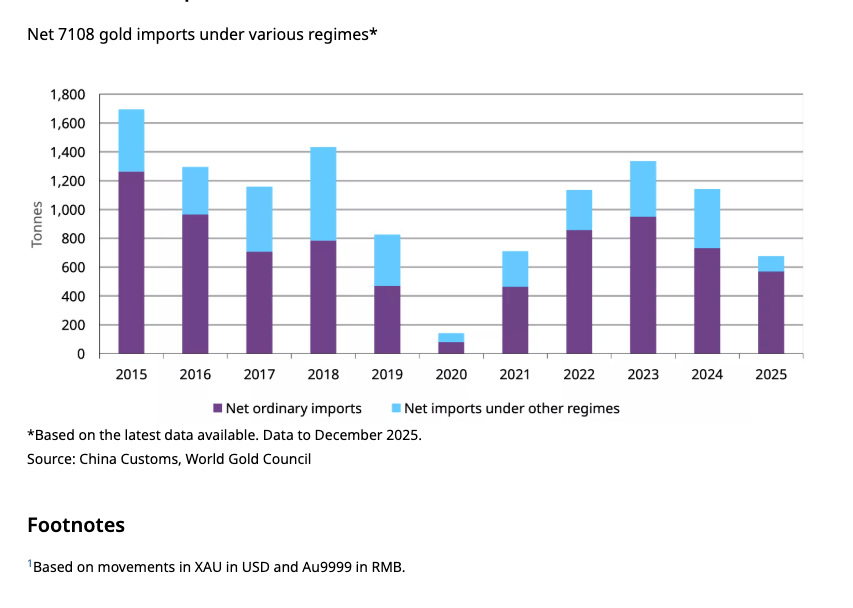
China was a major factor in last year’s gold bull market, but even so, gold imports into the country were modest at 675 tonnes in 2025. That represents a 41 percent year-on-year decline, and the lowest import total since 2020.
Unlike India, China doesn’t depend exclusively on imports to feed its gold demand. The country ranks as the top gold producer, with Chinese mine output around 380 tonnes annually.
Looking ahead, the World Gold Council projects the Chinese gold market to remain active in the months ahead, even as the higher price caps jewelry demand.
One gold investor told the South China Morning Post that he expects gold investment to remain robust, even if the gold price rises more slowly, because it provides a sense of security.
“Gold’s gains this year may not match last year’s, but it remains the safest bet.”
About the author