
There is SO much to pull together this weekend for a Deeper Dive. It’s amazing how quickly the various stages of the Everything Bubble Bust are coming together to where even the events that may seem to some like they are going suddenly in the opposite direction of what I predicted are really doing exactly what they should be doing in a major, major bust as the underlying fear in investors starts to become irrepressible. It is just that with so many bubbles of different kinds inflated by central banks all over the world, there is a lot of complexity in how they will go down.
I want to lead off by quoting an article just sent to me by one of my founding members in response to my own—someone who has been a stable and strong support for some time. It’s worth quoting as a way of triangulating a location to see where we are because it is written by “the guy who wrote the book on the Everything Bubble. He says he even coined the name.
In the days of World War II, the military set up targeting sites around major ports to sight in enemy ships approaching the harbor. Hawaii makes a good example. One site was set up in pill box on top of Diamond Head. Another on Mount Tantalus. The military could site with a telescope from each of those two locations and get an exact angle from that location to the enemy ship. By plotting where the two angles came together on a map of Pearl Harbor and the surrounding ocean, they could determine the exact coordinates of the ship they were siting, including its distance from the port, and aim their guns to those coordinates. That was called “triangulation”—two lines of sight from a different perspective determined the target.
So, I want you to remember what I wrote about the bursting of the Everything Bubble. Because it is the “Everything Bubble,” it will likely be the biggest crash we’ve ever seen if it goes down like I’ve said. The article given to me from another person’s perspective who has spent a good part of his life writing about the Everything Bubble is one I was not aware of until Friday, but when you look from his perspective, you find the exact same scenario laid out with the same complexity as seen from my angle.
Graham Summers from Phoenix Capital Research wrote the following in his newsletter to his paying clients:
In 2014, I coined the term “the Everything Bubble.” In 2017, I wrote the book on it.
The thesis was straightforward. U.S. Treasuries are the bedrock of the global financial system and the yields on these bonds are the “risk-free rate” against which every other asset on the planet is priced. So when central banks cornered the sovereign bond market in the aftermath of the Great Financial Crisis and EU Debt Crisis, forcing government bond yields to record lows, everything priced off of those bonds inflated right along with them: stocks, real estate, corporate credit, all of it.
The corollary was just as straightforward. When the bond bubble bursts, everything priced off of it must reprice.
That process is now underway. And it is unfolding in a very specific order.
I want you to note how precisely that aligns with what I wrote in my earlier article this week: 2027 PREDICTIONS: 2027 Brings the Everything Bubble Bust, and Here is What that Will Look Like. (As one reader noted that is a pretty bold set of predictions, so he asked am I really sure of it? Fair question, so let’s explore that.)
Major flight to safety
Now that we’ve triangulated in on it by seeing how the guy who wrote the book on the Everything Bubble is also saying NOW is the time when it is ALL beginning to fall apart, let’s look at the reprieve that long-term bonds, especially the US10YR Treasury got yesterday right after I pointed out how a 5% yield had become its new floor. To see if that made me a liar, let’s look at what actually happened yesterday and is continuing today.
First, yes, interest rates suddenly crashed through the 5% level that I said had become the new floor, but what was that crash in yields made of?
10-year Treasury yield tumbles below 5% to lowest level in nearly a month
Treasury yields fell sharply on Thursday, with investors turning to safe havens amid a steep sell-off in stocks driven by concerns around the artificial intelligence trade and surging oil prices.
The benchmark 10-year U.S. Treasury yield — used to price mortgages, auto loans and credit card debt — slid more than 17 basis points to 4.972%, the first time below 5% since Sept. 23. The yield saw its biggest one-day decline since March 10, 2023.
It was made of panic. Stocks took the kind of plunge—especially in AI stocks—that I predicted was coming right after I said it, and oil prices ripped through their recent ceiling, which had been the $110/bbl for Brent crude. Suddenly they are up at $116/bbl, and they are the driver of inflation right now, which is the driver of bond yields.
“It is a flight to safety,” said Mitch Goldberg, president of ClientFirst Strategy. “People are all of a sudden terrified of the amount of bond issuance by AI-related companies. They see the rates going up and people want to hold on to something that they think will be there at maturity.”
“Terrified.” And of what? Of the very thing that I predicted would bring AI stocks crashing down—the degree to which AI is dependent on massive bond issuance at a time when interest rates are soaring. The money dumping out of AI stocks had to have somewhere to land. Where did it go? To the Dow or the “value stocks?” Not really, the Dow stayed almost flat Thursday as the NASDAQ fell off its cliff.
Meanwhile, look at where the 10YR is just one day after yields fell:
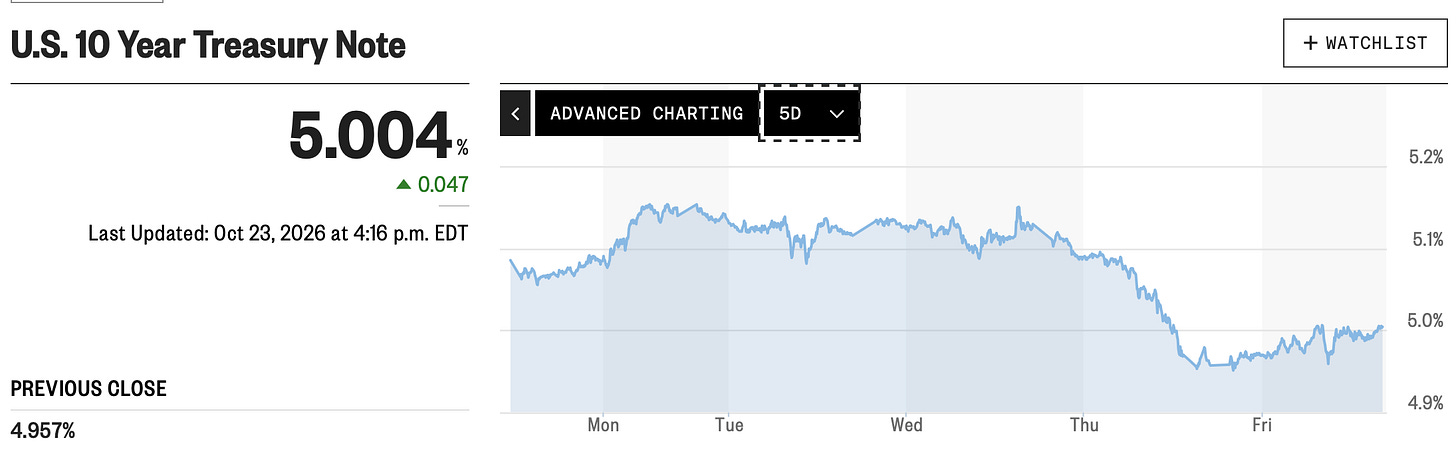
It took a tumble in rates because money swooped into the 10YR for long-term safety, but its yield has already recovered back to that 5% floor just a day after it took its big fall. It wasn’t that anything changed in concern about US Treasuries. It was that a huge amount of money had to have somewhere to go, and it didn’t know where else to run, except to its usual place of safety. So long as you are holding the bonds to maturity, they are a pretty safe bet. If you’re holding to maturity, you don’t have to worry that yields will go higher, causing their price to fall. You’ll get your 5% a year until they are done.
The money fleeing AI and some other stocks didn’t go to the Dow. Look at what happened to the Dow. It held flat all of Thursday, and Friday the Dow joined in falling off a cliff:
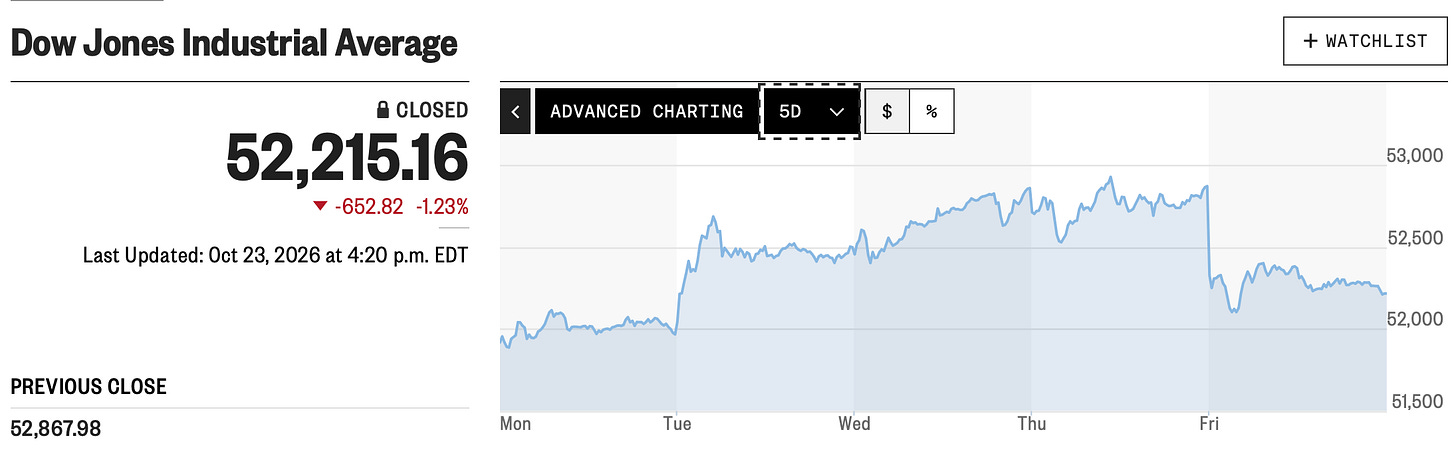
The NASDAQ and the S&P also went lower on Friday, so money kept flowing out of stocks in all the major indices. In net terms, none of what left the Dow went into the NASDAQ, so it likely continued going into Treasuries, pulling that yield down. Even so, the 10YR stabilized back up to its new yield floor of 5%. Most likely, long-term Treasuries will continue to get some assistance in lowering interest/yields from money pouring out of stocks in the days and months to come.
I’ve pointed out in the past how that works: Treasury yields fall when money from stocks pours into them. Treasuries will keep reaching up again for those higher yields because the inflationary pressures will be getting much worse. Stocks crash some more, and some of that goes into bonds. Yields relax again as a result. Inflation keeps coming in strong due to rising oil prices; so, yields rise again, becoming an attractive place for money from stocks to run to again. I’ve called it the stock-bond pump: The handle of the pump (yields) goes up; the handle goes down. With each cycle, it moves some money from the stock pool into the bond pool.
The moves were all about panic:
To put context around Thursday’s move, there only have been 15 trading days in the past decade in which the 10-year Treasury yield has moved by 19 basis points, in either direction, according to Dow Jones Market Data. This period covers the 2020 COVID crisis, the 2023 regional-banking crisis, the April 2025 tariff shock and the U.S. and Israel’s launch of the Iran war in late February.
“This kind of move is when we usually see more of a panic or a crisis,” said Dustin Reid, chief fixed-income strategist at Mackenzie Investments. His view is that something else has begun to unfold.
“We are clearly in a theme around concerns of an AI overextension,” Reid said. That’s sparked investors to start “taking chips off the table, given where we are in the year,” and by rotating money out of equities and into Treasurys and fixed income more broadly, he said….
“I think investors are worried right now, thinking: Is this the big one that’s coming in terms of a market selloff?” said Sam Stovall, chief investment strategist at CFRA Research. (Morningstar)
Yes, the banks are burning
Some money, however, did go into bank stocks, even though the NASDAQ fell overall. I just pointed out that banks are entering a time of peril; but keep in mind I did emphasize that I believed the time for a Bank Bubble Bust would come later in the upcoming year, even if this week made it look like the arrival would be earlier: (See: “The Banks Are Burning!”)
I placed banks toward the end of the order on my list because of all the things that will be impacting them to show that all those things would eventually be more than some of the major banks can handle. Then I indicated how far that would go. In my view, banks will be slow to join the party because banks did make changes in how they are capitalized, etc., after the big banking bust of 2008-2012.
Then I admitted,
Today’s news makes me wonder a little if I gave them too much time.
But I didn’t. Banks made some recovery in the last couple of days. Banks took a rough ride prior to that, and John Rubino, as I’m writing this Deeper Dive, just took note of that rough ride, and he pointed out the same troubles in how banks are capitalized in their reserves that I did:
On the surface, the US banking system looks pretty solid. But in reality, much is going wrong, including….
https://www.thedailydoom.com/p/the-deeper-dive-the-everything-bubble
About the author


David Haggith is the publisher/editor-in-chief of The Daily Doom.
Economic, Social and Political News of Our Troubled Times -- a non-partisan daily collection of the most consequential stories about our complex times from multiple sources around the world plus daily editorials like the one you read here.
Liked it? Take a second to support David Haggith by subscribing on Substack!