
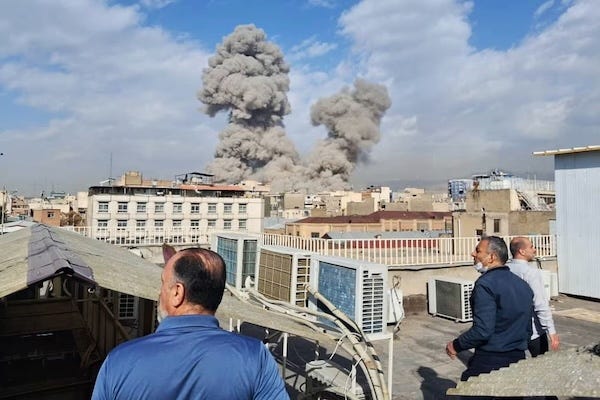
The US war with Iran has begun. This time, the threats of nuclear war or World War III are more overt than in any previous war, as I’ll lay out below.
The war with Iran began long before dawn on Saturday in the US as President Donald Trump confirmed in a video posted around midnight that the United States and Israel had launched “major combat operations” against Iran:
The risks from this war are extreme
Iran, as I noted earlier this week had promised a nuclear reprisal if the US launched an attack on Iran’s capital:
In a thinly veiled threat, Iran’s Army Chief has warned,
“If the US strikes Tehran, then IRGC will test it’s [sic] first nuclear capabilities during war.”
The strike on Iran’s capital is now a fait accompli. One had to wonder if that nuclear warning from the top was just the usual saber-rattling, or was it Iran’s first official admission that Iran has actually achieved nuclear weapon capability, contrary to its long claim that it was never working to acquire a nuclear weapon and never would.
One would think—given vastly superior US war power—that, if Iran were going to use a nuclear weapon, it would do so quickly while it still maintained the ability to launch one at Israel. If it is delayed at all, it may never again have the chance to strike Israel with a nuclear weapon. However, the need to launch quickly would depend on how much Iran’s leadership was convinced they had the location of such a weapon held in secret and how convinced they were that they could save themselves long enough to use it. At present, it appears that risk has faded for reasons given in the headlines below.
While the gravest risk, according to Iran, is that this quickly turns into a nuclear war or World War III, the more probable risk for the US is the death of US troops. In his speech, the president acknowledged risks from this war are higher than those of other recent wars when he pointed out the possibility (or likelihood) that US troops will die in a sacrifice of US lives in order to change the Iranian regime. It is unusual for a US president who is starting a war to tell Americans that some of their family members may die, but Trump stated the risk straight-up.
Trump had already stated that any attack, if it happened, would not be the kind of limited strike that some have suggested:
[General] “Razin Caine” is a Great Fighter, and represents the Most Powerful Military anywhere in the World. He has not spoken of not doing Iran, or even the fake limited strikes that I have been reading about. He only knows one thing, how to WIN and, if he is told to do so, he will be leading the pack.
While limited strikes seem unlikely based on the president’s statement, it is always possible, if Iran were to wave the flag of surrender quickly and promise to end all nuclear material development, turn over all nuclear material stocks, and fully open its doors to UN inspections, that Iran could end the war. Based on Iran’s claims that it would never negotiate under threat, that seems improbable.
So, war with Iran is likely to be fierce and then fiercer.
Israel's joining the US war with Iran makes the risk far worse
The president intentionally kept Israel largely out of his speech, focusing on the threat to US allies in Europe and the threat to the US in order to make a stronger case before America that the war he was starting was in the United States’ best interest and not something cooked up by Israel or on Israel’s behalf.
Israel’s involvement in attacking Iran increases the likelihood of drawing in other Arab nations that have long been adversaries of Israel. Lebanon/Hezbollah, for example, had said it would stay out unless Israel was involved in attacking Iran. So, Israel’s deep involvement, along with Iran’s threat that it will test its first nuclear weapon in this war if Tehran were attacked, raises the prospect that this war with Iran could become World War III, as many have feared, which is why the US has engaged with Iran for decades without attempting another regime change.
Already, Saudi Arabia has committed itself to defending other Arab nations around it, though that defense is aimed at Iran, which is already firing missiles into those nations.
The US attack on Fordow and other Iranian nuclear sites was intensely focused. The US made little effort to terminate Iran’s military, and it made no apparent effort at regime change. Israel’s involvement was less intense and more defensive in that war last year.
However, the president has stated this war IS about regime change. He has given his guarantee in the speech above that regime change will now happen, and has encouraged Iranians to seize the day as the one-and-only opportunity they are likely to ever see to install their own regime of the people’s choice to replace the current regime.
That also raises the risks and severity of this war beyond anything ever seen between the US and Iran or between Israel and Iran. One could say, “The fight is on.” This is the real deal where regime change is the clearly stated US objective and Israeli objective, even though the president did not go to Congress for approval as is required under the Constitution, though various acts by Congress have shifted the balance of power to the president as Congress abdicated its own responsibility.
A US War with Iran was likely to begin by this weekend, and now it has
President Trump often makes the decision to start a war ahead of his own final stated deadline in order to capture the element of surprise for the attack if it looks like the deadline is not going to be met. It’s not his way to remain patient with deadlines if no progress is being made. So, his usual M.O. indicated a US war with Iran was likely to begin by this Saturday.
Even though Trump had stated a “maximum” fifteen-day deadline, which would not have expired until Friday of the upcoming week, that maximum deadline would have required Iran to take clear steps within that timeframe to completely end its production of nuclear materials and of missiles capable of delivering a nuclear warhead to Europe and beyond.
The Trump administration, throughout the past week, however, made it clear it was not seeing any serious progress toward that objective and felt it was being faked by Iran in order to stall for more time for the regime’s continued existence. Moves like the evacuation of all but essential personnel from US embassies in the region indicated war had become an imminent and likely prospect.
Even though continued nuclear talks were scheduled for the coming week, Trump would likely have continued to schedule talks even if he knew a war with Iran was going to begin before those talks in order to enhance the element of some surprise. Congress, then, inadvertently pressed him hard to start the war with Iran this weekend when Democrats threatened to force a vote that would prevent Trump from doing so at the start of the upcoming week. They would try to finally withdraw som of the constitutional powers Congress had delegated in decades past to the president under various bills. That move increased the likelihood that Trump would act before such a congressional vote could even be taken.
The latest claim is that Ayatollah Khamenei is dead, but that is not a very specific report, and it's hard to believe the US could have already plowed through the rubble to make that determination or done some kind of DNA test to prove the corpse that was found was not a decoy.
Iranian authorities had not confirmed his death but satellite images showed significant damage to the leader’s Tehran compound, one of the first targets of the bombing campaign.
Khamenei’s death would represent a massive blow to the Islamic Republic that he had led since 1989, a decade after rising to prominence in the theocratic revolution that toppled Iran’s monarchy and rocked the Middle East.
Earlier stories had said Khamenei fled the compound more than 24 hours ahead of the attack, and he may have placed a lookalike in the palace to be found, should it be attacked.
Economic contagion
Besides the Saudis becoming involved against Iran as Iran started striking US military bases in various Gulf countries, other collateral spread is starting to show up.
Stock markets, bond markets, etc, are all likely to reposition. The US stock market was already fragile, and Treasury yields were plunging last week in what looked like a safe-haven flight from AI stocks and software stocks, as well as concern over the now apparent degradation of the US economy.
Some of that safe-haven flight may have been advanced moves in taking safety from the threat of this very war. If that is the case, that might somewhat mitigate the damage likely to hit on Monday when markets reopen, as this war would already be somewhat priced into Treasuries, but that is far from certain.
Some money managers said that risk-off positioning has been building for weeks, potentially providing some buffer against initial volatility once trading gets underway.
Weidinger noted that some cross-asset moves have already reflected “a little bit of a crisis environment,” citing firmer oil and stronger demand for Treasurys in recent weeks.
Oil markets will especially be hit:
Market watchers are bracing for turbulence after the U.S. confirmed it has launched “major combat operations” in Iran, a move investors say could carry far greater market consequences than the recent run of geopolitical flare-ups.
While markets largely ignored the brief over-and-done attack on Venezuela, oil markets are particularly likely to see major disruptions from this attack:
“Venezuela was a production story. [Iran] is a chokepoint story,” said Kenneth Goh, director of private wealth management at UOB Kay Hian in Singapore.
Located in the gulf between Oman and Iran, the strait is recognized as one of the world’s most important oil choke points. About 13 million barrels per day of crude oil transited the Strait of Hormuz in 2025, accounting for roughly 31% of global seaborne crude flows, according to data from market intelligence firm Kpler….
There could be a flight to safety with a strengthening of the U.S. dollar, Japanese yen, and a rush into gold….
Quantum Strategy’s David Roche framed the market impact in terms of duration and whether Iran would attempt to close the Strait of Hormuz. If the conflict is short and contained, he said, the risk-off move and oil spike could be brief.
If it turns into a longer, three-to-five-week “regime change endeavor,” markets would react “rather badly” as investors price in a wider conflict and longer oil disruption.
Iran has already ordered all ships to stay out of the Strait of Hormuz or be destroyed.
Vessels in the Gulf reported receiving messages warning that no ships were allowed to pass the Strait of Hormuz, according to EU … agencies though Iran has not confirmed any closure….
The UK Maritime Trade Operations (UKMTO) agency separately said it had received multiple reports from vessels in the Gulf that they had been informed of the closure of the Strait of Hormuz.
Oil majors and trading houses have suspended crude oil, fuel, and liquefied natural gas shipments, with satellite images showing vessels accumulating near ports.
Iran’s Revolutionary Guards issued orders for no passage through the Strait, though the UK Navy stated these orders are not legally binding and advised caution.
The US Navy warned against navigation in the area, and Greece’s shipping ministry advised vessels to avoid the Persian Gulf, Gulf of Oman, and the Strait of Hormuz.
In light of all these risks, what follows are some initial headlines on Day One of the US and Israeli War with Iran to give an overall sense of everything that is happening.
About the author


David Haggith is the publisher/editor-in-chief of The Daily Doom.
Economic, Social and Political News of Our Troubled Times -- a non-partisan daily collection of the most consequential stories about our complex times from multiple sources around the world plus daily editorials like the one you read here.
Liked it? Take a second to support David Haggith by subscribing on Substack!