

The closure of the Strait of Hormuz has severely disrupted the global fertilizer market, as the Persian Gulf region accounts for about one-third of global seaborne fertilizer and natural gas exports. The shock has caused urea prices to briefly double and led to sustained price increases of 20% to 30%, severely straining farm input costs and seasonal planting.
The crisis has led to several cascading effects:
- Supply Shortages: Tanker traffic through the strait collapsed by over 90%, suspending an estimated 3.9 million tonnes of urea exports in the first few months.
- Production Constraints: Because the Middle East supplies crucial natural gas feedstock (used to manufacture nitrogen fertilizer), the blockage has forced most production facilities in the region to reduce operating rates.
- Extreme Shipping Costs: War-risk insurance premiums for vessels in the region skyrocketed tenfold, pricing out many standard shipments.
- Vulnerability: Countries heavily dependent on Gulf fertilizers, particularly in South Asia and Africa, face severe supply bottlenecks.
The key input in agriculture is fertilizers, which farmers use to supplement natural soil nutrients, antibiotics to prevent animal diseases, pesticides to protect crops against animals, insects, weeds and various microorganisms, and of course diesel to run tractors and delivery trucks. Fertilizers used by farmers today are synthetically created, as they have proven to produce much larger crop yields than organic sources for over a century.
While global usage varies by crop type and region, research indicates that just under 50% of the world’s population is fed by crops grown using synthetic fertilizers. Without this technology, roughly half of the global population could not be sustained on current agricultural land.
(Organic fertilizers made from natural plant or animal byproducts account for only a small fraction of total agricultural crop nutrition.)
The Green Revolution
The modernization of the global agricultural industry led to history’s greatest explosion in food production. The agricultural reforms and resulting production increases fostered by the “Green Revolution” are responsible for avoiding widespread famine in developing countries and for feeding billions more people since. The Green Revolution also helped kickstart a substantial increase to the world’s population — it took only 40 years for the population to double from 2.5 billion to five billion, between 1950 and 1990.
The world produces enough food, so why are so many going hungry?
Norman Borlaug, an American scientist, is often called “the father of the Green Revolution”. In 1943 he began conducting research in Mexico regarding developing new disease-resistant, high-yielding varieties of wheat.
Through selective breeding, Borlaug created a dwarf variety of wheat that resulted in more grain per acre. Similar research at the International Rice Institute dramatically improved the productivity of rice, a cereal grain that feeds half the world.
From the 1960s to the 1990s, rice and wheat yields in Asia doubled, and though the continent’s population increased by 60%, grain prices fell, the average Asian consumed nearly a third more calories, and the poverty rate was cut in half. When Borlaug won the Nobel Peace Prize in 1970, the citation read, “More than any other person of this age, he helped provide bread for a hungry world,” states National Geographic.
The term Green Revolution refers to a series of research, development and technology transfers that happened between the 1940s and the late 1970s. The initiatives involved:
- Development of high-yielding varieties of cereal grains
- Expansion of irrigation infrastructure
- Modernization of management techniques
- Mechanization
- Distribution of hybridized seeds, synthetic fertilizers, and pesticides to farmers
Tractors with gasoline-powered engines (versus steam) became the norm in the 1920s after Henry Ford developed his Fordson in 1917 — the first mass-produced tractor. This new technology was available only to relatively affluent farmers and it was not until the 1940s that tractor use became widespread.

Electric motors and irrigation pumps made farming and ranching more efficient. Major innovations in animal husbandry — modern milking parlors, grain elevators, and confined animal feeding operations — were all made possible by electricity.
Advances in fertilizers, herbicides, insecticides, fungicides, antibiotics and growth hormones led to better weed, insect and disease control.
There were also advances in plant and animal breeding — crop hybridization, artificial insemination of livestock, and genetically modified organisms (GMOs).
Further down the food chain came innovations in food processing and distribution.
All these new technologies increased global agriculture production with the full effects starting to be felt in the 1960s.
The “revolution” in Green Revolution is well deserved, not so much the green, as we’ll see later in the article.
The use of hybrid seeds, irrigation, chemical fertilizers, pesticides, farm machinery, and high-tech growing and processing systems combined to greatly increase agricultural yields. The Green Revolution is responsible for feeding billions — and likely enabling the birth of millions more.
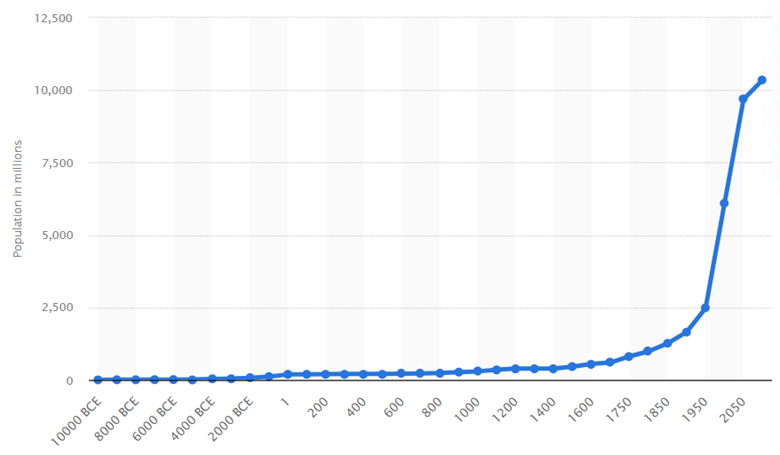 Source Statista
Cereal production more than doubled in developing nations — yields of rice, maize, and wheat increased steadily. Between 1950 and 1984 world grain production increased by over 250% and the world added over 2 billion more people for dinner.
Drawbacks
The Green Revolution had its drawbacks, the biggest being the reliance on synthetic fertilizers for food production; and the use of genetically modified organisms (GMO).
Since first tried in the 1990s, GMO plant species have been adopted by 28 countries and planted on 11% of the world’s arable land, including half the cropland in the United States.
Successful examples include a cross between a dwarf strain of rice and a taller variety from Indonesia that created India Rice 8, known for its role in preventing famine in Indonesia; drought-resistant varieties including one that can be planted in dry fields and subsist on rainfall like corn and wheat; and a flood-tolerant rice called Swarna-Sub1 that has been planted by farmers in Asia where every year floods destroy about 50 million acres of rice. A study of 128 villages in India that planted the rice variety increased their yields by more than 25%.
Opponents see farmers’ need to purchase GMO seeds from agro-giant Monsanto as a costly input to a broken agriculture system that relies too heavily on fertilizers and pesticides. Not only do the latter pollute the land, air and water, they also perpetuate a reliance on fossil fuels when they are applied.
We now pivot to the current backlog of fertilizer shipments and problems with other farm inputs — namely diesel fuel and water.
After the attack on Iran by Israel and the United States at the end of February, natural gas plants were shut down, fertilizer manufacturing plants were idled, and facilities were destroyed and damaged by missiles and drones.
Strait of Hormuz re-closure
During the peak of the Middle East conflict, over 40 vessels carrying approximately 1 million metric tons of nitrogen fertilizer, ammonia, phosphates and sulfur were trapped in the Persian Gulf behind the Strait of Hormuz.
While a June memorandum of understanding allowed a significant portion of this backlog to clear — including the release of over 600,000 tons of sulfur and major shipments bound for India — renewed Iranian tensions and skirmishes have recently caused incoming and outgoing traffic to drop to a trickle.
(The ceasefire between the United States and Iran broke in early July, less than a month after the mid-June agreement was signed. The truce collapsed when Iran attacked commercial vessels in the Strait of Hormuz, which prompted the US to launch massive retaliatory strikes on over 80 Iranian targets.)
Daily shipping traffic through the Strait of Hormuz has fallen to around 20 to 40 ships per day. This is a sharp decline from normal operations, where well over 100 to 140 cargo ships and oil tankers typically pass through the strait every single day.
According to the World Trade Organization, outbound fertilizer-related shipments through the Strait of Hormuz to destinations outside the Persian Gulf came to a standstill once the conflict started – and have remained close to zero since then. A stable resumption of shipments still remains to be seen.
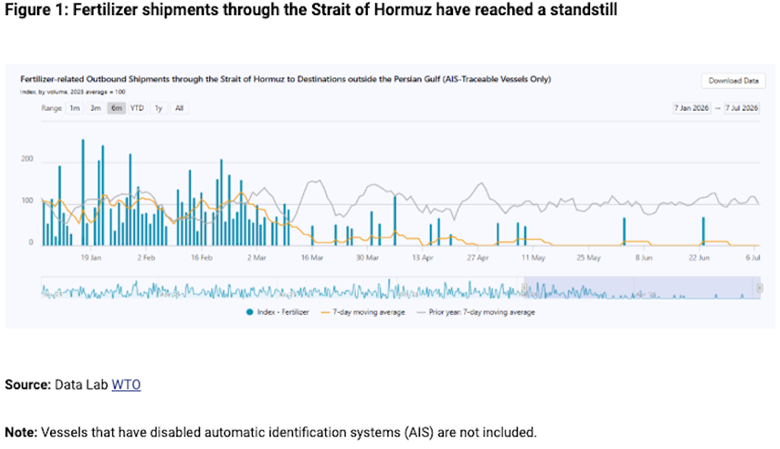
Figure 2 shows that urea prices have almost reverted to pre-war levels, after doubling following the outbreak of the conflict. In April 2026, urea prices rose from around US$ 400 per metric ton (mt) to over US$ 850/mt in April 2026, before falling again to US$ 453/mt in June.
Diammonium phosphate (DAP) prices also increased substantially after the outbreak of the conflict, climbing from approximately US$ 580/mt to around US$ 770/mt. However, these increases still remain below the peaks recorded in 2022 following the outbreak of war in Ukraine, when urea briefly exceeded US$ 900/mt, DAP approached US$ 960/mt, and potash surpassed US$ 1,200/mt.
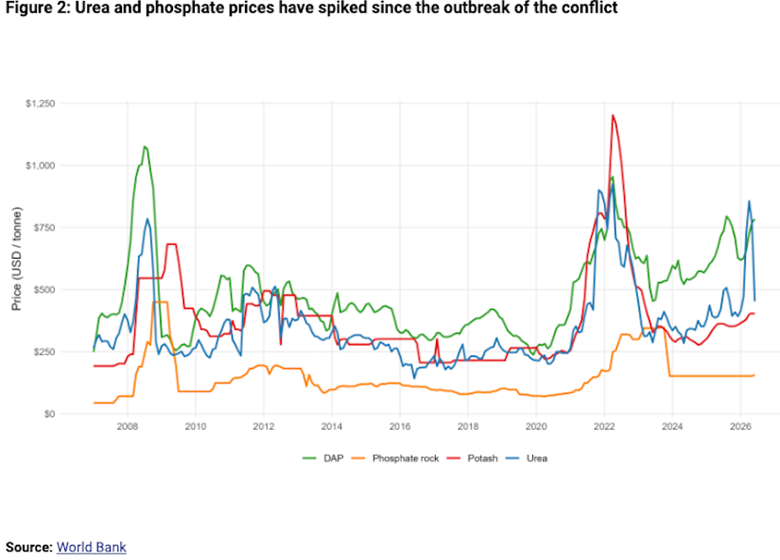
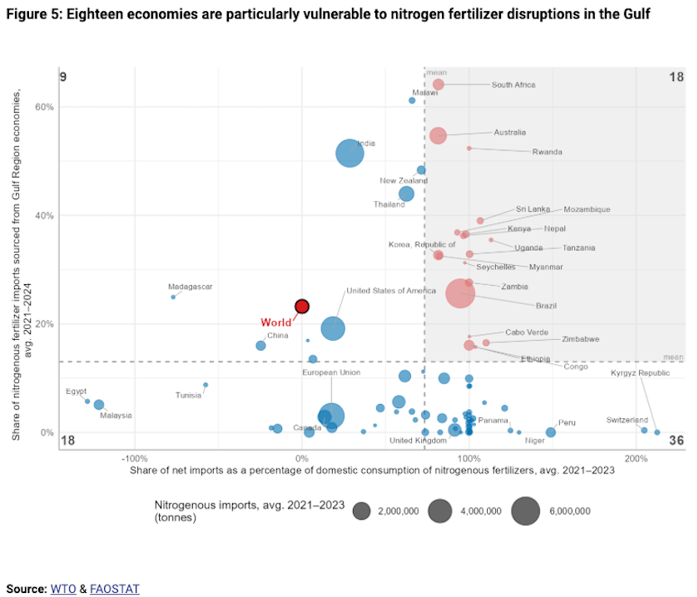
Figure 5 shows that 18 economies – in the upper-right quadrant – are particularly exposed to nitrogenous fertilizers supply disruptions in the Gulf. These economies, which constitute around one-fifth of the 81 economies of those that import from the Gulf region, combine high import dependence with strong reliance on Gulf suppliers.
This group includes developing economies in Africa, such as Kenya, Malawi, Mozambique, Rwanda, South Africa, Tanzania, Uganda and Zimbabwe. It also includes Brazil, Nepal and Sri Lanka. Seven countries in this group are least developed countries (LDCs).
Effects on farmers
The effective closure of the strait has severely disrupted global agricultural supply chains, primarily by blocking vital shipments of fertilizers and natural gas. This has triggered skyrocketing input costs, forced farmers to alter crop selections, and raised widespread concerns over compromised crop yields and global food inflation.
The crisis is affecting farmers worldwide through several specific challenges:
- Soaring Fertilizer Costs and Shortages: Because around a third of the world’s fertilizers transit through the Strait of Hormuz, the blockage has choked supply. Natural gas—a key ingredient in nitrogen fertilizer production—has also been constrained. Farmers in countries like Canada, the US, and across Africa and Asia are facing exorbitant fertilizer price spikes, exacerbating farm operating budgets.
- Shift to Less Nitrogen-Intensive Crops: To manage high input costs, many farmers are substituting away from nitrogen-demanding crops like wheat and maize in favor of less demanding alternatives like soybeans. This shift threatens to alter agricultural outputs and available food commodities.
- Reduced Crop Yields: Many farmers are choosing to use less fertilizer overall to save money, a practice the Food and Agriculture Organization (FAO) warns will severely lower crop productivity and yields.
- No Corresponding Rise in Crop Prices: Unlike past supply chain crises, prices for harvested agricultural commodities have not experienced the same surge as nutrient and fuel costs. This leaves farmers facing significantly squeezed profit margins.
The United States imports urea, ammonia, sulfur and processed phosphates from the Middle East. With the Hormuz blockade, US imports from affected ports fell to zero, resulting in a nearly 44% drop in overall crop nutrient imports and a 30% spike in domestic urea prices.
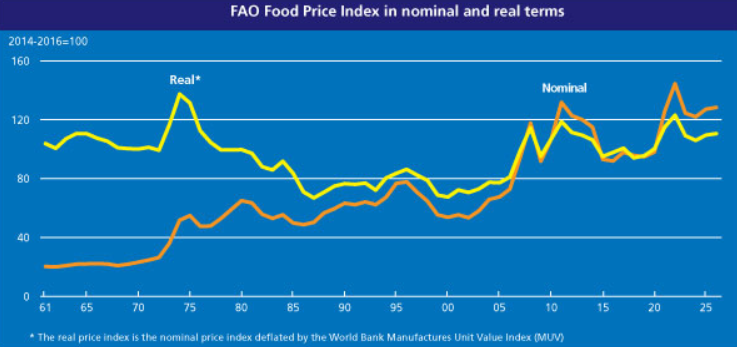
An American Farm Bureau Federation survey released in April reported that 70% of respondents said they couldn’t afford all the fertilizer they needed this season.
Some farmers are more vulnerable to price swings than others.
Producers of corn and wheat, which rely heavily on fertilizer, can spend around a third of their operating costs on fertilizer alone. Half of the farmers who responded to a survey released by the National Corn Growers Association in early April said they wouldn’t apply the full amount of fertilizer to their corn crop this year, due largely to higher costs and limited availability.
Fertilizer backlogs and supply-chain disruptions have hit Canadian farmers with soaring input costs, reduced supply options, and significant risks to crop yields. When combined with Strait of Hormuz conflicts and existing tariffs, producers face severe margin squeezes, threatening domestic food security and forcing them into a high-risk financial environment.
Canadian farmers effectively lost access to nearly half of the global nitrogen fertilizer supply due to trade tariffs on imports from Russia and Belarus.
Conflicts in the Middle East and Strait of Hormuz have tightened global availability, raising replacement costs for urea and ammonia by upwards of $100 per ton.
Diesel
High input costs — exacerbated by diesel prices reaching averages over $2.18 per liter — have forced farmers to engage in a precarious gamble on whether crop prices will cover the cost of planting.
The Financial Times reports that Russia just pulled roughly 11% of the world’s seaborne diesel supply after announcing a ban on diesel exports effective July 8 and lasting until at least July 31.
The reason is due to the war in Ukraine. Ongoing drone strikes on Russian oil refineries have steadily eroded the country’s refining capacity. According to the FT, by June 2026, Russian diesel exports had collapsed to roughly 428,000 barrels a day, more than 50% below prior averages.
Regions that had been relying on Russian diesel are now scrambling for alternatives. Turkey, Brazil, and North Africa face particularly acute supply constraints.
US retail diesel prices are nearing $5 a gallon compared to the record-high $5.81 reached in June 2022 soon after the war in Ukraine started.
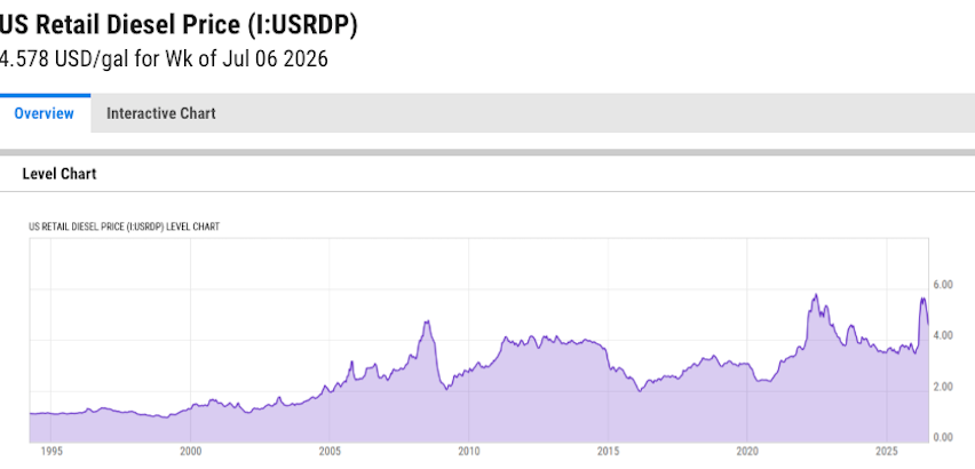 Source: YCharts
On average, diesel accounts for 5-15% of total farm operating expenses, depending heavily on the region and type of crop. However, when looking strictly at direct energy and fuel budgets, diesel typically makes up about 60% of total farm fuel and oil expenditures.
Water, droughts, global warming
About 70% of the world’s fresh water is locked up in glaciers, with the remaining 30% stored underground as groundwater. Less than 1% is found in lakes, rivers and swamps.
2025 was among the worst years on record for global ice loss.
The past decade has seen a dramatic acceleration in ice loss, with annual losses nearly four times higher than those observed in the late 20th century. (Phys.org)
The accelerating trend, of course, is driven by rising temperatures.
The coming water, food crises — Richard Mills
In North America, the canary in the coal mine for water loss is the Colorado River and its dams that hold back water in major reservoirs.
According to WyoFile, the outlook for the Colorado River, and Lake Powell in particular, continues to worsen due to an historically warm winter and dismal snowpack.
Projections show that Lake Powell on the Utah-Arizona border could drop low enough this year that it stops producing hydroelectric power at the Glen Canyon Dam. If it drops even lower, the dam is in danger of structural failure.
The water situation is crashing so rapidly that authorities can’t confidently track the extent of it.
Global droughts are devastating farmers through severe crop yield losses, escalating production costs, and critical livestock threats. Farmers are forced to grapple with depleted soil moisture, dying orchards, and skyrocketing feed prices, often leading to total income collapse and threatening rural livelihoods worldwide.
Nearly 40% of the US is currently in moderate drought or worse.
USDA Cuts Corn Stocks as Weather Threats Loom Over Tight Supplies
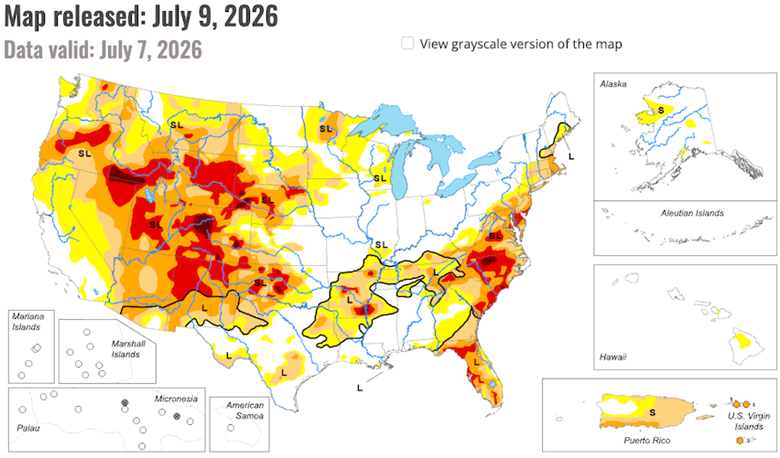 Source: U.S. Drought Monitor

In Canada, as of June 30, 35% of the country was classified as Abnormally Dry (D0) or in Moderate (D1) to Severe Drought (D2), including 13% of the country’s agricultural landscape.
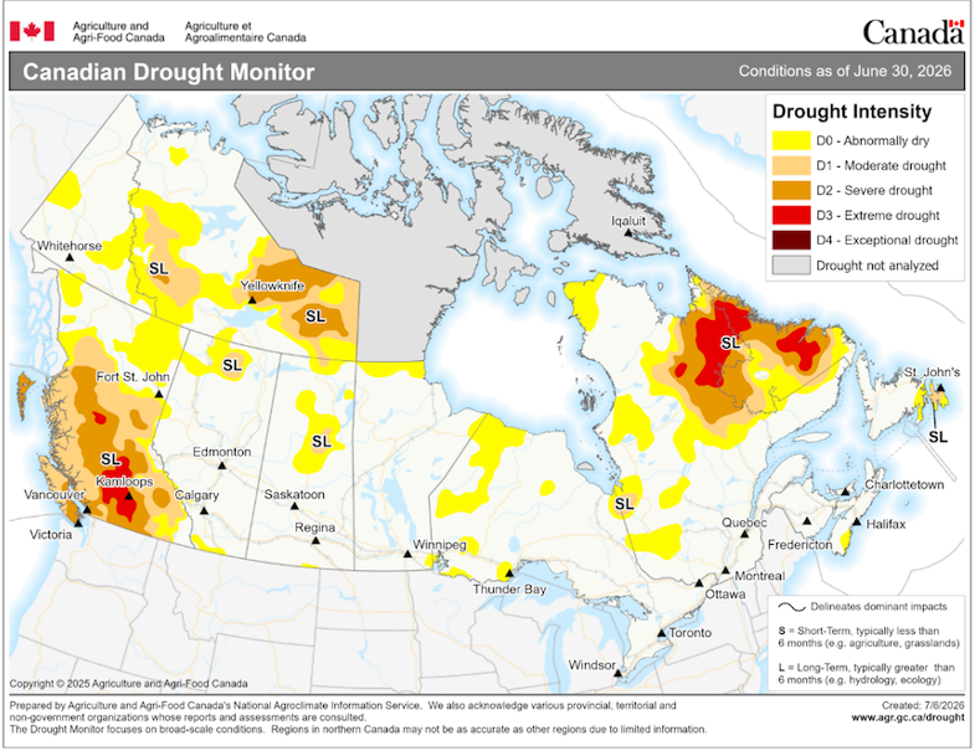 Source: Canadian Drought Monitor
We know what heat does to plant growth. Yields begin to decline at temperatures above 30C for most agricultural crops. We’re also quickly running out of capacity. Norman Borlaug, the father of the Green Revolution, said the Earth could support 10 billion people if we did everything right.
We’re at 8.3 billion and we’re not doing everything right. As far as I know, Borlaug never factored global warming into his forecasts.
El Nino conditions are currently present and intensifying.
A strong El Nino generally makes the whole world warmer, as heat wafting up from the ocean gets spread far beyond the tropics. That could lead to a hotter-than-usual summer in the western US, potentially worsening the wildfire season in California and Oregon.
An El Nino event could put upward pressure on cocoa, food oils, rice and sugar, bananas, tea, coffee, chocolate and soy-fed meat.
Closer to home, heat, droughts, fires, water shortages, failed crops and food inflation are all either happening now or forecasted.
Drought in British Columbia, northern Quebec and Labrador expanded significantly in June, with Extreme Drought (D3) areas emerging in both regions. British Columbia remains the region of most significant concern with 80% of the province in abnormally dry or drought conditions, up from 40% in May.
US food prices rose by 3.1% over the 12 months ending in May. Groceries increased by 2.7%, while dining out rose by 3.5%.
Canada’s food inflation sits at 4.3% year-over-year, outpacing the headline inflation rate of 3.2%. Grocery price spikes are heavily driven by fresh produce, with vegetable prices jumping 9% year-over-year. Experts cite Canada as having the highest food inflation rate in the G7.
Rise in bankruptcies
Small family farms are collapsing at an alarming rate. Driven by crushing debt, inflation in input costs (seed, fertilizer), generational succession hurdles, and fierce competition from corporate mega-farms, mid-sized operations are being squeezed out of the agricultural landscape.
Between 2017 and 2022, the United States lost over 141,000 farms, representing a 7% drop in just a five-year window.
Chapter 12 farm bankruptcies in the Midwest spiked by roughly 70% in recent years, fueled by higher interest rates and shrinking net farm incomes.

Conclusion
Global famine is a near certainty if fertilizer production is shut down or severely curtained, because synthetic fertilizers feed up to 5 billion people, roughly half of the world’s population.
The current farming malaise is driven by a litany of factors including supply chain disruptions, higher input costs (fertilizer, diesel), Russian tariffs on fertilizer, droughts/ water shortages, global warming, a Super El Nino, and farmers’ need to purchase expensive GMO seeds annually.
All of the above has led to a disturbing increase in farm bankruptcies.
It’s also leading to fears of a global famine. If that sounds far-fetched, be reminded that it has happened before. The last worldwide food crisis occurred during the early 1970s (1972–75), and the last multi-continental famine was caused by the global droughts of the late 1870s.
In recent years, severe food crises have led to famines in Somalia (2011), South Sudan (2017 and 2020), parts of Gaza and Sudan.
As in all of nature, human populations tend to increase in size to the limit of the local environment’s carrying capacity.
The current fertilizer shortage will trigger severe spikes in food prices and increase acute hunger in import-dependent regions; Sub-Saharan Africa and South Asia are at the highest risk. When farmers cannot afford to apply the necessary nutrients to their fields, crop yields drop, which translates directly into higher food inflation. This forces poorer nations to allocate more of their shrinking budgets toward basic food staples, pushing millions of people into poverty and malnutrition.
Ecological Overshoot
For most of human history there is no doubt we were consuming resources at a rate far lower than what the planet was able to regenerate.
Unfortunately, we have crossed a critical threshold. The demand we are now placing on our planets resources appears to have begun to outpace the rate at which nature can replenish them.
The gap between human demand and supply is known as ecological overshoot. To better understand the concept, think of your bank account – in it you have $5000.00 paying monthly interest. Month after month you take the interest plus $100. That $100 is your financial, or for our purposes, your ecological overshoot and its withdrawal is obviously unsustainable.
Humans are currently withdrawing more natural resources then our Earth bank is able to provide on a sustainable basis. How much more? At today’s rate of withdrawal, we need just over another half earth.
If today, everyone on earth were to start consuming the same amount of natural resources as the average Australian we’d need 5.4 planets, an ecological overshoot of 4.4 planets.
Earth Overshoot Day
According to the Global Footprint Network (GFN) August 8th was Earth Overshoot Day 2016 – the day when humanity exhausts our ecological budget, the day when our consumption exceeded the environment’s renewal capacity for the entire year.
The rest of the year we were in ecological overshoot and used the renewable resources of 1.6 Earths.
The date Earth Overshoot Day 2026 falls on is July 30th. The GFN predicts that by 2030, Earth Overshoot Day will be in June and it will take two entire Earths to sustain our species’ consumption.
Malthusian pessimism
“The power of population is indefinitely greater than the power in the earth to produce subsistence for man“. Thomas Robert Malthus
Malthusian pessimism has long been criticized by doubters believing technological advancements in
- Agriculture
- Energy
- Water use
- Manufacturing
- Disease control
- Fertilizers
- Information management
- Transportation
would keep crop production ahead of the population growth curve. Malthus’s prediction hasn’t come true because, so far, rising agricultural yields have always outpaced population growth.
Norman Borlang, Father of the Green Revolution, is on record as saying if we did everything right the Earth has a human carrying capacity of 10 billion people.
Ester Boserup, an agricultural economist says don’t worry, that population growth is the driver of land productivity – our planet’s human carrying capacity is based on the capabilities of our social systems and our technologies more than environmental limits.
Ester’s downgrading of environmental limits to second place has never given me much comfort. It seems a little shortsighted.
The Earth has gone through five major extinction events – from the Ordovician-Silurian (350 million years ago) to the Cretaceous-Paleogene (65 million years ago), in each event 70-90% of all species died.
The Anthropocene, or the age of the humans, is considered by scientists to be a 6th extinction event. That gets to be real bad news long before even 50% extinction – loss of species means loss of pollinators – which is a real problem since so many varieties, and so much of our food crops rely on insects (ie. bees) to pollinate.
The revolution wasn’t really green
The modern agricultural complex spawned by the Green Revolution may have allowed us to grow more food, but dependence on this high cost industrial input type of system extracts an extreme toll:
- Agricultural output did increase as a result of the Green Revolution, but the energy input to produce a crop increased faster – the ratio of crops produced to energy input has decreased. This is because High Yielding Varieties (HYVs) of seeds only outperform traditional varieties when adequate irrigation, pesticides and fertilizers are used.
- Green Revolution agriculture produces monocultures of cereal grains. This type of agriculture relies on the extensive use of pesticides because monoculture systems – with their lack of genetic variation – are particularly sensitive to bug infestations.
- The transition from traditional agriculture to GR agricultural meant farmers became dependent on industrial inputs – not made on the farm inputs.
- Farmers faced severely increased costs because they now had to purchase such items as farming machinery, fertilizer, pesticides, irrigation equipment and seeds.
- The increased level of mechanization on larger farms removed a large source of employment from the rural economy. New machinery – mass produced gas tractors, large self propelled combines and mechanical cotton pickers – all combined to sharply reduce labor requirements.
- Less people were affected by hunger and died from starvation – but many more are affected by malnutrition such as iron or Vitamin A deficiencies.
- Green Revolution grains do not have the same nutritional values as traditional varieties. The switch from heavily rotated multiple crops to mono cropping or dual cropping reduces total soil fertility and the nutritional value of our food.
- The Green Revolution reduced agricultural biodiversity by relying on just a few varieties of each crop. The food supply could be susceptible to pathogens that cannot be controlled by agrochemicals.
- Many valuable genetic traits, bred into traditional varieties over thousands of years, are now lost.
- Wild plant and animal biodiversity was hurt because the Green Revolution expanded agricultural development into new areas where it was once unprofitable or too arid to farm.
- The 20/80 phenomenon – the rapid increase in farm size and the concentration of production among large producers means 20% of producers generate 80% of the agricultural output.
- As a result of modern irrigation practices, aquifers in places like India (once Borlaug’s greatest triumph) and the US mid west have become depleted. There are two types of aquifers: replenishable, most of the aquifers in India and the shallow aquifer under the North China Plain are replenishable – depletion means the maximum rate of pumping is automatically reduced to the rate of recharge. For fossil, or non-replenishable aquifers – like the U.S. Ogallala aquifer, the deep aquifer under the North China Plain, or the Saudi aquifer – depletion brings pumping to an end. In the more arid regions like the southwestern United States or the Middle East the loss of irrigation water could mean the end of agriculture in these areas.
- Green Revolution techniques rely heavily on chemical fertilizers, pesticides and herbicides, some of these are developed from fossil fuels which makes today’s agriculture regime much more reliant on petroleum products.
- Farming methods that depend heavily on chemical fertilizers do not maintain the soil’s natural fertility and because pesticides generate resistant pests, farmers need ever more fertilizers and pesticides just to achieve the same results. Like the Red Queen, always running faster and faster just to stay in place.
- The increased amount of food production, and foods low price, led to overpopulation worldwide.
I said earlier we currently use the renewable resources of +1.6 planets and that by 2030 we’ll use the renewable resources of two planets. We do that by agricultural inputs – the massive use of fertilizers, diesel, insecticides, pesticides, fresh water for irrigation etc.
Has anyone thought about the further effects on our environment of ramping up fertilizer, pesticide, insecticide and herbicide applications even further?
How about increasing use of pollution emitting fossil fuels and fresh water for irrigation to enable big agra to feed billion’s more of us?
Have you thought about the effects of the existing billions of people (who don’t live even close to a western lifestyle) all wanting to live, or at least consume, like an American or Australian does? What happens when urbanization increases all the newly minted urbanites living standards and all those new consumers start to climb the protein ladder alongside the future billion’s coming to the dinner table?
(Many people in emerging/developing economies have increasing discretionary income, they are becoming richer. As income increases people move up the protein ladder, from staples such as rice they climb the ladder and demand more protein in the form of meat and dairy.)
It’s obvious the world needs a new farm – one the size of South Africa.
Unfortunately, the UN also says that by 2030 an area twice the size of South Africa will have become unproductive due to desertification, land degradation and drought.
Richard (Rick) Mills
aheadoftheherd.com

About the author

Richard (Rick) Mills

Legal Notice / Disclaimer
Ahead of the Herd newsletter, aheadoftheherd.com, hereafter known as AOTH.
Please read the entire Disclaimer carefully before you use this website or read the newsletter. If you do not agree to all the AOTH/Richard Mills Disclaimer, do not access/read this website/newsletter/article, or any of its pages. By reading/using this AOTH/Richard Mills website/newsletter/article, and whether or not you actually read this Disclaimer, you are deemed to have accepted it.
Any AOTH/Richard Mills document is not, and should not be, construed as an offer to sell or the solicitation of an offer to purchase or subscribe for any investment.