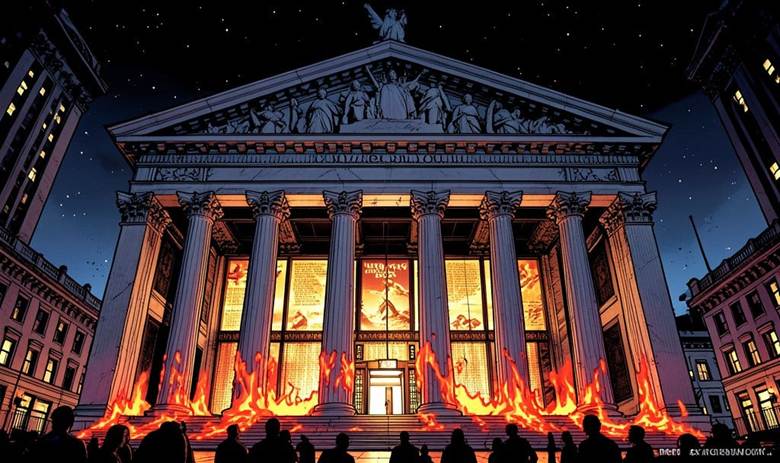
On Friday, the NASDAQ dropped 2% with almost all of the action being in AI-related stocks. The week as a whole was mostly a loser for stocks, meaning not just AI, but a more general slide. However, it focused on a shift away from tech and artificial intelligence-related names in conjunction with another big rise in oil prices that took North Sea Brent above $110/bbl and West Texas Intermediate above $100.
Both the S&P and the NASDAQ ended the week below their fifty-day moving average with the S&P shedding 2% for the week and the NASDAQ 4%; but the most significant change was what was moving and why as the volatility index for the stock market rose to a four-month high above 22. (Breaking above 20 is considered the level at which the index starts to indicate fear in the marketplace.)
A fairly strong flow from AI stocks into bonds showed a strategic shift. Bond rates have risen to the level where they are competing for investor interest against stocks now that Treasury bonds deliver a consistent level of relatively no-risk income above 5% for just sitting on your money and doing nothing … so long as you intend to buy and hold to duration. “No-risk,” however, may become a phrase of the past in time as we shift into the major bond meltdown that includes Treasuries and other national sovereign bonds all over the world that is threatening the AI trade.
It’s hard to say how the US will eventually discharge its debt, which is becoming difficult to manage now that annual interest payments exceed a TRILLION DOLLARS, but I’ll get to that at the end of this article. In the meantime, raising money just to maintain the debt by paying the interest due is increasingly bearing a higher and higher rate of interest on the new debt used to fund the interest.
Another factor in the week’s demolition of stocks was the reported rise in inflation that is driving bond interest higher and higher, creating a stronger syphon out of stocks.
Wholesale inflation this week saw its biggest gain since 2022, while consumer inflation remained well above the Federal Reserve’s target of 2%. (Nasdaq slides 2% Friday in worst week since June, pressured by AI sell-off and oil prices)
The gravitational force of heavy debts
The current force from bonds pulling down stocks is like the gravity of a passing planet that rips at the market’s surface to strip material away. However, this time the problem is far more serious than just competition for stocks from rising easy-money that can be made from relatively safe bonds.
This time the problem is that a lot of the money being invested into AI stocks and into AI data centers was coming from increasingly lower-grade commercial bonds that are costing the issuers interest rates well above the already rapidly rising interest on Treasuries. It’s simply getting harder and harder to fund the AI mania as Treasuries force all interest rates up at a time when a multitude of investors have begun to question whether or not AI companies can EVER make profits that will match up to the investments that are being poured into them.
Big Tech companies better hope their grand visions for artificial intelligence play out as planned.
Or else bondholders could be left holding the bag right along with stockholders.
The total capital raised by hyperscalers, data center special-purpose vehicles, and neo-clouds in the form of investment-grade debt, high-yield debt, and equity capital rose from $172 billion in 2025 to $346 billion thus far in 2026….
Debt markets are beginning to flash warning signs as they try to absorb all the paper that’s being tossed at them.
“Over the past two quarters, with unprecedented credit supply hitting the market, credit spreads have widened materially for investment grade and high yield bonds, as well as convertible bonds, across hyperscalers, data centers, and neo-clouds. Along with it, credit default swap spreads have risen sharply for all hyperscalers in 2026,” Krishna pointed out.
(Debt is fueling the AI boom, and warning signs are flashing)
Credit-default swaps are a hedge for trying to insure the debts in case of default. The cost of such “insurance” is soaring as the apparent likelihood of defaults is rising.
The artificial intelligence (AI) boom has a bit of a problem: someone has to pay for it. Despite soaring sales, the costs are still far ahead of the revenues, and more and more companies are turning to the debt market to fund the gap and continue the AI build-out.
But as companies borrow more to build their data centers and fill them with advanced chips, investors are getting nervous about when they’ll see a return -- or if they will. This week, that fear has shown up in the bond market where yields are spiking, and the cost to insure the debt against default has reached record levels for companies like CoreWeave and Oracle….
Perhaps the clearest sign of bond investor unease was the jump in the five- year credit default swaps (CDS) spread -- basically the cost to insure CoreWeave debt against default -- which reached a record high of about 1,195 basis points. In simple terms, that means it would cost an investor $119,500 a year to insure $1 million in CoreWeave debt.
When bonds on these out-of-scale investments in massive data centers start looking like they could default, some of those who hold bonds start to sell them in order to get out from under the risk of a default. But fewer people want to buy them, so the seller has to lower the price, which means raising the yield that the bond will provide to the buyer. So, the seller gets a lower price than what he/she originally paid so that the buyer of the aging bonds is assured of getting more back when the bond matures than what he/she paid for it along with whatever interest might be made by clipping coupons along the way while they wait to get their money back.
We are starting to hear a bit of a rushing sound to that vortex in the AI bond market. That is making it an increasingly scary place for stock investors as well since the build-out of AI is dependent upon those bonds continuing to be issued, which is rapidly costing higher and higher interest on the new issuances. On the other hand, as money is rushing out of stocks now, much of it is flowing into bonds, helping to lower those yields back down … for the time being.
Mushrooming fear cloud
Once the fear appears, it can mushroom quickly, and that can be seen in Wall Street’s fear gauge, which is now on a tear because traders anticipate the move higher in yields over the months ahead is far from finished. The prospect of an AI stock crash has been building for some time. Now the fear is becoming palpable.
The sell-off in AI-related stocks pushed the Cboe Volatility Index (VIX) above 22 for the first time in four months. A cluster of trades suggests it could go even higher.
In a series of eyebrow raising trades, investors purchased a number of November VIX calls that payoff if the index stays elevated through November. Specifically, one trader bought 9200 of the November 18, 20-strike calls for $1.7 million and 12,500 of the November 18, 23-strike calls for $1.1 million, wagering that the VIX will close above 23 by the third week of November.
(Wall Street’s fear gauge is ripping. Traders see it going even higher)
What this means is that speculators are now increasingly confident in the rise of fear to where they are placing large bets that it will run even higher in another month or so.
Cracks in the AI complex and fears around neo-cloud provider CoreWeave caused the Nasdaq to shed 2%, its worst day since June 5th. CoreWeave lost 13%.
Are these just the first stress marks showing on the larger crackup, which would be the crash I have been predicting? One caveat to this becoming the main event would be if Tesla, SpaceX and Meta report stellar earnings in the upcoming week. Investors will be looking for any sign of troubles or of continuing hope.
At the moment, however …
The jitters rippled through Wall Street in recent days as investors eyed the huge sums of borrowed money being used to fund the AI buildout, the health of which is being questioned as yields surge and more of the debt inches toward distressed territory.
The concern is that more stress could be on the way, potentially resulting in negative consequences for the AI trade and the broader financial system if losses on the bonds trigger a cascading effect that trickles into the stock market.
(AI debt fears are suddenly rippling across Wall Street as yields surge)
Components reaching critical mass
We are teetering right on the edge of a cascade into a nuclear explosion right now, and it is made up of a flow of factors that are all ganging up to erode at AI stock values.
About the author

David Haggith is the publisher/editor-in-chief of The Daily Doom.
Economic, Social and Political News of Our Troubled Times -- a non-partisan daily collection of the most consequential stories about our complex times from multiple sources around the world plus daily editorials like the one you read here.
Liked it? Take a second to support David Haggith by subscribing on Substack!