
This is wild news. Just shocking. I wouldn’t believe it if I hadn’t read it with my own two eyes.
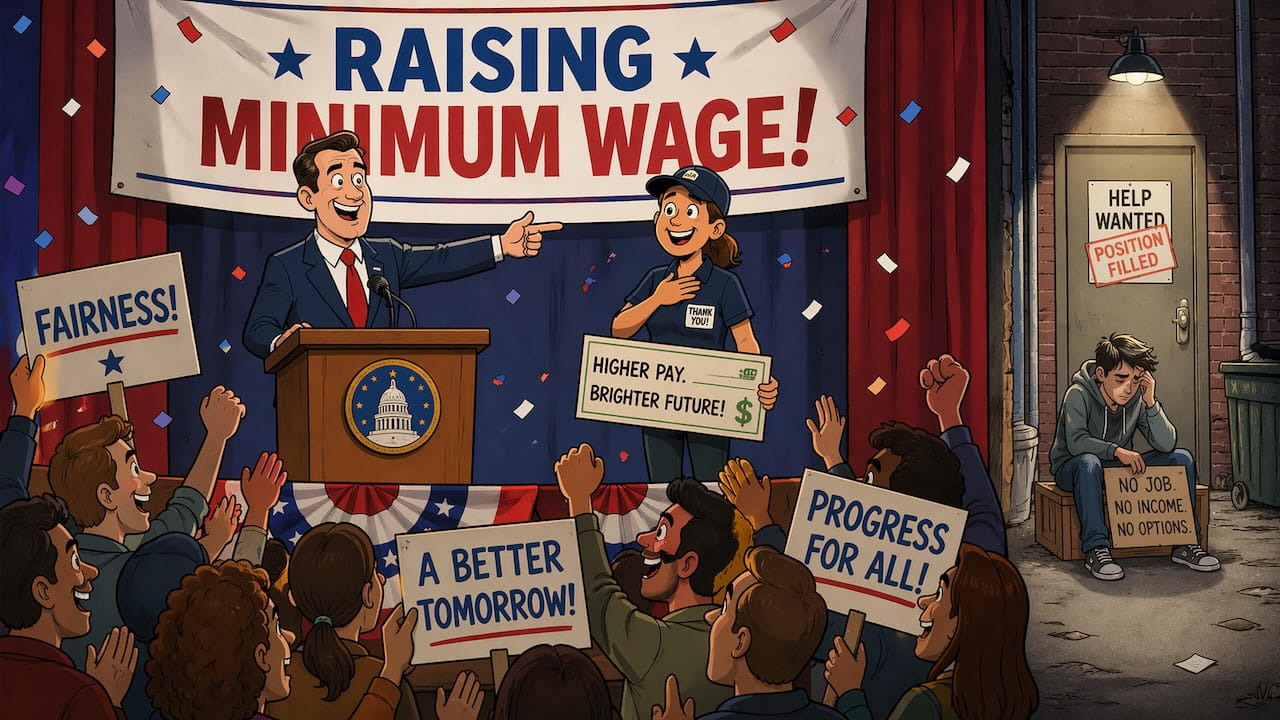
The state of California levied a $ 20-per-hour minimum wage for fast-food workers, and it led to “negative outcomes.”
Wow! Just wow!
Oh, wait. This isn’t shocking at all. Do you know why?
Incentives matter!
When he signed the minimum wage hike into law back in 2023, California Governor Gavin Newsom insisted the new wage floor would help fast-food workers cope with rising prices. And you know, that might be true – for the ones who kept their jobs.
And even a lot of them aren’t better off.
By the way, neither is the consumer.
According to a report by researchers at the University of California, Santa Cruz, the minimum wage led to a host of unintended consequences.
"The results indicate a plethora of negative outcomes such as higher menu prices for consumers, reductions in employee working hours, widespread elimination of overtime and loss of benefits for employees.”
Some workers are no longer workers, which underscores the fact that the real minimum wage is always zero.
This isn’t just speculation by some nerds with calculators. The data reveals the loss of fast-food jobs. According to BLS data, the sector shed 10,700 jobs between June 2023 and June 2024 – the year after passage of the bill.
And researchers say this exodus is accelerating.
"Further decreases in employee opportunities are being driven by automation, and the adoption of labor replacement technologies is accelerating."
Meanwhile, menu prices rose 14.5 percent after the minimum wage became law.
Now, our boy Gavin is having nothing to do with this gloomy report. The governor’s office contacted Fox News and insisted the analysis of the study was flawed, and it was not peer-reviewed. A Newsom spokesperson called the claims “flat wrong.”
"The facts are clear: higher wages are strengthening our economy and lifting workers out of poverty."
That's a loose use of the word "facts."
In a game of dueling studies, the governor’s office sent another analysis from the University of California, Berkeley that shows wage increases of up to 11 percent and growth in the number of fast-food establishments.
Oddly, the minimum wage was raised from $16 to $20 – a 25 percent increase.
Of course, nobody denies that minimum wage laws help some people. But what about the people who lose their jobs?
I should also note that analyzing the impact of a minimum wage is difficult because there are so many factors impacting employment. It’s tough to isolate the effect of a single dynamic. Job losses due to a minimum wage could be obscured by other factors in the economy boosting employment.
This is why it’s important to understand basic economic principles.
Because here’s the rub: if you have a high school level of economic knowledge, you could have predicted job losses and rising prices with an imposed wage hike. It’s very basic supply and demand.
Unfortunately, most politicians don’t even have a rudimentary grasp of economics. They either can’t comprehend that rising prices reduce demand when everything else is equal, or they somehow imagine that these basic economic laws cease to operate when it comes to labor. (They don’t.)
So, Newsom’s office might be right. The Cal Santa Cruz report may have some flawed analysis. But I don’t need a report to tell me a price floor has negative economic impacts because I’ve read (many) economic books.
However, government people seem incapable of learning because they keep doubling down on these asinine policies.
The City of Los Angeles decided to help, and the local government imposed a $30 minimum wage for hotel and airport workers. The Hotel Association of Los Angeles commissioned a study that found hotels plan to or have already eliminated 6 percent of their positions. That's around 650 workers who were “helped” right to the unemployment line.
So, sure, some workers in LA will benefit. Politicians will point at them and run victory laps. Meanwhile, the people harmed by the policy will languish in the shadows, pretty much unseen. And sadly, these are generally workers on the margin - youngsters and those with fewer skills.
Politicians never talk about these people. They just run around doing victory laps, claiming they're helping the poor and downtrodden.
This calls to mind French economist Frédéric Bastiat, who reminds us that, “Between a good and a bad economist this constitutes the whole difference — the one takes account of the visible effect; the other takes account both of the effects which are seen, and also of those which it is necessary to foresee.”
Let me tell you, there are a lot of bad economists out there. And it seems like most of them found their way into government.
I want to reiterate a very important point. You need to understand the basic economic principles to draw economic conclusions. We’re not talking about chemistry here. We’re talking about human behavior, and that’s nearly impossible to quantify. I can massage numbers and spin data to prove just about anything. If you don’t understand the underlying dynamics, I can fool you. But if you grasp the principles, you can look at wonky data and immediately know – yup, that data is wonky.
I’m not saying there is no use for data-driven research in economics, but you darn sure better understand the principles before you lean too heavily on it.
Economics is fundamentally about human action. People act. They act in response to incentives. Ergo – incentives matter.
About the author