
Trump made a pledge not to strike Iran until after the midterm elections today to try to calm riled oil markets. As I wrote yesterday,
So much war to finance, you know, and so much higher inflation due to the fact that this war attacks oil directly, and that isn’t letting up:
As if on cue, oil soared today, blowing way past the $100 level, shooting all the way up to just under $106 for Brent crude midday, and finally settling back to a little over $104, which yielded a 4% rise in just one day.
Trump’s statements have been a significant driver of daily moves in the oil market since the start of the war with Iran in February. But on Thursday, after a brief price dip, oil markets largely shrugged off the president’s announcement.
Several factors likely ganged up on energy prices today. The war intensified with the Houthis blowing up a plane in Riyadh, Saudi Arabia. Pakistan reportedly joined with its airplanes in SA’s defense against the Houthis, bringing a new entity into the war. An explosion occurred at a Venezuelan oil refinery. It is unknown if it had anything to do with sabotage. Two deadly natural gas pipelines in New Mexico blew up. Again, unknown if it had anything to do with sabotage. However, Iran has stated it will now be greatly expanding the extent of the battlefield. Also Hurricane Isaias, bearing down on the gulf states, shut down 63% of oil production in the Gulf of Mexico. Meanwhile, shipping through the Strait of Hormuz remains throttle at about 23 ships per day compared to the prewar level of 100s per day according to data from MarineTraffic. Iran also said that overnight more tankers ran into mines that exploded. So, it was a total storm for oil today.
Stocks, instead of rising with glee over Trump’s announcement of further postponement of heavy US action in the war, had a day of turmoil due to AI troubles as OpenAI’s revenue report renewed questions about the profitability of AI.
Oh, and the New York Fed has news for you. The inflation you’re feeling right now, outside of energy prices has nothing to do with oil pricing through to other items. It’s all due to the Trump Tariffs passing through. The Trumpflation from war has yet to arrive on the shelves, according to the Fed.
The cost of many everyday items would have declined last year and early this year without President Donald Trump’s tariffs, according to the New York Federal Reserve.
The cost of 67 categories of goods was 2.9 percentage points higher as of February thanks to tariffs, according to a paper from a team of researchers at the central bank’s New York arm.
Without the levies, the team found that prices for the products they studied would have pulled back by almost 1%.
The difference from tariffs looks like this, according to the NY Fed:
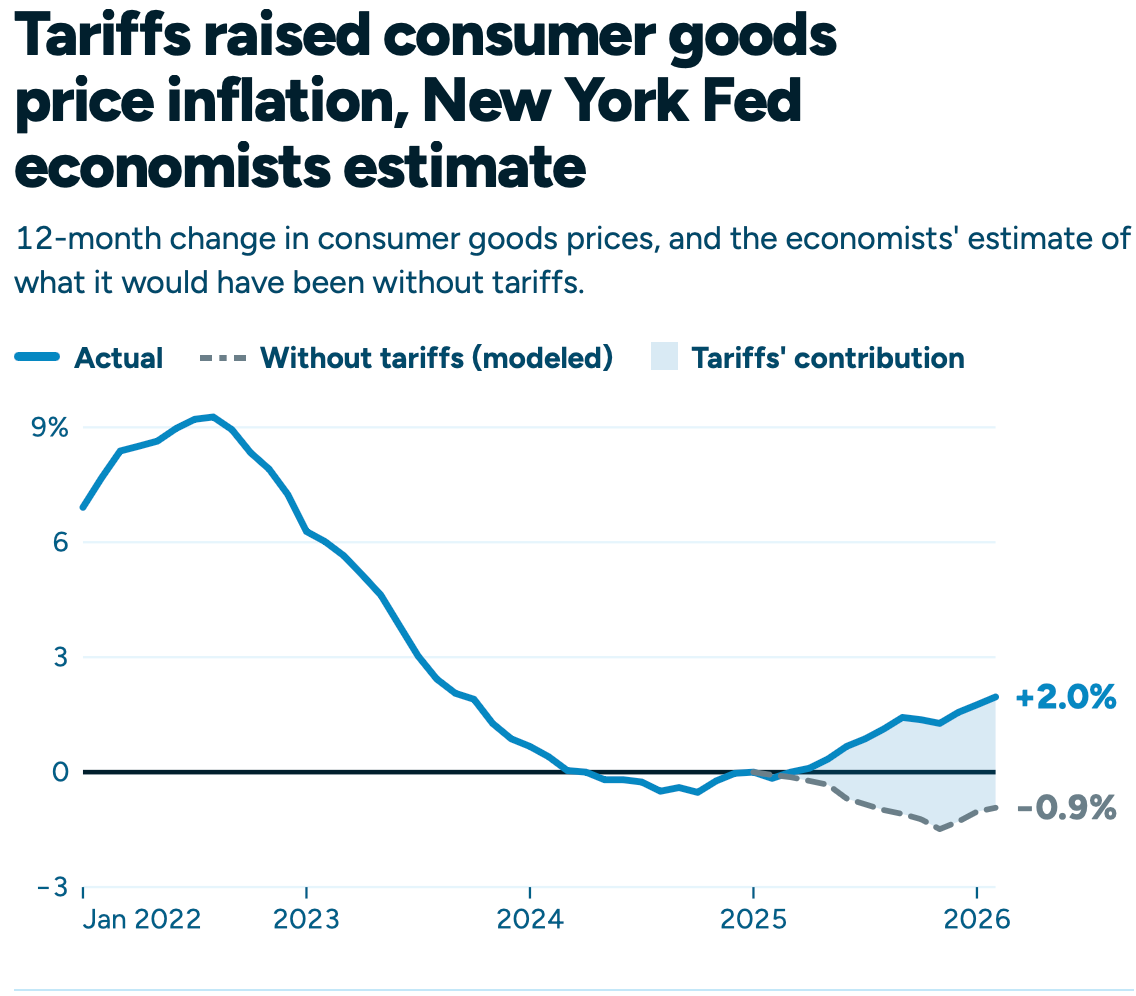 CNBC
CNBC
The New York Fed’s report offers the clearest evidence yet of the impact of Trump’s tariffs — a core policy of his most recent campaign and second term in the White House — on consumers’ wallets. Economists had widely expected his levies to push up prices, though the precise effects had been hard to estimate due to the changing nature of the policy and the lack of transparency on how companies set their prices.
“The Trump administration has consistently maintained that the cost of tariffs will ultimately be borne by foreign exporters who rely on access to the American economy,” White House spokeswoman Taylor Rogers said in a statement to CNBC.
Yes, we realize the White House has consistently lied about this, and that it has the audacity to keep using the same lie in its response now.
Trump argued that companies could absorb the increased cost from tariffs rather than pass them down to shoppers in the form of price hikes. The New York Fed team said that around 26% of last year’s tariff increases ended up trickling into higher prices.
Anyone believing that US businesses would just absorb the costs and NOT pass them on to consumers hasn’t been alive in this world long. That is not how it works. As I said way back at the start of tariffs, it may take companies time to find moments of slack where they can add more of the tariff into the price based on consumer resistance, but the pressure will always remain there until they finally manage to get it all priced through.
The damage, of course, has been lessened by the Supreme Court striking down most of the unconstitutional tariffs, which Trump then replaced with much smaller 10% tariffs that he had the power to enact other other laws.
About the author

Since 1995, providing gold investors with the latest precious metals information & financial truth!