
As we look to my 2027 economic predictions for a huge stock crash and an economic collapse, I will show how the various bubbles that are collapsing will interact with each other to evolve into a huge recession. Let’s lead off with the auto industry that hit the predawn news this morning. It’s not really a bubble, but it is going bust, so it will play a role in the economic crash of 2027. Exactly as we saw during the Great Financial Crisis, auto loans have already entered a severe state of default:
Remember the subprime mortgage crisis that ultimately resulted in the global financial meltdown of 2008? Bad loans, sketchy financial instruments, and defaults from high-risk borrowers plunged the world into the worst economic downturn since The Great Depression. Lessons were learned and measures have been taken to make sure something like that never happens again – right?
So you’d think, but there’s a reason why we’re bringing up the GFC and it most certainly isn’t good. A Reuters report recently brought some chilling details to light about the current state and trajectory of auto loans in America. Many parallels can be drawn between where said market stands right now and the factors leading to the housing crash nearly two decades ago, which is rather concerning to say the least.
A $1.7 trillion market might be on the verge of collapse.
In short, subprime loans are once again the main headliner, but they’re just the symptom of multiple underlying facets bundled together.
Covid stimulus checks made buyers look better than they were. Now many of those loans, without the temporary stimulus money behind them, have devolved into subprime:
Pandemic-era government incentives are now long gone, loans approved during the COVID years are recording late payments at alarming rates, and buyers are left with depreciating assets costing them more than they can afford. Not only that, but your typical vehicle on sale is six years old in 2026 compared to just over three years back in 2019, which translates to higher maintenance and servicing costs on top of loan repayments they can barely keep up with.
And based on data from the SEC, the share of loans expected to reach maturity when the vehicle is more than 12 years old rose from just 5.8% in 2019 to over 30% in 2026. Costly repairs for less dependable cars increase the likelihood of subprime borrowers defaulting on their payments, and that’s not a good scenario for investor funds tied up in asset-backed securities.
And, just as in the GFC, auto manufacturers are now looking imperiled. General Motors just saw its shares plunge 6.8% in trading today, in spite of offering major stock buybacks to prop up its share prices and in spite of an earnings beat.
The selling comes as GM continues to grapple with a weakening U.S. auto market, where higher financing costs and pressure on household budgets have made it increasingly difficult to sell lower-priced vehicles. Demand for the company’s more expensive trucks and SUVs has held up considerably better, allowing GM to preserve profitability even as overall sales volumes come under pressure.
High-end vehicle sales will soon enough be impacted by soaring interest, too. The buyers may be a little more able to hold there; but most are not bought with cash. So, buyers in the middle class, who buy most of these vehicles will start to recede, too.
Looking ahead, GM is putting additional emphasis on its bread-and-butter pickup business, with redesigned Chevrolet Silverado and GMC Sierra trucks expected later this year. The company also plans to increase output of higher-end models equipped with V-8 engines, betting that wealthier consumers will continue paying a premium for larger vehicles.
Maybe.
The approach marks a notable change from GM’s previous enthusiasm for electric vehicles and autonomous driving, both of which have resulted in expensive setbacks. CEO Mary Barra has increasingly redirected attention toward established profit centers, while pursuing more targeted opportunities in vehicle software, advanced driver assistance and even defense-related manufacturing.
Automakers made some major wrong turns on EVs, which have not yet started to do well even in today’s oil-starved markets; and the market on the high end is bound to experience some hammering from soaring interest, too. For the richest, not so much; but most people buying relatively expensive pickups are not rich. Just watch what happens in the higher-end of the market in 2027 as more auto loans default so that creditors tighten standards to protect themselves, and interest continues to rise.
The broader auto industry has undergone a significant reassessment over the past two years. After spending much of the early 2020s promising an accelerated transition to electric vehicles, several major manufacturers have scaled back EV investments, delayed launches and absorbed substantial losses as consumer adoption failed to match earlier expectations.
In good part because the subsidies ended, making the vehicles unaffordable if Uncle Sam isn’t going to use other people’s money to help buy them for you.
At the same time, persistently expensive vehicles, elevated interest rates and increasingly stretched consumers have complicated the outlook for traditional auto sales. The result is an industry increasingly focused on protecting margins, generating cash and selling the vehicles customers are actually willing to buy, rather than pursuing the ambitious growth narratives that dominated the sector just a few years ago.
2027 will be belt-tightening time, and that usually comes with layoffs, too. The caveat will be that replenishing all US weaponry stock may keep people at work in repurposed manufacturing facilities, which is a direction GM has been pursuing, and the president does love to throw some big imperial wars.
Another major housing bust in 2027 like the Great Recession
The housing market is crashing already. Pending sales fell to a RECORD low in September due to soaring mortgage rates, which are certainly going to go higher under the inflationary pressures from the Trump-Iran War that are driving up demand for higher yields in US Treasuries to compensate for the erosion of inflation over the time of the loan. That sets the climate for a housing crash to begin in 2027.
Pending sales are already lower than anytime since tracking of those sales began in 2001, according to the National Association of Realtors.
“Market conditions weakened in September due to fast-rising mortgage rates,” said Lawrence Yun, the NAR’s chief economist.
Contracts fell in all four regions. Pending home sales dropped 11.3% year-on-year in September.
It’s all about interest rates as they get handed down from the troubled US bond market. That’s not going to improve in 2027 because there is no cause for interest to drop. The Fed cannot afford to try to lower interest rates in order to stimulate the housing market out of this crash, as it has done in past times, because it is caught in the inflation trap I said all of this would end in. It didn’t solve the last inflation, and now it has new inflation already coming in on top of that!
The Fed cannot lower rates when inflation is soaring. There may be temporary little dips in mortgage rates, of course, because, as I always say, “there are no straight lines to anything in economics.” (Which is why the fact that stocks rebounded today does not change my thoughts at all on the AI stock crash that is starting to unfold.) However, the cause of that soaring inflation is not going away, so rising interest rates are a new trend that is here to stay.
While homebuilder confidence is down to where it was when we were climbing up out of the last great housing bust, homebuyer confidence is extremely deep in a pit of despair: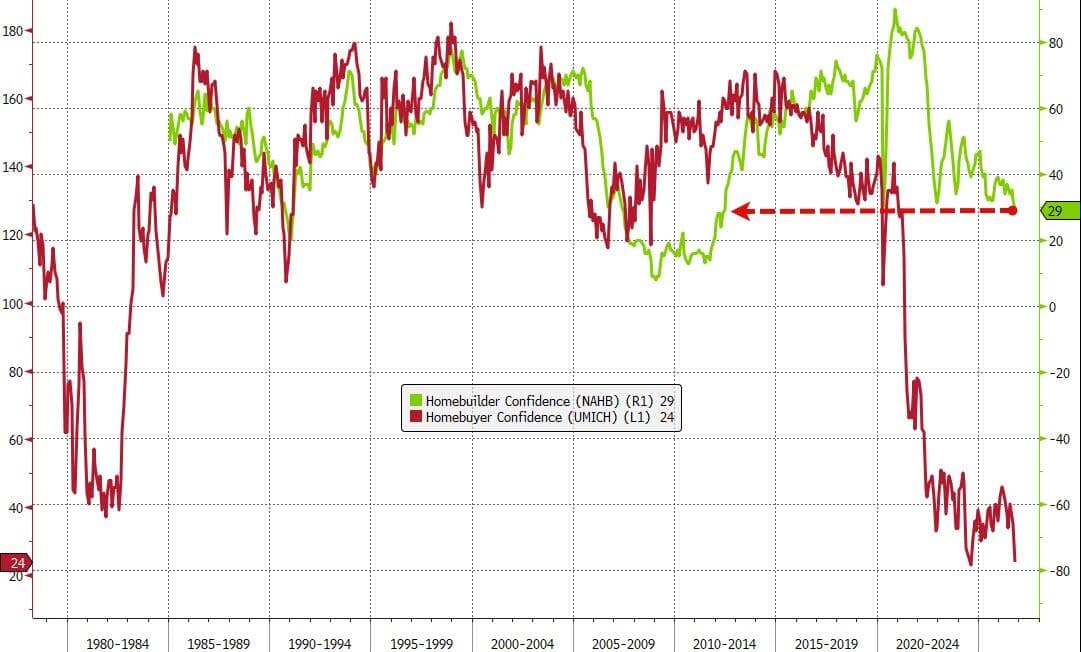
It has never looked this bad during the decades in which it has been tracked. When the confidence of homebuyers and homebuilders ebbs this much, naturally builders don’t build, and that brings huge job losses because home construction is the dominant economic engine of the US economy:
...it should be no surprise that homebuilders are unwilling to Start building (Housing Starts -5.2% MoM in September and August revised down to a 5.9% MoM plunge).
Things haven’t been this bad for housing since the market absolutely fell off a cliff during the Covid lockdowns:
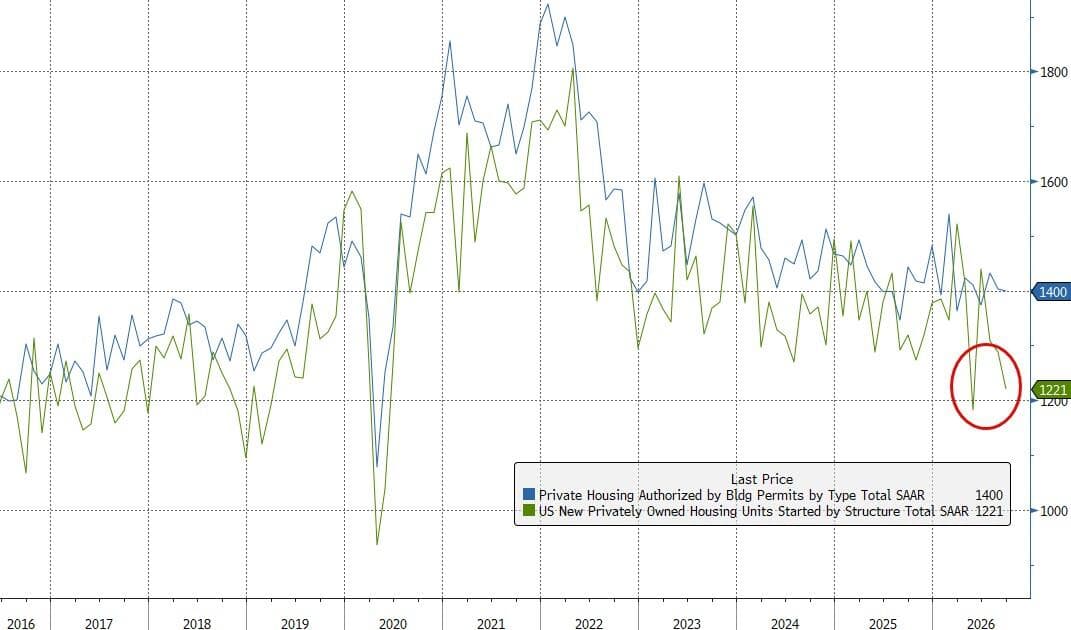
While that market saw a massive rush into a bizarre upsurge in sales and prices as soon as the Covid lockdowns ended the huge crash during a time of rock-bottom interest rates, there is no upsurge from some sudden economic reopening coming this time. No great reopening is going to save things in 2027.
When you shut off an entire economy with a throw of the main circuit breaker by decreeing it closed, you can restart much of it just by turning the power back on (ending the mandatory lockdowns, decreeing the economy reopened). That remedy doesn’t exist this time. This is not an artificial lockdown. This is years of horrible policies and profligate spending all crashing into itself. This is time to pay the piper on all those massive mountains of debt as debt reprices and time to pay the inflation from all of the past year’s war on oil and a time when all bubbles end in recession.
Good thing we stopped Iran from getting that nuclear bomb that they now swear they are working harder than ever to attain as quickly as possible. So much winning!
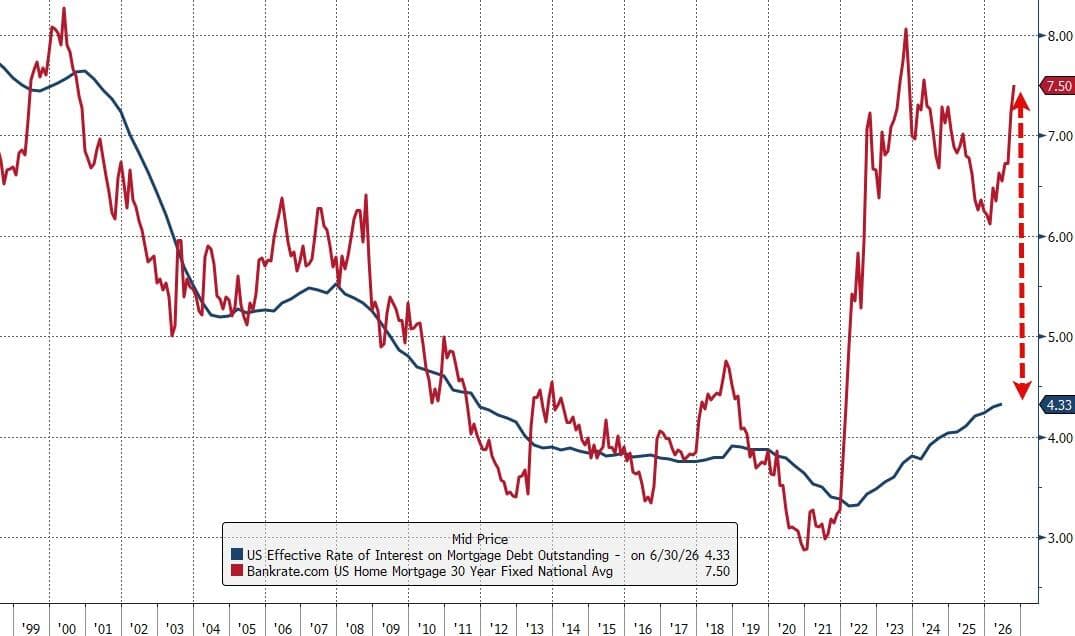
So, new mortgage rates are up, and the average rate of all outstanding mortgages in the US is back up to the level it was at during the last housing bust
With backed-up inventories of new homes sitting around on the market at levels where they were right at the start of the last mega housing bust in early 2008, there is not ANY incentive for builders to build more new homes:
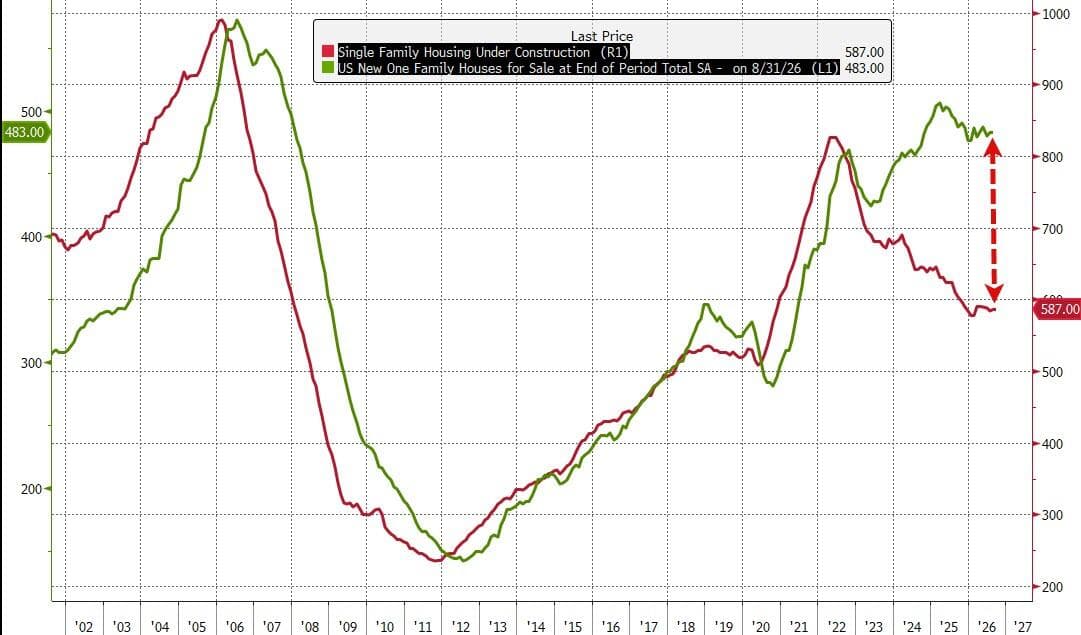
In summary: housing starts have collapsed to the lows last hit when people temporarily stopped buying homes during Covid. Homebuilder confidence has fallen off a cliff because builders are surrounded by those high mortgage rates that are keeping buyers at bay. The whole market is locked up around high mortgage interest. And that means the housing driven economy is coming down, too.
It’s not hard to predict where all of this going in 2027 because …
If you want to see the full coming picture become a paying supporter of The Daily Doom.
The president’s war against the economy
While the president’s tariff wars got ripped to shreds before they could do all the damage I said they would bring, thanks to the Supreme Court declaring them illegal, the president’s war against Iran isn’t going away. As usual, Iran, today, denied reports that a potentially workable deal is on the table.
Iran clarified, as it always has to in the face of endless lies, that the same deal as always is on the table—the one that demands total US surrender—total evacuation from the Hormuz region while guaranteeing total control over the Strait of Hormuz to Iran, and total reimbursement for all damages to Iran while Iran totally keeps all of its enriched uranium and the total end of all sanctions against Iran. Yes, THAT deal is still on the table and acceptable to Iran, as it always has been. There is no other deal on the table as far as Iran is concerned.
This all means that scorching oil prices are going to heat up inflation a lot higher in the months ahead, causing interest to go up more, causing all the problems above to get worse, not better. I have been underscoring this about the war from the very start, and it has always proven to be correct.
Meanwhile, Trump is depriving Ukraine of the purely defensive missiles it needs to defend itself from Putin’s attacks in order to twist Zelensky’s arm into surrendering in order to push some sort of perceived end to the Ukraine War in time for the midterm elections. That won’t happen that quickly; but Trump needs someone to blame for high fuel prices. Since Z is doing his part to raise prices by punishing Russia, Trump wants to move the entire focus onto Z as the fall guy. He’s throwing Zelensky under the bus because he wants to try to take some of the hot blame off of himself during the elections for all the inflation.
That is why Trump has returned to presenting false hopes of a deal with Iran. He may not be the one voicing those hopes today, but there can be little doubt about the sources of false information about new deals on the horizon. Barring the success of a new deal, Hegseth is in Israel today having discussion with PM Netanyahu, and Israel has said Trump nearly approved a plan to advance to full-on war again.
Of course, that has been Trump’s tactic time and again, wrongly believing every time that he could arm-wrench Iran’s leaders into making a desperate deal if he just threatens to erase their civilization entirely. It has never worked, as I keep saying it won’t; but it seems to be all Trump has short of accepting Iran’s terms of total surrender or going to all-out war to try desperately to bomb his way through to victory.
Iran’s mullahs are clearly determined to let him off with NO easy victory claims. He will crawl out of Iran with his tail between his legs as far as they are concerned because they seek intense revenge but also because they want to win something big from all of this: they want to humiliate America to such an extreme (like Vietnam did) that it will never try anything like this again and so that America gets out of the Persian Gulf. They have stated that clearly a number of times, as I have repeatedly pointed out faithfully along the way so that we know where this is going.
Another Great Recession in 2027
With AI stocks showing troubles, US bond market yields soaring, oil prices around $110/bbl and still climbing, general inflation now picking up speed again, gas and diesel more expensive than anytime in history, the war having little chance of an end in site, the housing market going into default, construction at a standstill, and auto loans going into default at dangerous levels, and GM’s stock plummeting today, we’re going into another Great Recession in 2027….
About the author


David Haggith is the publisher/editor-in-chief of The Daily Doom.
Economic, Social and Political News of Our Troubled Times -- a non-partisan daily collection of the most consequential stories about our complex times from multiple sources around the world plus daily editorials like the one you read here.
Liked it? Take a second to support David Haggith by subscribing on Substack!