Below are remarks I delivered during the Constitution Party’s National Committee Meeting in Evansville, Ind., on Nov. 13, 2026. Since my address focused on the incremental replacement of gold and silver with fiat currency, I’m sharing the presentation with my Substack subscribers and readers.
Good evening. This is by far the largest audience of Constitution supporters I’ve ever spoken to. And based on the dwindling number of Americans who support strict adherence to that monumental document, you’re a rare group.
Before I get started on my primary topic, I’m going to tell you a little about myself and why was I invited to speak to you on Friday the 13th. Just good luck, I guess.
I was invited, I suppose, because I’m an author and writer, and a native Hoosier who supports Constitutional principles, particularly as they relate to the nation’s money, and that other esteemed founding document, the Bill of Rights.
After gold and silver prices spiked last January, I published my latest book “Patient Millionaire.” To promote the financial memoir, I sent a press release to my hometown newspaper and other local papers in Dubois County, which is about an hour’s drive east of here. That’s where I was born and raised before I attended Indiana University and studied journalism in the early ’80s.
The press release I sent out contained this quote: “Most Americans don’t know that gold and silver are the only legal tender mentioned in the U.S. Constitution, the highest law of the land.”
As I understand it, someone affiliated with your organization read that quote and thought I’d be an appropriate, and hopefully worthy, guest speaker for this event.
Background & Upbringing
Growing up in Ferdinand, Ind., I gained an early interest in American history and money. I must have inherited the money part from my mother, who was an amateur coin collector. My parents were small business owners and managers in the late 1960s and ‘70s, and my mother was the bookkeeper and money handler. She also worked as a waitress for a time at a truck stop cafe in Dale, Ind., in the 1970s. I recall her sitting at the kitchen table after dinner, counting money and sifting through her tips and change looking for coins she needed for her collection. She also saved every dime, quarter and half-dollar that contained constitutional silver. That image is etched in my mind and memory.
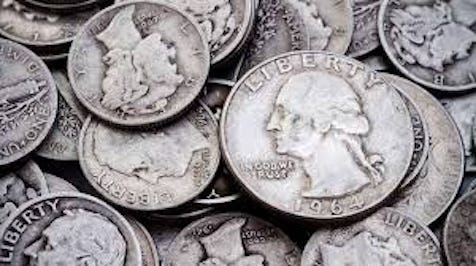
Prior to 1965, most U.S. coinage, including dimes and quarters, contained 90% silver.
As a child, I didn’t understand the significance of my mother saving silver. But as I grew older and studied American history, monetary policy and the Constitution, I came to appreciate my mother’s wisdom. She knew the value of silver coins would increase as the U.S. government stopped issuing them and they gradually stopped circulating as money. History proves she was right. The silver in a single 1964 Roosevelt dime today is worth about $4. That’s 40 times its face value, a respectable gain, though still far below the inflation rate over the last 62 years.
I actually acquired my first silver coin in 1974. As a kid, I collected U.S. postage stamps. I appreciated them for commemorating and depicting significant people, places and events since the nation’s founding. A buddy had a Morgan silver dollar he wanted to trade to start his own stamp collection. I agreed. With the trade, I acquired a fairly rare 1893 Morgan Silver Dollar minted in Carson City, Nevada. I gave the coin to my mother as a birthday gift. When she died in 2006, I inherited that coin as well her coin collection. I still have those treasured keepsakes.
Enough about my childhood and heirloom silver.
Let me tell you about my political and monetary awakening.
When I reached voting age in 1979, my interest in American history and politics grew. I was intrigued by the economic and monetary system as well. During my college years, like many young adults, I was an idealist and politically naïve. I believed government could solve humanity’s problems and ills. At the time, my political views aligned with those of the Democrat Party, which I’d been indoctrinated to believe was the party of the working class.
I soon had a political awakening. I discovered I’d been duped and misguided. I began to see the two-party system as flawed and a political duopoly, a uniparty some call it. I suppose many of you agree.
By the mid-1980s, my constitutional, libertarian and anti-Establishment views began to emerge. I started voting for third-party candidates whenever they appeared on the ballot. At the Idaho newspaper where I worked at the time, a colleague called me apolitical. I preferred being independent and non-partisan.
In 1988, I voted for Ron Paul, the Libertarian candidate. In 1992 and 1996, I voted for Ross Perot, the Reform Party candidate. I’ve since regularly voted for third-party candidates in protest to the entrenched political duopoly. I’m certain I voted for a Constitution Party candidate or two over the years.
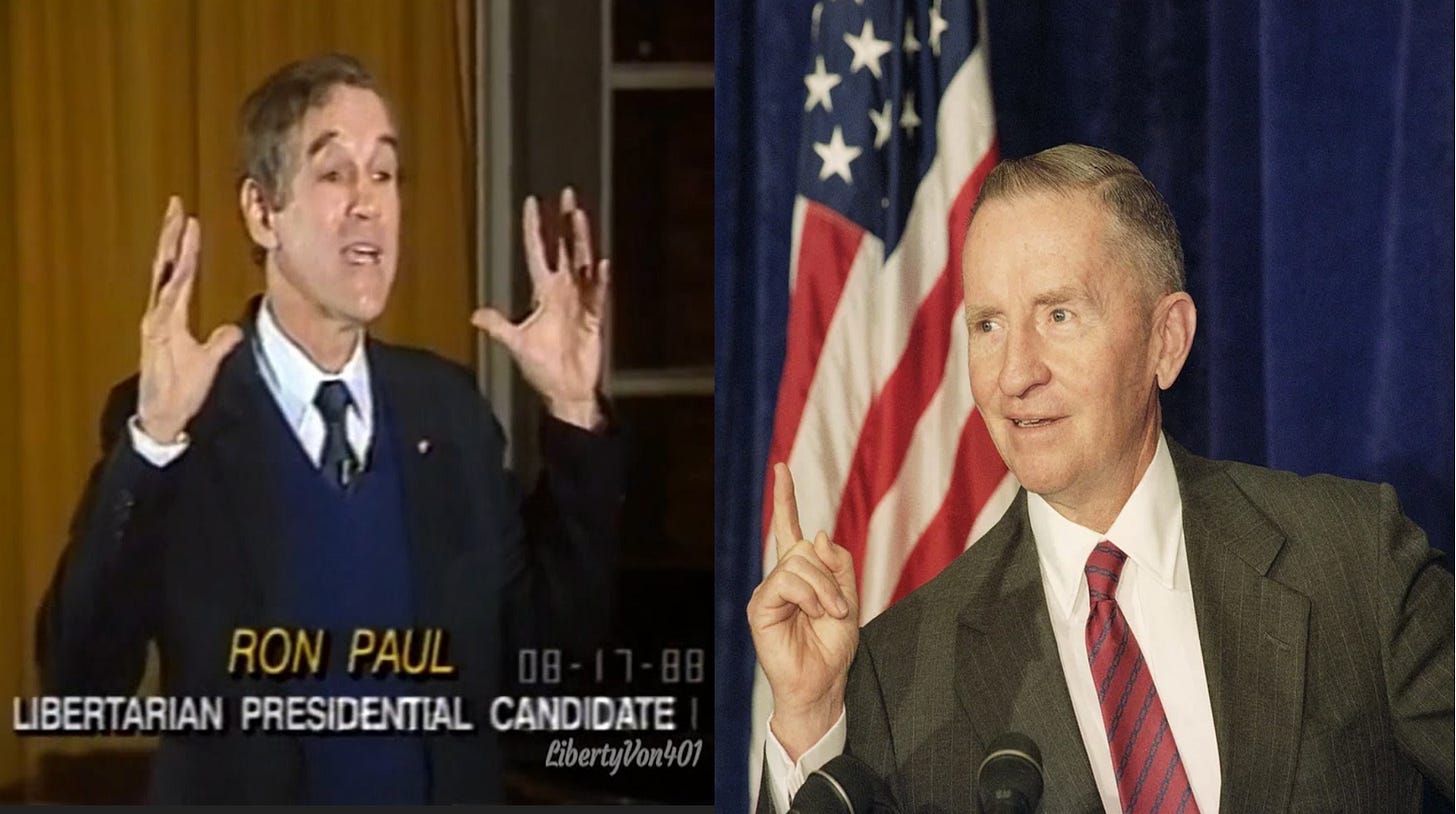
Presidential candidates Ron Paul and Ross Perot addressed the nation’s fiscal ills.
More than anyone, Ross Perot and Ron Paul enlightened me about the nation’s economic and financial system, particularly as it relates to the nation’s unchecked spending and borrowing, and the national debt. Both sent me on a decades-long quest for insight and knowledge about the nation’s money and monetary system. What I discovered wasn’t pretty. I found our currency and financial system are deceptive, defective and unsound. The racket involves corruption, fraud and collusion between the U.S. government and entrenched financial interests.
Deep Dive into Debt & Money
With the bursting of the dot-com bubble in the year 2000, my focus heightened on economic and financial issues. I questioned how the U.S. government, year after year, could spend billions more than it collected in tax revenue.
As I approached the age of 40, I began thinking about retirement. That’s when the national debt became a major concern of mine. I pondered whether Social Security would be solvent when I retired. If not, I decided I needed to find a way to secure my own retirement savings.
Beginning in 2005, I took a deep dive into debt and monetary issues. I read dozens of books and began researching the financial and monetary system. I also discovered the Gold Anti-Trust Action Committee, known as GATA. Since its founding in 1999, GATA has documented manipulation of precious metal markets and suppression of gold and silver prices.
In 2019, I asked GATA’s secretary/treasurer Chris Powell if he’d like to write a book about GATA’s findings. Since I’d previously self-published several of my own titles, I told him I would publish the book. He declined the offer, saying he was too busy posting daily dispatches on GATA’s website.
Based on my own research and GATA’s documentary evidence, I decided to write the book myself. “Rigged: Exposing the Largest Financial Fraud in History” was published in January 2020. Over the last seven years, nearly 4,000 copies have been sold across the United States and in 13 foreign countries.
The book concludes Western central and bullion banks, with the complicity of the U.S. government, have conspired to throttled precious metal prices for decades to defend the U.S. dollar as the world’s dominant currency. In the exposé, I explain the methods and mechanisms used since the 1960s and ‘70s to manipulate and suppress gold and silver prices, including the large volume of financial derivatives and paper contracts traded daily on precious metal exchanges.
In the book I also suggest the fraudulent scheme ultimately will come to an end when precious metal demand exceeds available supply, which is underway with mass accumulation of gold by central banks around the world and silver consumption by industrial users.
If you’re not aware, gold and silver prices hit all-time highs of $5,500 and $120 an ounce, respectively, last January, before being driven significantly lower through leveraged derivatives trading this summer and fall.
By the way, silver is in its sixth year of a structural deficit, meaning consumption is greater than mine production, so prices should be rising, not falling. That is, if prices weren’t managed and markets weren’t manipulated.
Now let me move on to the actual topic of my presentation.
The Abdication of Constitutional Money
As many of you know, and I’ve previously stated, gold and silver are the only money mentioned in the U.S. Constitution.
Article 1, Section 10, Clause 1, reads in part: “No State shall . . . make any Thing but gold and silver Coin a Tender in Payment of Debts.” That’s definitive language, and difficult to refute, though as with many constitutional provisions and principles, they’re too often forgotten, abandoned and violated. That’s happened with the nation’s money.
Not to be too technical, but tender is a synonym for currency, an official medium of exchange, or legal tender.
So why did the Constitution’s authors and proponents insist on such a definitive stipulation for gold and silver as money?
Well, some of the nation’s founders learned painful and valuable lessons about the perils and problems of unsound money. The fiat Continental currency authorized by the Continental Congress in 1775 were paper notes used to finance the American Revolution.
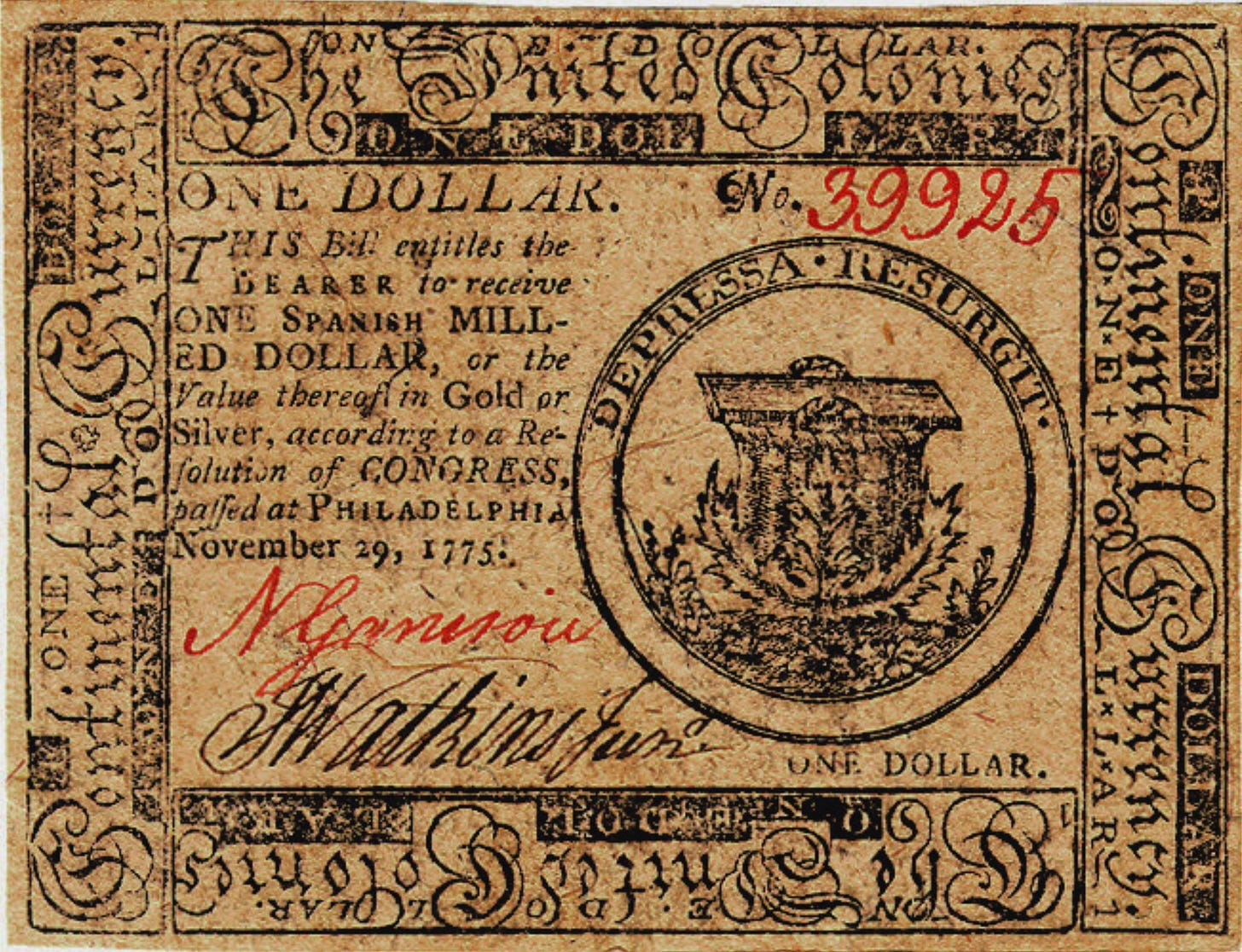
Issued in 1775, a Continental bill promises redemption in silver or gold.
This particulate note reads: “This bill entitles the bearer to receive one Spanish Milled Dollar, or the value thereof in Gold or Silver.” The problem was, the notes, or “bills of credit” as they were called, weren’t redeemable for gold or silver. Therefore, when they were printed and counterfeited in excess, they hyperinflated and rapidly lost value. Hence the phrase they inspired: “Not worth a Continental.”
Irate citizens, resentful soldiers and the prospects of an economic collapse caused a public and political backlash against the worthless currency. Some of the nation’s most prominent forefathers learned a hard and worthwhile lesson from the experience.
After the War of Independence was won, the nation was in debt. George Washington, Thomas Jefferson, Thomas Paine, James Madison and other patriots condemned unbacked paper currency and spoke out against it.
In his 1786 essay, “Dissertations on Government: The Affairs of the Bank and Paper Money,” Thomas Paine argued unbacked paper money was a form of state-sponsored counterfeiting. He believed fiat currency—or paper notes not backed by precious metals—destroyed public morality, cheated creditors, caused destructive inflation, and undermined representative government and personal liberty.
In a 1787 letter to the chancellor of Brown University, George Washington, the nation’s future and first president, wrote: “Paper money has had the effect in your state that it will ever have, to ruin commerce, oppress the honest, and open the door to every species of fraud and injustice.” That’s quite an indictment of fiat currency, and very relevant today.
In a 1788 letter to a fellow Virginia planter and patriot, Thomas Jefferson, chief author of the Declaration of Independence, said: “Paper is poverty, that is only the ghost of money, and not money itself.” He preferred gold and silver, or hard currency, as money.
In 1813, after his retirement as the nation’s third president, Jefferson wrote to his son-in-law. He said: “The trifling economy of paper, as a cheaper medium, or its convenience for transmission, weighs nothing in opposition to the advantages of the precious metals . . . “[Paper currency] is liable to be abused, has been, is, and forever will be abused, in every country in which it is permitted.”
Based on the historic record of unredeemable, government-decreed paper currencies, Jefferson’s words were accurate and profound.
James Madison, the principal architect of the U.S. Constitution, shared similar views about fiat currency and hard money. That’s why he advocated for a bimetallic money standard and championed gold and silver as the basis of the nation’s currency system. His efforts succeeded and resulted in adoption of Article 1, Section 10, Clause 1, mentioned prior, which prohibits the states from making anything but gold and silver tender for payment of debts.
The article’s primary shortcoming was this: The gold and silver requirement only applied to the state governments, not the federal government, the Supreme Court ruled in 1871. I’ll address that in more detail a little later.
Furthermore, Article 1, Section 8, Clause 5 of the Constitution gives Congress the exclusive power “to coin money” and “regulate the value thereof.” Notice the clause grants the power to coin money. It doesn’t say print money. In addition, Clauses 1 and 2 of that section give the federal government the power to tax, spend and borrow money. Therefore, the U.S. government could coin, tax, spend and borrow as long as gold and silver were the nation’s money.
Thus, when Congress over the years passed legislation abandoning gold and silver as money, the ability of the states to make “anything but gold and silver tender for payment of debts” was usurped. This nullified the constitutional provision and abdicated sound, stable constitutional money.
The good news was the nation’s founders supported gold and silver as the nation’s money with passage of the Coinage Act of 1792. The law authorized creation of the U.S. Mint in Philadelphia, and the issuance of gold, silver and copper coins. The Mint’s first gold coin was released in 1795.
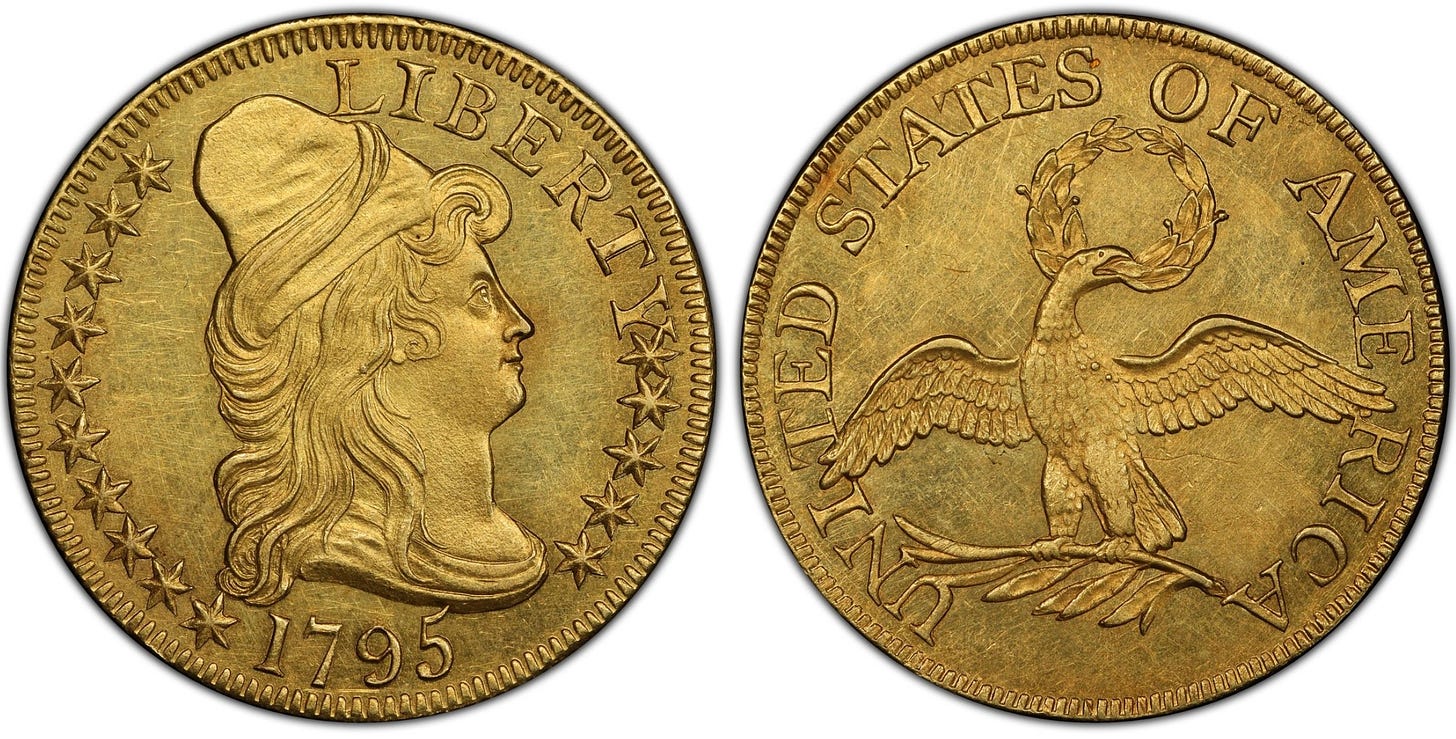
Lady Liberty and a bald eagle were featured on the U.S. Mint’s first gold coin.
By the way, the U.S. dollar was based on the Spanish silver dollar or pieces of eight, which circulated in the American colonies as money. In fact, the Spanish silver dollar remained legal tender in the United States until the Coinage Act of 1857 was passed.
So how and why did the nation and states stray so far from the founders’ firm, principled position of silver and gold as money? Well, the process was both gradual and insidious. It occurred incrementally over the previous two centuries. And, as always, the monied interests, with the cooperation of elected and unelected federal officials, were behind the rejection and abandonment of sound, constitutional money.
Like the founders, President Andrew Jackson also preferred coined money over paper notes. But after Jackson slayed the Second Bank of the United States in 1832 and retired the national debt in 1835, sound money and sound fiscal policy soon were discarded with the onset of a series of financial panics and bank runs in the 19th century, not to mention the proliferation of fiat currency and financial turmoil during the American Civil War.
In fact, both the North and South relied heavily on unbacked paper currencies to fund their armies and wartime operations. The North issued Greenbacks. President Abraham Lincoln, who spent his formative years in a log cabin 40 miles east of here, appears on the front of this paper note.
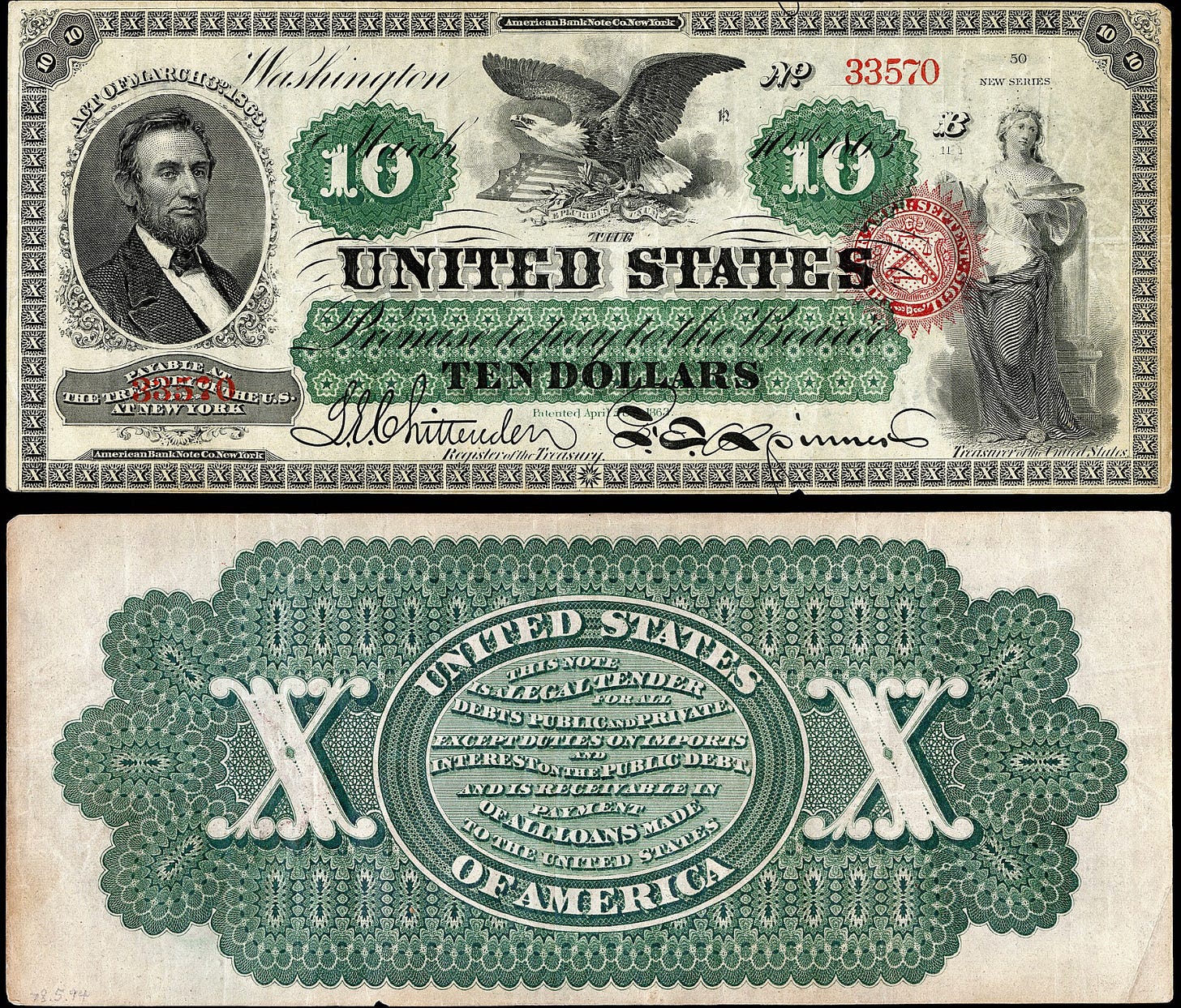
Issued during the Civil War, unbacked Greenbacks were fiat currency notes.
On the reverse it reads: “This note is legal tender for all debts public and private, except duties on imports and interest on the public debt . . . ” That’s because the money lenders insisted the interest they collected be paid in gold rather than depreciating paper notes. Average citizens, however, had to accept the debased fiat currency as legal tender.
The South, meanwhile, issued its own unbacked Graybacks. These too were fiat currency, not redeemable for gold or silver.
I think it’s important to state this now: War, fiat currencies and public debt go together like bayonets and blood, paper promises and price inflation, death and indebtedness. Let that sink in. That’s why financial interests and war profiteers support perpetual armed conflict and warfare. Read Maj. Gen. Smedley Butler’s “War Is a Racket” if you need proof of that.
While President Lincoln relied on fiat currency to win the war and preserve the Union, he also increased the national debt by over 2800%. After the war ended, Lincoln, who previously opposed Andrew Jackson’s hard money policies, realized gold and silver were needed to repay the $2.7 billion national debt that he helped incur.
On April 14, 1865, a few hours before Lincoln was assassinated, the president reportedly told Indiana Rep. Schuyler Colfax: “Now that the rebellion is overthrown, and we know pretty nearly the amount of our national debt, the more gold and silver we mine makes the payment of that debt so much easier.” By the way, Colfax at the time was due to depart for mining districts in the resource-rich West.
Lincoln was correct; silver and gold mined in the West could discharge—or at least reduce—the nation’s wartime debts. But reducing and eliminating debt isn’t and wasn’t in the financial interest of the money lenders. Creditors can’t profit without borrowers and debtors, and major 19th-century silver discoveries in the West threatened to reduce the interest income of the banks and financiers if private and public debts were repaid in plentiful silver.
Following the 1858 Comstock Lode discovery in Nevada, other major silver strikes and rushes occurred across the West in the 1860s & ’70s. Hundreds of millions of ounces of silver flowed from mines in California, Idaho, Utah, Colorado, New Mexico, Montana and Arizona during the mid-to-late 19th century.
With a surplus of silver available, and abundant silver coinage in circulation, borrowers such as farmers and the working poor could pay off their debts more easily, which was disadvantageous and unfavorable to the banks and creditors who opposed deflationary monetary policies. So American and European banking and financial interests convinced U.S. government officials to demonetize silver, the nation’s foundational and Constitutional money.
That was accomplished when President Ulysses S. Grant signed the Coinage Act of 1873, which intentionally omitted the standard U.S. silver dollar, allowing the U.S. Mint to halt production of the silver coins. The act effectively demonetized silver and abolished the bimetallic standard established by the nation’s founders a century earlier.
Opponents dubbed the law the Crime of ’73 because it prohibited the U.S. Mint from accepting private silver bullion from miners to mint into silver coinage. This created a de facto national gold standard sought by domestic and foreign financial interests who could more easily control the supply and value of money by reducing the amount of silver dollars in circulation.
The controversial law set the stage for a showdown between gold advocates, known as gold bugs, and silver proponents or Silverites. What resulted was a heated, decades-long feud and series of subsequent laws aimed at appeasing both sides by remonetizing silver and restoring bimetallism while limiting the number of silver coins minted and released into circulation.
The gold bugs ultimately won when President William McKinley signed the Gold Standard Act of 1900, which created a national gold standard and put the final kibosh on the Free Silver Movement.
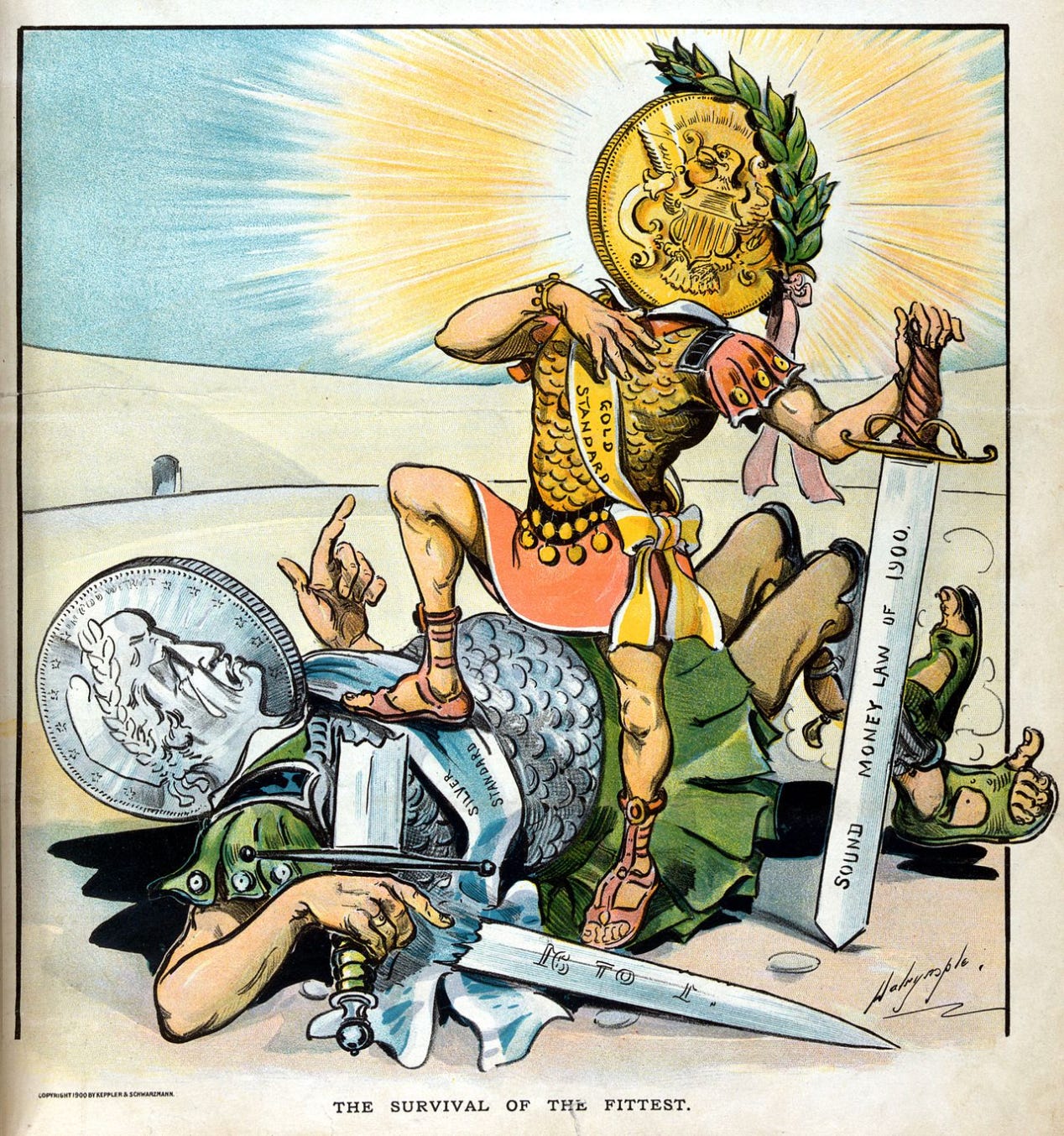
The gold standard triumphs over the silver standard in this colorful 1900 illustration.
In this political cartoon, gold slays the silver standard. Bimetallism was dead, silver was demoted and ultimately removed from the nation’s coinage in the 1960s and ’70s. The score was: One down, one to go, in abandoning constitutional money.
Children’s Story Reveals Monetary Allegory
How many of you are familiar with “The Wonderful Wizard of Oz” story? Did you know the 19th-century silver-gold feud is immortalized in the 1900 allegorical children’s novel by L. Frank Baum? In the original book, Dorothy’s magical slippers are silver—not ruby as in the TV version—and the yellow brick road represents gold bricks or bars. The brainless scarecrow represents the farmers, and the heartless tinman, the industrial workers.
The Cowardly Lion symbolizes William Jennings Bryan, the presidential candidate who supported both silver and gold as money. The Free Silver proponent roared loudly in his famous “Cross of Gold” speech, delivered during the 1896 Democratic National Convention.
“You shall not press down upon the brow of labor this crown of thorns, you shall not crucify mankind upon a cross of gold,” Bryan bellowed.
While his powerful rhetoric secured his party’s nomination, his political oratory was greater than his bite. As a politician, he couldn’t defeat the powerful East and West Coast banking cabal represented by the evil witches. Sound familiar? Even then, the banks were too big to fail.
Oz, incidentally, is the abbreviation of an ounce. The good witches in the metaphorical tale represent the angelic guardians of the working-class citizens and laborers of the North and South during the period. The wizard or conman behind the curtain pulling the levers of power represents the central planners, propagandists and financiers who create a captivating illusion while maintaining covert control over our money and the citizenry, which unfortunately has been bestowed upon them by our accommodating politicians.
It’s past time to pull back the curtain.
Beyond the allegorical intrigue, the Supreme Court dealt two severe blows to the nation’s hard currency and sound money policies during the late 19th century. In 1871, the high court ruled in favor of fiat currency, deciding the U.S. government could issue paper notes as legal tender without precious metal backing. Furthermore, in 1884 the court decided Congress could authorize the issuance of legal tender notes even during peacetime, which cemented the constitutional basis for the proliferation of fiat currency, and paved the way for unrestricted government expansion and indebtedness.
In 1913, Congress further paved the path to unsound finance, financial ruin and servitude by creating the Federal Reserve, the nation’s third and current central bank, which can conjure credit and fiat currency out of thin air. Also in 1913, the states ratified and Congress authorized a federal income tax so Americans could pay interest on the public debt during war or peacetime.
Two additional political actions in the 20th century eliminated gold as money and transitioned the United States to a fully fiat monetary system. During the Great Depression in 1933, President Franklin D. Roosevelt issued an executive order that required citizens to surrender their gold coins, bars and certificates to the Federal Reserve banks. Violators faced up to a $10,000 fine and/or 10 years in prison. The presidential decree later was codified into law, which demonetized gold domestically.
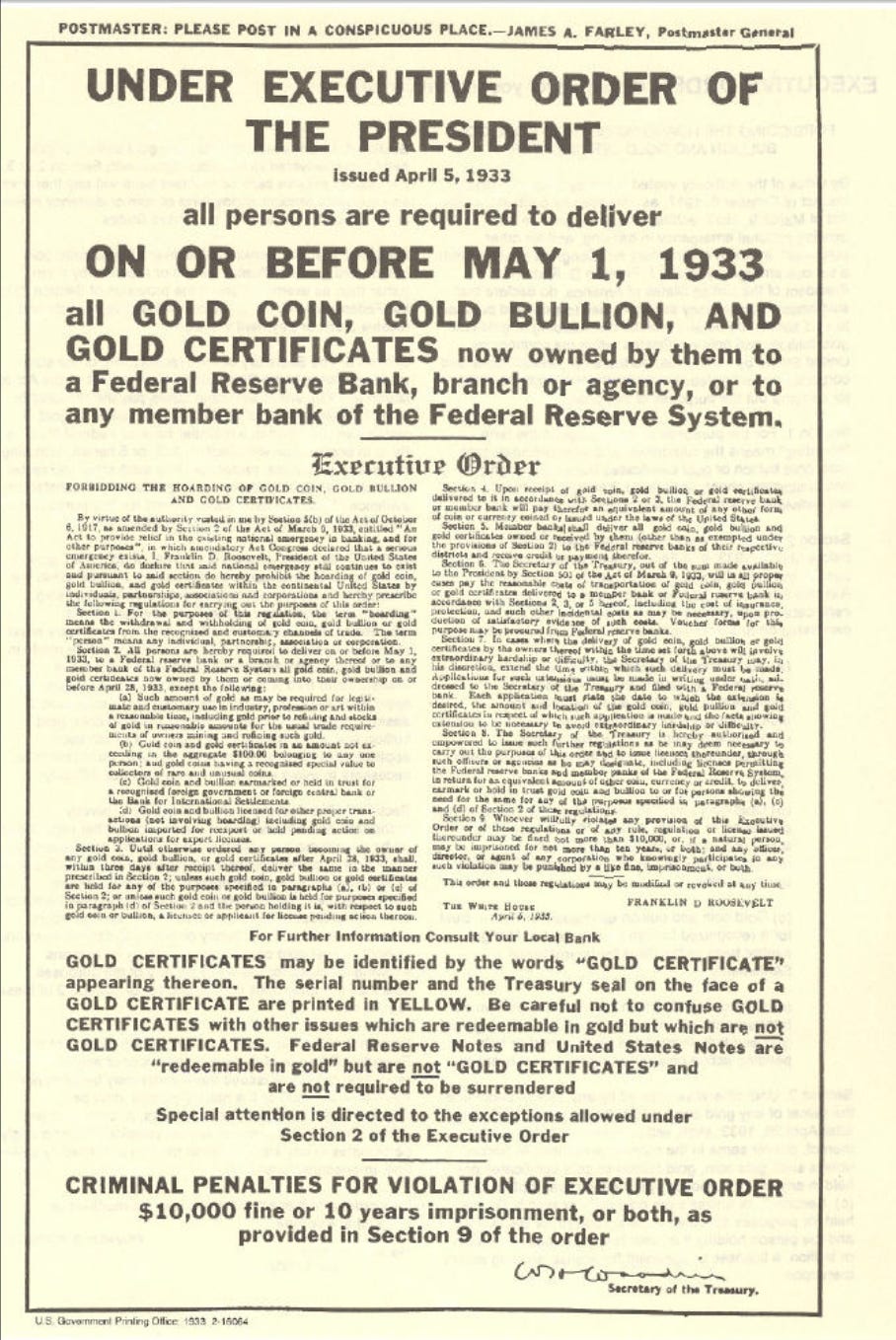
President Roosevelt’s 1933 executive order demonetized gold domestically.
Five decades later, President Richard Nixon severed the dollar’s monetary ties to gold internationally. In 1971, Nixon ordered the Treasury to stop exchanging gold for dollars with foreign nations. In his broadcast address to the nation, the president of later Watergate fame claimed the suspension was “temporary,” but as we know, it’s been permanent ever since.
That reminds me of a Milton Friedman quote: “Nothing is so permanent as a temporary government program.”
By the way, Nixon’s monetary hocus-pocus makes his nickname seem appropriate. Tricky Dick’s decision to demonetize gold at the global level allowed further credit expansion and massive debt accumulation, which has been ongoing ever since.
Excessive credit and currency creation debase the dollar and contribute to price inflation. The result is the loss of the currency’s purchasing power. The dollar, as we all know, buys less and less with each passing year.
Since 1971, Congress has raised the so-called federal debt ceiling more than 60 times, indicating the ceiling has no discernible roof. Moreover, fiat currency has allowed the national debt to balloon a whopping 10,000 percent in the last 55 years, from $389 billion in 1971 to over $40 trillion today.
Fiat currency poses more than an American debt problem, however. The burden is international in scope. Global debt totals $350 trillion today thanks to the fiat monetary system.
A Mutually Beneficial Partnership & Fiat Dependency
How does public debt happen? In the U.S., the government and financial interests, led by the lender of last resort, the Federal Reserve, have a symbiotic relationship. They play good cop/bad cop, pointing fingers at one another, much like the Democrat and Republican parties, but truth be told, they’re in cahoots. They’re co-dependent. They need one another to distract the citizenry and voters with political clashes and social disputes from the important financial issues and fiscal problems facing the nation.
You might ask: Why haven’t the states and citizens held the federal government accountable for its depreciating, failing currency and demanded sound, constitutional money? The simple answer: The states and citizens are dependent on federal revenue sharing grants and financial assistance for health and medical care, roads and transportation, education and welfare funds, and disaster relief.
When the nation was founded, the idea was that a unified confederation of states would support a limited central government. But as the federal government grew larger, and assumed more responsibility, power and control, the states relied more and more on the federal government to spend and borrow on their behalf.
The transition advanced greatly during the Great Depression. That’s when the federal government basically confiscated the public’s gold, or at least coerced it from the citizenry, ended the domestic gold standard, and greatly expanded its role and “socialistic” programs.
During the extended economic downturn, the struggling states and citizenry grew dependent on the federal largess, programs, handouts and jobs. Now the states and citizens are addicted and reliant on an indebted and profligate Uncle Sam, just like the nearly 200 foreign nations that receive U.S. aid.
Since World War II, more and more countries have grown dependent on foreign aid. Many nations are addicted to the U.S. dollar and the United States wants it that way. Widespread circulation of the U.S. dollar allows the currency to retain its role as the dominant global trade and reserve currency. Once again, a co-dependent and symbiotic relationship exists between the U.S. and the world.
The federal government could create its own interest-free money backed by gold and silver. Instead, it borrows and pays interest to its debt buyers and money lenders to maintain and sustain the fiat dollar.
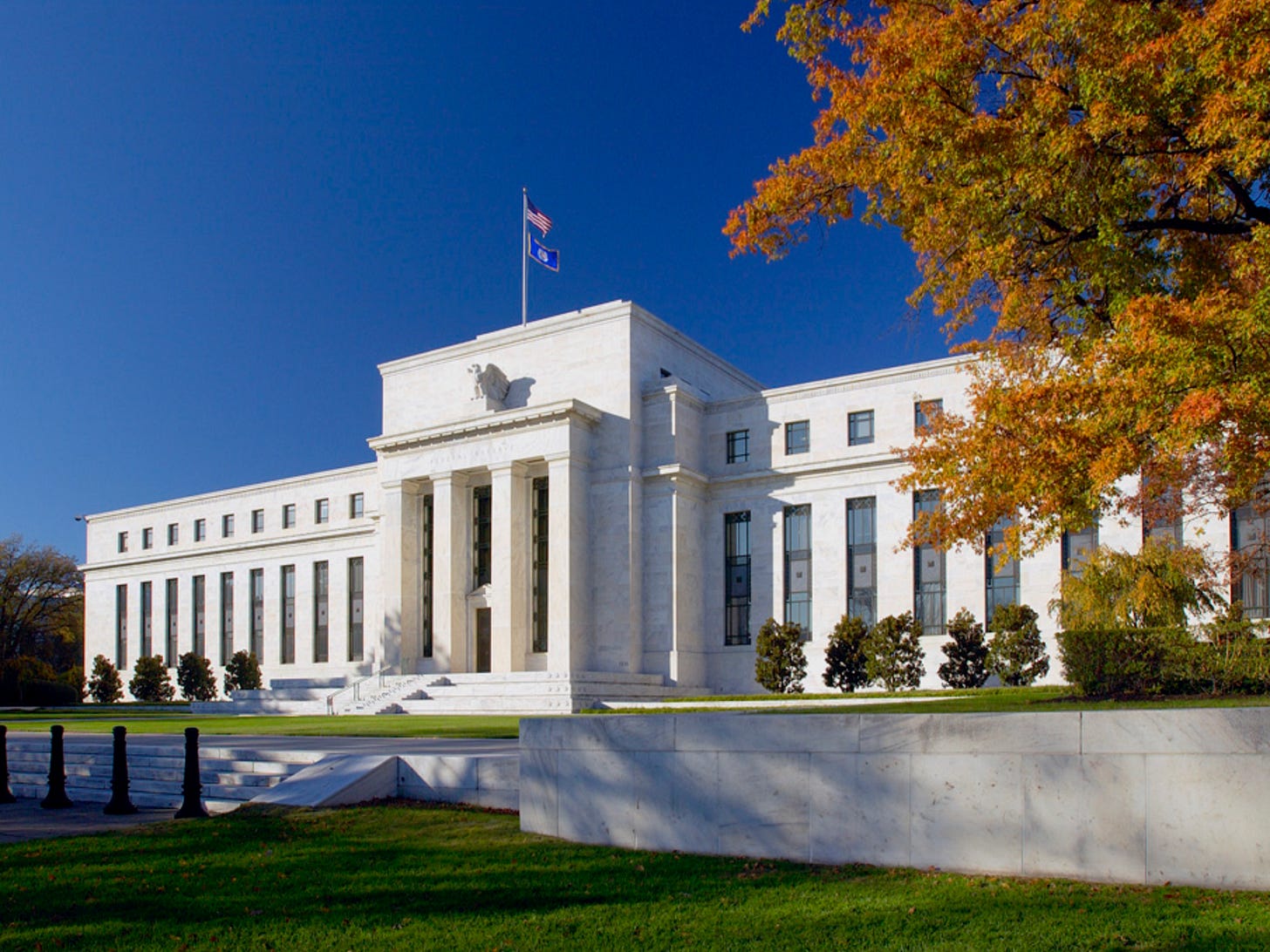
By conjuring currency, the Federal Reserve supports the fiat U.S. dollar.
The Federal Reserve creates all the fiat currency the politicians in Washington, D.C., want and need to keep their campaign donors, the states and foreign governments satisfied. It’s a mutually beneficial relationship. If limits existed on currency creation and borrowing, the politicians might have to reduce spending and assume fiscal responsibility for the nation’s runaway debt and unfunded liabilities.
As I suggested, the abdication of constitutional money was both gradual and insidious. While the abandonment of gold and silver as money helped the United States emerge as the world’s wealthiest nation in the 20th century, it also has resulted in the United States becoming the world’s largest debtor nation. Much of our wealth is based on credit and debt, not physical constitutional money as envisioned and advocated by the nation’s foremost forefathers.
In summary, creditors want to lend and politicians want to spend. Constitutional money was abandoned because it restricted borrowing and spending to the amount of gold and silver that could be extracted from the Earth.
And since gold and silver supplies are finite—unlike fiat paper and digital currencies—precious metals limit borrowing, deficit spending and economic growth, at least at officially suppressed government prices. Therefore, lenders and most contemporary politicians prefer unredeemable fiat currency, which they use to expand and stimulate the economy, and boost bank and corporate profits.
The problem is government-mandated fiat always results in currency debasement, price inflation and burgeoning debt. Over time, these factors undermine and weaken economic expansion and growth, which requires evermore credit creation and debt accumulation in a revolving cycle, until the depreciated currency loses its value and public trust, just like the worthless Continental and hundreds of other failed and defunct currencies throughout world history.
Currency decay and fiat failure are the predictable and unavoidable consequence of abandoning constitutional money.
© 2026 Stuart Englert. All rights reserved.
Englert is the author of “Rigged: Exposing the Largest Financial Fraud in History” and “Patient Millionaire: A Financial Memoir.”
About the author
