
Equating gold with financial independence has been a tenet of sound money advocates for more than two centuries.
“Gold is freedom” is the common refrain.
If gold is an instrument of economic autonomy and fiscal liberation, debt-based fiat currency is a tool of financial servitude and enslavement, since nearly every U.S. dollar is loaned and borrowed into existence, creating ever-larger financial liabilities and obligations for debtors and government taxpayers to repay.
Such wisdom is largely forgotten or unknown by Americans accustomed to easy credit and unbacked dollars their entire lives, especially those with little to no understanding of the primary cause of price inflation: excessive credit and fiat currency creation. Fiat currency is government-mandated money not backed by gold or silver.
Precious Metals Can Discharge Debt & Prevent Peonage
Gold and silver have provided financial independence and wealth preservation since their use as money at least 2,500 years ago. That’s because precious metals can be used to discharge debt, and to free individuals and families from financial obligations, creditor subjugation and usury, historically any interest charged on a loan.
Debt as an instrument of financial enslavement and human bondage is as old or older than money itself. In ancient times, if a farmer or herdsman negotiated an advance on his crops or flocks and failed to make payments in grain or livestock, his spouse and their offspring could be forced into debt peonage.
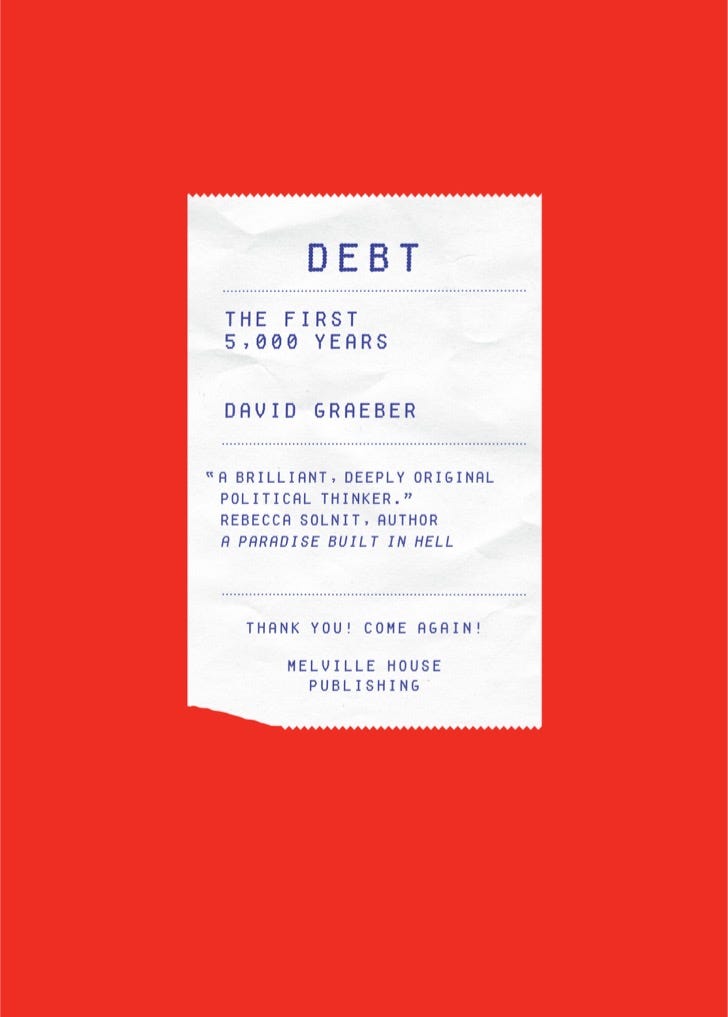
David Graeber’s book explores the ancient history and debate about credit and debt.
“Everything changed the moment he took out a loan,” anthropologist David Graeber explained in his 2011 book, “Debt: The First 5,000 Years.” “Since if he did, it was perfectly legal . . . to use his wife and children as surety.”
Human bondage demonstrated the immorality of punitive loans and the degradation of indebtedness. It also discouraged excessive and frivolous borrowing, and likely dissuaded productive providers from accepting the shackles of financial servitude for themselves and possible debt bondage for their family members.
Contrasting Debt Deprivation with Economic Autonomy
Through the ages, astute economists, pragmatic politicians and insightful intellectuals have recognized the deprivations of debt and debt-based currencies. They’ve also recognized the advantages of precious metals to ensure financial freedom, and provide personal benefits and blessings.
President Thomas Jefferson supported physical gold and silver over paper fiat currency, which he dubbed “the ghost of money.” He also opposed public indebtedness, which he knew would result in oppressive taxation and subjugation of the citizenry.
“To preserve [the] independence [of the people], we must not let our rulers load us with perpetual debt,” Jefferson wrote in a July 12, 1816, letter to author and lawyer Samuel Kercheval. “We must make our election between economy and liberty, or profusion and servitude.”
Ironically, when Jefferson, chief author of the Declaration of Independence, died on July 4, 1826, his personal debts totaled $107,000, which required the sale of his Monticello estate in Virginia.
Other intellectual luminaries shared Jefferson’s views on independence and self-reliance, even if they didn’t endorse his slave ownership or lavish lifestyle.
 Ralph Waldo Emerson believed indebtedness diminishes economic autonomy.
“A man in debt is so far a slave,” wrote philosopher and poet Ralph Waldo Emerson in his 1841 essay titled “Wealth,” which noted how poverty demoralizes and indebtedness deprives an individual of economic autonomy.
Thirty years later, Emerson expounded on personal wealth, well-being and the human penchant for gold. “The desire of gold is not for gold,” he offered in his 1870 essay collection “Society and Solitude.” “It is for the means of freedom and benefit.”
Advocating Independence over Dependency
In the late 1940s and ’50s, Rep. Howard Buffett of Nebraska advocated for a return to the gold standard to restrain federal spending, monetary inflation and citizen dependency on government.
“In a free country the monetary unit rests upon a fixed foundation of gold or gold and silver independent of ruling politicians,” Buffett wrote in a 1948 article published in The Commercial & Financial Chronicle. “Our dollar was that kind of money before 1933. Under that system paper currency is redeemable for a certain weight of gold, at the free option and choice of the holder of paper money.”
The father of renowned investor Warren Buffett went on to equate gold ownership and redeemability with economic independence in the article titled “Human Freedom Rests on Gold Redeemable Money.”
“The redemption right gives money a large degree of stability,” the elder Buffet wrote. “The owner of such gold redeemable currency has economic independence. He can move around either within or without his country because his money holdings have accepted value anywhere.”
Detailing the Attributes of Gold & the Gold Standard
Two decades before assuming leadership of the nation’s central bank, Federal Reserve Chairman Alan Greenspan also espoused the gold standard, detailed the role of gold in a free society, and opined on the indivisible relationship between gold and economic freedom.
 Before heading the Federal Reserve for nearly 19 years, Alan Greenspan supported the gold standard, and declared gold and economic freedom are inseparable.
“Gold and economic freedom are inseparable,” Greenspan wrote in his 1966 essay “Gold and Economic Freedom,” which was published in Ayn Rand’s “Objectivist” newsletter.
“In the absence of the gold standard, there is no way to protect saving from confiscation through inflation,” he said. “There is no safe store of value. If there were, the government would have to make its holding illegal, as was done in the case of gold.”
Greenspan was referring to President Franklin Roosevelt’s 1933 executive order, which outlawed most private gold ownership in the United States. The prohibition was lifted by President Gerald Ford in 1974.
Greenspan also suggested “The financial policy of the welfare state requires that there is no way for the owners of wealth to protect themselves.”
“Deficit spending [by government] is simply a scheme for the confiscation of wealth,” he concluded. “Gold stands in the way of this insidious process. It stands as a protector of property rights. If one grasps this, one has no difficulty in understanding the statists’ antagonism toward the gold standard.”
Coincidentally, federal deficit spending went largely unabated while Greenspan served as Federal Reserve chairman between 1987 and 2006, and the national debt rose by nearly $6 trillion, or about 250 percent.
Like a ball and chain, statist central planners, profligate politicians and eternal indebtedness weigh down—and nullify—the loftiest of monetary ideals.
Americans Impoverished, Enslaved by Inflation and Taxes
A sound, stable currency is impossible with a fiat monetary system dependent on an ever-larger amount of credit and unpayable debt.
However, without continued credit expansion and borrowers assuming ever larger liabilities, the financial system and economy soon would collapse. Therefore, central bankers and politicians do what they must to prolong and sustain the fragile and untenable status quo.
Through deficit spending, fiscal legislation and interest rate policy, they enable and encourage credit- and debt-driven economic growth, which benefits the too-big-to-fail creditors and corporations at the expense of most taxpayers and wage-earners.
Since 90 percent of Americans are debtors, most are working in servitude to their creditors and the same monetary system that impoverishes and enslaves them through persistent inflation and onerous taxation.
Dollar debasement, perpetual indebtedness and monetary inflation have and continue to encourage public reliance on the government, prompting rising calls and increasing support for communism and socialism among the younger generations.
What most collectivist activists fail to recognize is the underlying cause of the financial struggles and woes of the masses: fiat currency and the flawed, debt-dependent monetary system, which promote wealth concentration and contribute to financial inequality.
Few American debtors, however, accept responsibility for their own financial distress. Despite economic hardships and rising prices, millions of debt-burdened borrowers continue to live beyond their means, consume more than they produce, re-elect spendthrift politicians and demand ever more from their corrupt, indebted government.
Only those who own and hold silver and gold, including the world’s central banks, seem to appreciate the financial freedom and protection precious metals offer over depreciating fiat currencies and self-imposed debt bondage.
© 2026 Stuart Englert. All rights reserved.
About the author
