
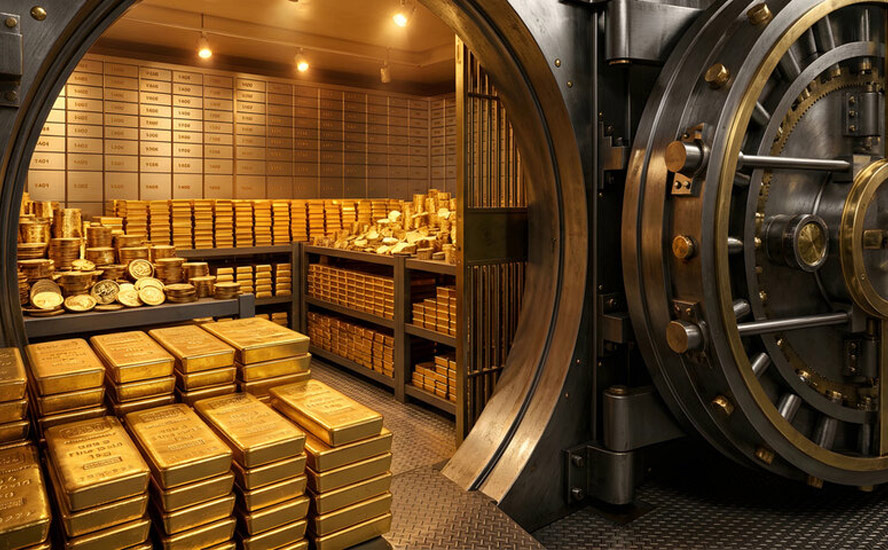
Unlike sovereign bonds or foreign currencies, physical gold held in a domestic vault is not a liability of another government.
Following the freezing of foreign exchange reserves during geopolitical conflicts, monetary authorities increasingly view U.S. Treasuries as vulnerable to political weaponization. According to The Conversation, 37% of surveyed central banks cite protection against foreign financial sanctions as a key driver for holding gold.
Central banks purchased an average of roughly 1,000 tonnes of gold annually between 2022 and 2024, followed by over 850 tonnes in 2025. This accumulation pushed total official gold holdings past 36,000 tonnes, marking a 50-year high.
Institutions are not only buying bullion but also moving it closer to home. Foreign gold stored at the New York Federal Reserve has fallen to its lowest level since 1957 following withdrawals by countries like France and the Netherlands.
While gold’s share of global reserves has surged, analysts offer differing interpretations on whether it is actively replacing U.S. Treasuries.
Data highlighted by the Financial Post shows that gold reached 27% of global central bank reserves by the end of 2025, surpassing U.S. Treasuries at 22% for the first time in roughly three decades.
A research note from the Federal Reserve argues that gold’s rising share is largely driven by market price appreciation rather than a mass liquidation of Treasury bonds. When excluding U.S. domestic gold reserves, foreign official holdings of U.S. Treasuries rebounded above non-U.S. gold reserves by mid-2026.
Gold pays no interest and lacks the deep daily settlement liquidity of the U.S. Treasury market. Most central banks continue to hold both assets, using Treasuries for active currency management and gold as a long-term geopolitical hedge.
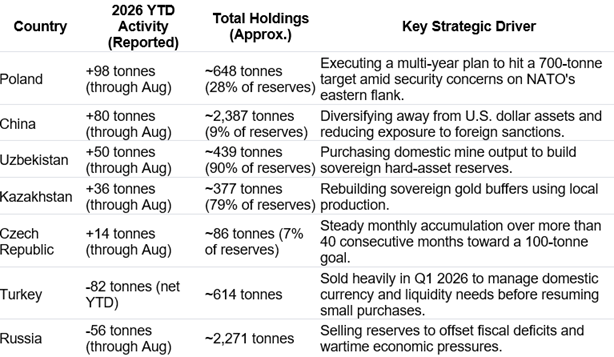
Data from the World Gold Council shows emerging-market central banks led by Poland and China continue to dominate official gold accumulation in 2026, while institutional investors have piled into gold ETFs even as high prices cooled Western retail bar and coin demand.
Official sector net purchases reached 675 tonnes through the first three quarters of 2026, driven by a sharp Q3 rebound of 321 tonnes. While most central banks are accumulating, a few nations sold reserves to manage domestic economic pressures.
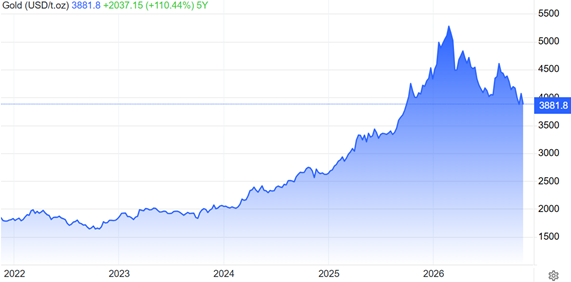
With gold prices trading near $4,000.00 an ounce, institutional and retail investors have taken diverging approaches to positioning.
According to World Gold Council ETF data, global physically backed gold ETFs added $41 billion (246 tonnes) during the first ten months of 2026, pushing total holdings to a record 4,275 tonnes.
European and Asian funds accounted for nearly 90% of global ETF inflows through October, led by funds in the UK and China. North American institutional investors reversed early-year outflows with a massive $12 billion inflow in Q3 ahead of Federal Reserve rate adjustments.
Institutional and sovereign wealth demand in the opaque OTC market remained elevated at 143 tonnes in Q3 2026, up 43% year-over-year, reflecting large block allocations outside public exchanges.
High spot prices—averaging over $4,260/oz in Q3—caused global physical bar and coin demand to drop 19% year-over-year to 268 tonnes. Western retail investors largely paused new purchases while waiting for price consolidation, leaving China as one of the few retail markets where physical bar and coin buying grew (+7% year-over-year).
Tier 1 money
Marketing pieces and macro commentators use “Tier 1 money” as a catchy shorthand to imply that global banking regulators have elevated physical gold to the exact same monetary and balance-sheet status as physical cash and sovereign bonds. While financial commentators frequently describe this as a “sweeping upgrade of gold to Tier 1 money,” banking analysts point out important distinctions between how regulators treat gold for capital adequacy versus short-term liquidity.
In the Basel framework, “Tier 1” refers exclusively to a bank’s core equity capital (liabilities), never to assets or forms of money. Gold is still excluded from Level 1 High-Quality Liquid Assets (HQLA) and cannot be used by commercial banks to meet short-term cash liquidity rules.
European and UK regulators implemented the Net Stable Funding Ratio (NSFR), which introduced strict funding requirements for unallocated (“paper”) gold while granting clearing exemptions for physical bullion backing client deposits.
(In major clearing hubs like London, regulators such as the UK Prudential Regulation Authority (PRA) introduced an interdependent precious metals exemption. If a clearing bank holds unencumbered physical gold on its balance sheet strictly to back customer precious metal deposits (such as for ETFs or clearing accounts), regulators can assign it a 0% RSF factor so it does not cripple daily market clearing.)
U.S. banking rules tied to the Basel III Endgame had a scheduled implementation date of July 1, 2025, reinforcing the treatment of unencumbered physical gold at 100% of its market value for core capital ratios rather than applying historical markdowns.
(When officials or economists discuss the U.S. “revaluing its gold,” they are referring to changing the U.S. Treasury’s statutory accounting price for the federal government’s sovereign gold reserves, not the Basel III banking rules for commercial banks. Under a 1973 law, the Treasury still carries this gold on its balance sheet at an outdated statutory price of $42.22 per ounce.)
The July 1, 2025, compliance date was part of the Federal Reserve, OCC, and FDIC’s July 2023Notice of Proposed Rulemaking(NPR) for the Basel III Endgame, following heavy banking industry pushback, U.S. regulators missed the July 1, 2025, start date. which never took effect as scheduled.
Rather than creating a new valuation boost for physical bullion, the Basel III Endgame proposals focus on market risk (the Fundamental Review of the Trading Book) and credit valuation adjustments (CVA). Those provisions strictly govern how banks model price volatility and counterparty risk on precious metals trading desks, derivatives, and unallocated bullion exposures—not a sudden revaluation of physical gold reserves.
On March 19, 2026, the Federal Reserve, OCC, and FDIC formally rescinded the 2023 proposal and issued a scaled-back re-proposal built around an Expanded Risk-Based Approach (ERBA).
As of late 2026, following the June 18, 2026, public comment deadline, U.S. banking agencies have still not set a final effective date for the revised rules.
Despite widespread headlines claiming gold is identical to U.S. Treasuries, regulators still do not classify gold as a High-Quality Liquid Asset (HQLA) for the 30-day Liquidity Coverage Ratio (LCR). Banks still rely on cash and sovereign bonds to meet short-term stress-test liquidity rules.
Despite sustained lobbying from bullion industry groups, there is currently no regulatory proposal or schedule to reclassify gold as a High-Quality Liquid Asset (HQLA). While gold satisfies almost every market-liquidity metric on paper, central bankers and banking supervisors face structural and policy incentives that make a near-term upgrade unlikely.
Industry bodies like the World Gold Council and the London Bullion Market Association (LBMA) actively campaign to designate gold as a Level 1 HQLA.
Their argument rests on several points:
- When the Basel Committee drafted the Liquidity Coverage Ratio (LCR) after the 2008 financial crisis, gold was initially included in 2013 but later dropped because regulators lacked transparent daily over-the-counter (OTC) trading data to calculate standard illiquidity ratios. Since 2018, mandatory LBMA trade reporting has eliminated that data gap.
- Global gold trading exceeds $120 billion daily with tight bid-ask spreads, rivaling or outperforming long-term U.S. Treasuries during periods of acute bond market stress.
- Physical bullion carries no default or counterparty risk, aligning with the core solvency criteria required for Level 1 assets.
- While moving physical bars across borders requires slow, expensive logistics, allocated bullion sitting inside certified London vaults allows banks and institutions to hold direct legal title to specific physical bars while transferring ownership instantaneously via book-entry.
Even with improved market data, the Basel Committee on Banking Supervision (BCBS) has kept gold excluded from HQLA lists across the U.S., EU, and UK. The BCBS has two reasons for denying HQLA status for gold:
- Level 1 HQLA rules currently compel commercial banks to hold massive buffers of cash and domestic government bonds. Elevating gold to Level 1 HQLA would allow banks to substitute bullion for sovereign debt, potentially raising borrowing costs for governments (United States, China, Japan, France, the United Kingdom, and Italy)running large deficits.
- HQLA rules prioritize assets that commercial banks can instantly pledge to a central bank’s discount window for emergency cash. Modern central banks generally do not accept physical gold from commercial banks in routine open-market liquidity operations. Modern central banks—such as the Federal Reserve, the Bank of Canada, and the European Central Bank—conduct routine open-market operations and discount window lending against sovereign debt (like U.S. Treasuries), not physical commodities.
Regulators in the U.S., UK, and EU have repeatedly delayed broader Basel III Endgame (Basel 3.1) rollouts into 2027 and beyond.
Gold’s real secular move has yet to even begin
If banking regulators ever classified physical gold as a Level 1 High-Quality Liquid Asset (HQLA), market analysts widely expect a sharp upward repricing.
Global commercial banks hold trillions of dollars in Level 1 HQLA (primarily central bank reserves and sovereign debt) to satisfy their Liquidity Coverage Ratio (LCR). Even a small portfolio reallocation—such as banks shifting 1% to 3% of their liquidity buffers into physical gold to diversify sovereign credit risk—would represent hundreds of billions of dollars in new institutional demand, dwarfing annual mine supply.
Under current Basel III Net Stable Funding Ratio (NSFR) rules, gold carries an 85% Required Stable Funding (RSF) factor, whereas Level 1 HQLA assets carry a 0% to 5% RSF factor. Reclassifying gold as Level 1 HQLA would slash the long-term funding cost of holding physical bullion on a bank’s balance sheet, making bullion desk operations and inventory financing vastly cheaper.
(Under Basel Standard NSF 30.31, all on-balance-sheet “physical traded commodities, including gold” carry the 85% RSF factor. Regulators apply this 85% charge to both the bank’s own physical bullion stock and its unallocated gold exposures.)
Level 1 HQLA assets are the lifeblood of the overnight repurchase (repo) and derivatives clearing markets. Granting gold Level 1 status would allow banks to pledge physical bullion as pristine, zero-haircut (or minimal-haircut) collateral for central bank liquidity facilities and interbank funding—transforming gold from an idle asset into active working collateral.
Here are the four primary forces that could compel regulators to grant gold High-Quality Liquid Asset (HQLA) status:
- The strongest catalyst would be a crisis where existing Level 1 assets—specifically government bonds—fail to provide safe, stable liquidity:
HQLA rules assume sovereign bonds will always hold their value and trade smoothly during stress. During events like the March 2023 U.S. regional banking crisis (where sharp rate hikes caused massive unrealized losses on bank Treasury holdings) and the April 2025 bond market volatility, gold held its value and maintained tight bid-ask spreads while sovereign bonds sold off.
If sovereign credit downgrades or fiscal deficits trigger a broader loss of confidence in major bond markets, banking regulators could be forced to add a neutral, non-sovereign asset to bank liquidity buffers so the entire banking system isn’t concentrated in a single point of failure.
- Central banks wear two hats: they manage national reserves, and they sit on the Basel Committee on Banking Supervision (BCBS) that writes commercial bank rules.
According to the World Gold Council 2026 Central Bank Survey, 89% of reserve managers expect global central bank gold holdings to keep rising. As central banks increasingly rely on gold for their own crisis liquidity and balance-sheet safety, denying commercial banks the right to count that exact same asset toward liquidity ratios becomes harder to justify.
In the European Union, one historical hurdle cited by the European Banking Authority (EBA) was that gold was not an eligible asset for standard central bank liquidity operations. If major central banks begin accepting allocated gold as standard collateral in their standing repo facilities, Level 1 HQLA recognition would naturally follow.
- When Basel III liquidity definitions were written between 2010 and 2013, regulators excluded gold largely because the over-the-counter (OTC) London bullion market lacked transparent, verifiable daily trading volume data.
Since 2019, the LBMA has published daily OTC trade reporting showing average daily gold trading volumes exceeding $229 billion—rivaling or surpassing several sovereign bond markets.
In March 2026, the World Gold Council and LBMA launched a joint HQLA advocacy initiative presenting empirical proof that gold satisfies every quantitative Basel HQLA requirement (low volatility, deep liquidity, and negative correlation to risk assets). Regulators typically only update HQLA lists during formal Basel framework reviews, meaning sustained lobbying backed by this multi-year dataset could force gold onto the agenda during the next regulatory cycle.
- As emerging market central banks (such as Poland, China, India, and Turkey) accumulate gold to reduce reliance on foreign fiat currencies, commercial banks facilitating trade across BRICS and Asian corridors face rising demand to hold and clear physical bullion.
Currently, the punitive 85% Required Stable Funding (RSF) rule discourages commercial banks from expanding bullion clearing capacity. If physical bullion becomes essential for settling cross-border trade outside Western bond markets, non-Western regulators (such as the People’s Bank of China or regional central banks) could unilaterally grant gold HQLA status within their domestic jurisdictions, pressuring Western regulators to follow suit to keep London and New York competitive.
Conclusion
Worsening U.S. fiscal metrics and ongoing reserve diversification are actively creating the exact structural conditions that could eventually push regulators to reconsider gold’s High-Quality Liquid Asset (HQLA) status, though it would likely require a severe bond market liquidity shock rather than slow fiscal drift alone.
The macro picture in late 2026 shows clear strain on the sovereign bond model that underpins current banking rules:
- The U.S. closed fiscal year 2026 with a $2.0 trillion deficit and gross national debt surpassing $40 trillion. Even more striking, October 2026 opened fiscal year 2027 with a record single-month deficit of $404 billion.
- Even with the Federal Reserve policy rate near 3.68% to 4.00%, 20-year and 30-year Treasury yields have pushed toward 5.5% as bond investors demand higher risk premiums to absorb heavy Treasury supply. Net federal interest payments now exceed $1.1 trillion annually, surpassing national defense spending.
- Central banks continue adding roughly 1,000 metric tons of gold annually. In 2025 and 2026, even major Western allies like France and the Netherlands repatriated or relocated tens of tonnes of bullion out of the New York Fed, while 74% of central banks surveyed by the World Gold Council expect the U.S. dollar’s share of global reserves to decline over the next five years.
Current Basel III rules assume that domestic government bonds are the ultimate risk-free liquid asset. As sovereign debt piles up, two pathways could break that assumption.
A Treasury Market Plumbing or Auction Crisis
If heavy Treasury issuance collides with foreign buyer pullbacks—triggering failed auctions, extreme yield spikes, or forced bank losses on bond portfolios—regulators face a systemic liquidity trap.
Just as the Federal Reserve created emergency lending facilities during the March 2023 regional banking crisis to accept underwater bonds at par, a severe sovereign debt liquidity crunch could force the Basel Committee to designate physical gold as a Level 1 HQLA so banks have a non-sovereign, zero-default-risk buffer that does not lose value when yields spike.
Regional Fragmentation Before Global Consensus
Because the U.S. Treasury and European finance ministries depend on HQLA rules to keep commercial banks buying government bonds, Western regulators have a strong fiscal incentive to delay gold HQLA approval.
However, central banks in Asia and the Middle East—which are actively building gold-backed trade settlement and bullion corridors—face no such constraint. If major Asian banking regulators unilaterally recognize allocated gold as HQLA to support regional trade finance, Western regulators could eventually be forced to match the rule to prevent bullion liquidity from migrating out of London and New York.
Despite these mounting pressures, no formal Basel Committee reclassification is currently scheduled. Regulators remain caught in a Catch-22: the worse U.S. and global fiscal deficits get, the more governments rely on captive bank demand to buy their bonds—and the more reluctant finance ministries become to let banks substitute gold for sovereign debt.
Until a crisis forces their hand, gold’s role will likely remain driven by central banks and private investors hedging against fiscal stress rather than commercial bank HQLA rules.
AOTH
aheadoftheherd.com

About the author

Richard (Rick) Mills

Legal Notice / Disclaimer
Ahead of the Herd newsletter, aheadoftheherd.com, hereafter known as AOTH.
Please read the entire Disclaimer carefully before you use this website or read the newsletter. If you do not agree to all the AOTH/Richard Mills Disclaimer, do not access/read this website/newsletter/article, or any of its pages. By reading/using this AOTH/Richard Mills website/newsletter/article, and whether or not you actually read this Disclaimer, you are deemed to have accepted it.
Any AOTH/Richard Mills document is not, and should not be, construed as an offer to sell or the solicitation of an offer to purchase or subscribe for any investment.