
Strengths
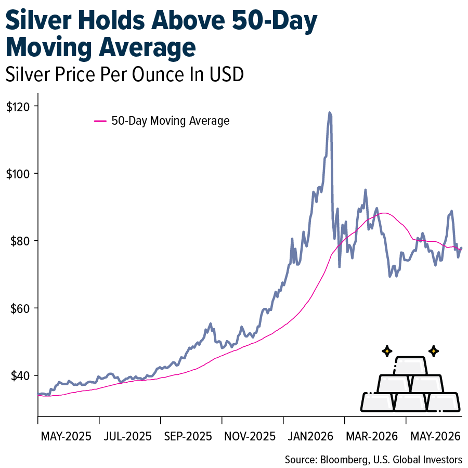
- The best relative precious metal for the past week was gold, although it was down 1.16%. Gold slipped to approximately $4,500 per ounce, down nearly 15% since the Iran conflict erupted, as traders shifted focus from safe-haven flows to the risk that a prolonged Strait of Hormuz closure keeps energy prices elevated and forces central banks to hike rather than cut rates. This marked a reversal from the rate-cut consensus that prevailed before late February. Silver has shown relative strength through the selloff, holding its 50-day moving average at $75.42, supported by dual tailwinds of industrial demand from solar and electronics, as well as its monetary-metal bid. This setup could allow silver to outperform gold if the macro regime tips toward the stagflationary outcome Citi flags as historically strong for precious metals.
- SSR Mining announced the sale of its 20% ownership stake in Hod Maden to Lidya Mines. In exchange, SSR Mining will receive a 4.0% net smelter return (NSR) royalty. Royal Gold has the option to purchase 2.0% of this royalty for $160 million until 12 months after commercial production, according to RBC.
- Net gold ETF inflows turned positive for the first time since early April, driven by North America ($824 million) and Europe ($180 million), according to BMO. Silver ETF inflows also surged to their highest level since late February, led by Europe, at 6.2 million ounces.
Weaknesses
- The worst-performing precious metal for the past week was palladium, down 4.77%. The U.S. imposed combined duties of more than 240% on Russian palladium, effectively shutting Nornickel's approximately 40% global market share out of American supply chains. Meanwhile, China absorbed record imports of 8.6 tons in April, nearly triple the seasonal average, as traders arbitraged the spread between Guangzhou futures and global spot prices rather than responding to any pickup in industrial demand.
- The latest first-quarter 2026 Platinum Quarterly highlights a shift back into surplus, with the market recording its first surplus in six quarters at 268,000 ounces. This was driven by an 18% year-over-year increase in total supply to 1.736 million ounces, with mine supply rebounding 22% YOY, recycling rising 7% YOY and total demand declining to 1.468 million ounces, driven by softer investment demand.
- Northern Star Resources CEO Stuart Tonkin will step down in the third quarter of 2026 after 10 years as CEO. Bank of America does not view the timing of the announcement, ahead of the company's multi-year outlook, as positive for investor sentiment. Bank of America expects the company to make an external appointment.
Opportunities
- Perpetua Resources secured a $2.9 billion loan from the Export-Import Bank of the United States (EXIM) under EXIM's “Make More in America” initiative, the largest loan yet under the program. The loan is intended to help the U.S. secure domestic access to critical minerals such as antimony from the Stibnite project, reducing reliance on Chinese exports and helping meet domestic demand.
- Johnson Matthey notes that “platinum is forecast to remain in deficit this year, despite the surplus recorded in the first quarter. Combined primary and secondary supplies are set to contract, with moderate growth in auto catalyst recoveries outweighed by lower jewelry recycling and weaker mine supply from South Africa. On the demand front, platinum has a broader base of applications than the other platinum group metals (PGMs), making it less vulnerable to downturns in any single sector.”
- Agnico Eagle Mines is approving development of Hope Bay. Capital expenditures are estimated at $2.4 billion, and the project generates a 26% internal rate of return (IRR) at $4,500 per ounce. The project will add 400,000 to 435,000 ounces per year starting in 2030, according to BMO. The initial 11-year mine life is based on 50% of the resource, which BMO expects to grow considerably. BMO sees this as a positive step in Agnico Eagle Mines' push to deliver 20% to 30% production growth over the next decade.
Threats
- Ghana asked large-scale gold miners to sell 30% of annual output to the central bank as part of a revamped reserve-building drive, Reuters reports. The amount producers would be asked to set aside compares with 20% currently.
- Johnson Matthey says that “demand for palladium is forecast to decline by 9% this year, with automotive use shrinking in line with a drop in internal combustion engine (ICE) vehicle production, industrial consumption flat and investment turning negative. Supplies are also expected to fall, as a sharp drop in Russian shipments more than offsets growth in auto catalyst recycling, but this may not be enough to prevent palladium from moving into a small surplus.”
- India has placed most silver imports under the “restricted” category with immediate effect, including silver bars, according to Reuters, as the government looks to curb imports and support the rupee. India meets more than 80% of its silver consumption through imports, with the newly restricted categories accounting for more than 90% of silver imports last fiscal year. The move follows last week's increase in gold and silver import duties to 15% from 6%.
About the author
