
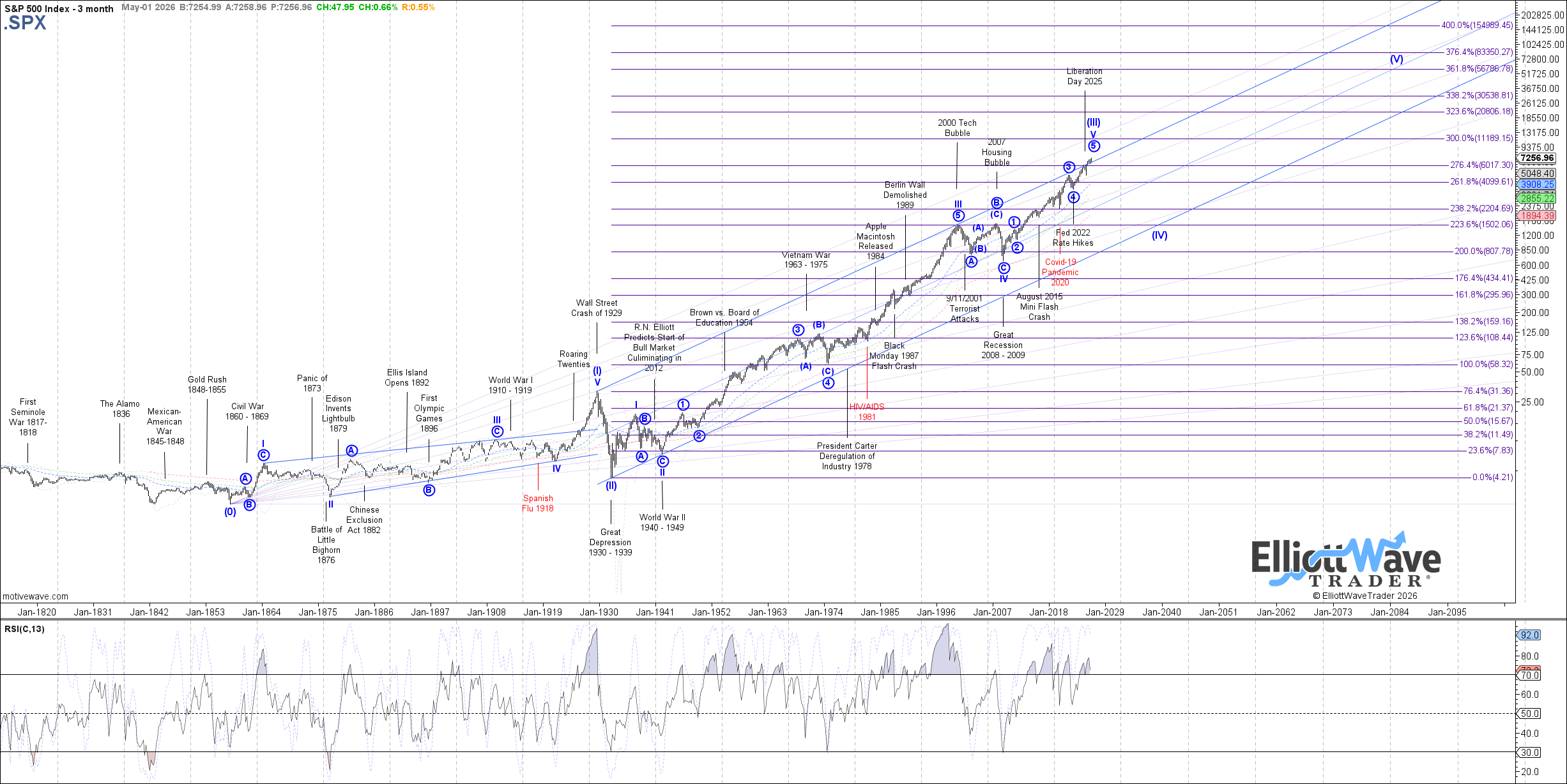
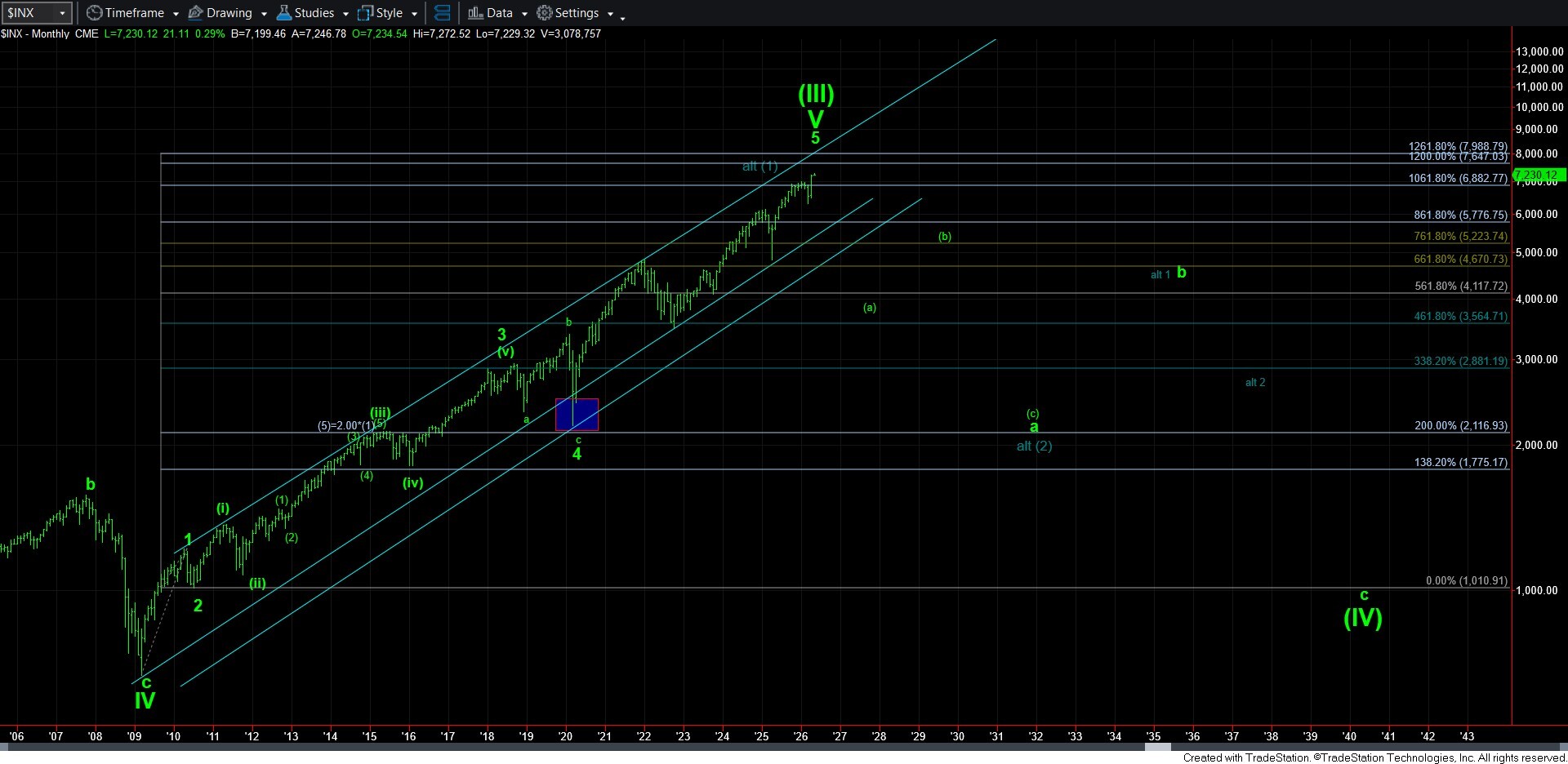
We have been in a Grand Supercycle bull market for over 200 years. And, within that, we have been within a Supercycle 3rd wave since 1932. You can see this in this 100+ year chart of the SPX.
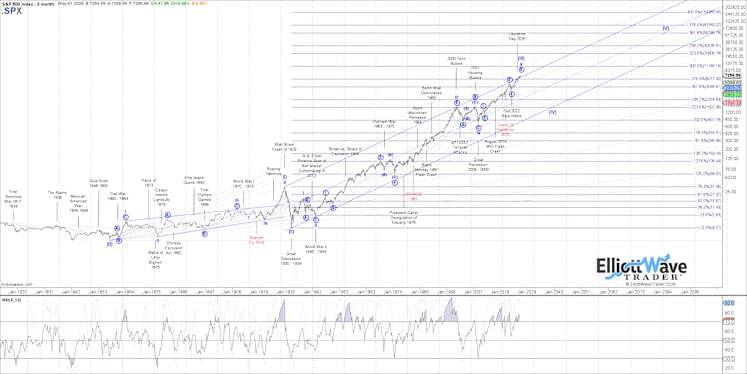

This long-term 3rd wave is what has fostered the bullish mantras of “buy the dip,” “do not time the market,” “always be invested,” and “the market always comes back.” And, this long-term bull market has done its job of convincing the masses that this cycle will not end and will continue unabated. But, markets are not linear and like everything within the natural course of life, these periods of progression are followed by periods of regression.
In fact, if you would travel back in time to the United Kingdom during the 1700’s, everyone at that time would think you are crazy for any bullish thoughts at all. You see, it was during that period of time that investors were entangled within a 60-year bear market, when the mantra was only “sell the rips.” As an aside, I do not see a bear market that long as being in our future until we complete the 5-wave Grand Supercycle in approximately 70-100 years.
(For those that are questioning how I could presume that the next 50+ year bear market will not likely begin for another 70-100 years, I will tell you that Ralph Nelson Elliott himself (the progenitor of Elliott Wave analysis) used this same analysis to call for a 70+ year bull market in 1941).
And, if you move forward in time by another century, then you come to the speculative mania of the early 1800’s, which culminated in the panic of 1837. The market immediately preceding the panic of 1837 was characterized by an intense, speculative bubble fueled by rapid credit expansion and unregulated banking. This particular boom was driven by high cotton prices, a surge in mechanical improvements (canals and railroads), and the rapid settlement of new territories. Yes, everyone at the time only saw the bright future brought about by the innovations and expansion of the time. But, as we know, the panic of 1837 struck at the height of such optimism.
This time period was captured quite eloquently by Rev. Leonard Bacon:
“A few months ago, the unparalleled prosperity of our country was the theme of universal gratulation. Such a development of resources, so rapid an augmentation of individual and public wealth, so great a manifestation of the spirit of enterprise, so strong a seemingly rational confidence in the prospect of unlimited success, were never known before. But how suddenly has all this prosperity been arrested! That confidence, which in modern times, and especially in our own country, is the basis of commercial intercourse, is failing in every quarter; and all the financial interests of the country seem to be convulsed and disorganized . . . The speculator who dreamed himself rich, finds his fancied riches disappearing like an exhalation. . .”
If we then move forward in time by another century, of course, we all know what happened during the “Roaring 20’s,” and what followed thereafter – the market crash of 1929, which ushered in the 10-year long Great Depression.
So, here we are after another century since the crash of 1929, and the market is completing the 5-wave bull market rally off the low struck in 1932, again, a bull market rally which was called for by Elliott himself in 1941. And, we seem to be progressing no differently than those living in the centuries before us.
Yet, in our own times, many of us lived, and even traded, through the largest bear market of the last 30 years from 2000-2009 (which was the 4th wave within the 5-wave structure off the 1932 low), the cause of which was described by Alan Greenspan in the Financial Times in 2008:
“The cause of economic despair, however, is human nature’s propensity to sway from fear to euphoria and back, a condition that no economic paradigm has proved capable of suppressing without severe hardship. Regulation, the alleged effective solution to today’s crisis, has never been able to eliminate history’s crises.”
Please read what Greenspan said very carefully. And, also note that he supported my proposition above that natural transitional cycle swings from periods of progression to periods of regression cannot be suppressed by government or the Fed.
And, I think the US market is now due for its 100-year event, as the 2000-2009 4th wave was a correction of a smaller degree relative to what I am expecting for our future. It is for this reason that I believe the next bear market can last for longer than a decade, as it represents one wave degree higher than the 2000-2009 bear market. This would be similar to what Japan has seen through its 20-year bear market.
Yet, we continue to assume this time will be different and the latest shinny object upon which market participants are focused is the reason why the bull market will continue unabated. Of late, that happens to be artificial intelligence. Could this time be different? Could we finally conquer the natural cycle of human nature? History suggests that we cannot.
Yet, how do we continue to fool ourselves over and over again? In fact, as I have outlined above, this cycle repeats through generations, as one generation does not ever seem to learn from the prior generations.
I propose that the main reason is because we believe we are more rational in the present, whereas we view those of the past as being inappropriately emotional. We look back and say to ourselves, “how could they not have foreseen what was coming?” So, we assume we are smarter than our predecessors. We assume that our rational brain is appropriately guiding us and that our result will clearly be different than the lessons of the past. Yet, while we believe that we are rationalizing to attain this reasoned perspective, many recent studies of how the brain works tell us otherwise.
Much of today’s research indicates that the primitive emotional brain (the limbic system) processes information and makes decisions significantly faster than the rational prefrontal cortex. As Douglas Noll found in his 2025 research, the emotional brain processes data five times faster than the logical brain, selecting a choice well before the prefrontal cortex even processes the relevant information. A recent Standford study noted that 90-95% of decisions are shaped subconsciously by the emotional brain, and not by logical reasoning. These, and many other such studies, support the proposition that emotions drive our primary decision making, while rational thought simply justifies those emotional choices after the fact.
I find it quite interesting that the recent psychological studies of the human brain support a perspective set forth through one of Ben Franklin’s pithy, but wise, declarations uttered centuries ago:
“So convenient a thing it is to be a reasonable creature, since it enables one to find or to make a reason for everything one has a mind to do.”
And, when we apply this perspective to financial markets, we must recognize that decision driving emotions are strongest at the high and low points, right before major turns occur. That means that the strong bullish emotions which are seen at market highs convinces us that we will go much higher, which, in turn, drives our buying behavior. We then rationalize why we are certainly going higher to support our subconscious emotional decision.
At the end of the day, it is our primitive brains that cause investors to buy high and sell low, as those decision driving emotions are strongest at the various market turning points.
To this end, I am seeing more and more people absolutely convinced that this time is different, all pullbacks will result in V-shaped recoveries to new all-time market highs ad infinitum, and the next 15 years will be exactly like the last 15 years.
Looking at it from a little different perspective, Daniel Crosby, in his book The Behavioral Investor, noted:
“the normalcy bias is the belief that “all that has been is all that will ever be”. . . normalcy bias leads us to believe that all we have experienced is all we can ever experience. . . A behaviorally-informed investment paradigm should be robust to periods of mania and panic even greater than those observed historically. It is worth repeating that every developed country in the world has suffered equity market losses of at least 75%, so at least that level of disaster is possible in your lifetime. . . . After all, there is no assurance that the Great Depression will be the Greatest Depression when considered on a long enough timeline.”
And, as the market fills in the final stages of what is likely a culminating 5th wave to end the massive 3rd wave predicted by Ralph Nelson Elliott back in 1941, the risks have never been greater in the bigger picture for a devastating long-term bear market. Yet, as we see, the masses are absolutely convinced otherwise. As Daniel Crosby further noted:
“Our flawed brain leads us to subjectively experience low levels of risk when risk is actually quite high, a concept that Howard Marks refers to as the “perversity of risk.”
Now, my point in writing this diatribe is not to convince you to hide under a rock, but rather to have a plan to prepare. As Ben Franklin also wisely noted, “by failing to prepare, you are preparing to fail.” So, you need to take stock in what you own (pun intended) and make some determinations as to how aggressive you want to be in this environment.
For now, we have yet to see any indication that the market has struck its long-term top. So, my purpose in this missive is to make sure you are not allowing your emotional brain to cloud what will be a very difficult rational decision in the face of rising risk, along with conflicting and strong emotions, as everyone around you will pound the table in certainty regarding the continuation of this bull market. I strongly urge each and every one of you to develop a plan to protect yourself when the eventual time arrives.
Even within our own cyber walls of EWT, a member who has been with us for some time recently posted the following:
“In my opinion, as long as the Fed and Treasury continue to provide unlimited liquidity, bailouts, etc this party goes on and on news or no news. See you at 20,000 over the next decade. In other words I respectfully disagree a long term top will happen.”
And, this is the view of the HUGE majority of the market right now. They have already forgotten or simply do not realize that there have been more market crashes since the advent of the Fed than before it. Yet, their belief in the Fed is much stronger and unwavering today than ever before in history.
But, consider what the former “Maestro” Alan Greenspan himself noted:
“It's only when the markets are perceived to have exhausted themselves on the downside that they turn.”
Note that he did not say that when the Fed or Treasury provides liquidity that the market will turn, or that it can even prevent the downturn in the first place. In fact, we have seen many times where the Fed or the US government has provided massive amounts of liquidity, yet they could not prevent a crash. Just look at all the massive amount of money thrown at the market during the 2008 crash or the Covid crash. I somewhat jokingly post this chart regarding the Covid crash as an example:
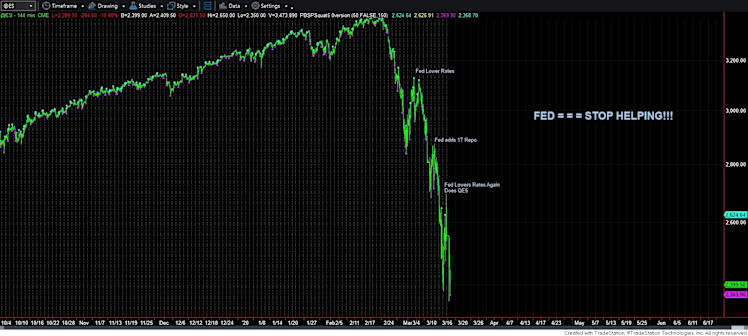
But, keep in mind that the market bottomed within 13 points of the 2200SPX support to which we continually pointed many times throughout (and before) that crash, a point at which I strongly bought, yet was even openly criticized for doing so in our chat room at EWT and was labeled as “crazy.”
I guess the multiple Fed efforts all the way down during that crash finally “caused” the market to turn at that support. Yes, I am kidding about the Fed being the cause of the expected turn up from support. The true cause was described by Mr. Greenspan, as we reached that support level as we were completing a 5-wave extreme exhaustion in bearish sentiment.
Yet, the masses are clearly convinced that the Fed has the market’s back, and I believe this has allowed the largest financial hazard of the modern era to mature. In fact, it will be that exact reliance on the Fed that will likely cause a very drawn out bear market as each bounce that will be seemingly “caused” by the Fed will raise the public's hopes that we are going to new highs, as was seen before, only to be discouraged when another decline is seen before reaching new highs. That will potentially be the hallmark of the bear market I expect, and the ubiquitous reliance on the Fed will likely only prolong the pain, as Mr. Greenspan surmised above.
I want to now address something that many of you are likely contemplating. Back in 2020, when I was pounding the table about a buying opportunity at 2200SPX, my minimum upside expectation was that the market would likely double from that point in a 5th wave rally, while my “ideal” target was 5300-6000SPX. Yes, I know we have clearly exceeded that ideal target zone, which seemed quite unrealistic at the time of my initial prognostication. But, that does not change the fact that this is a 5th wave. And, while it can still extend even further, I want to give you an example through which you can view the market and, maybe, better understand how to approach the market.
When weather conditions develop that make it ripe to bring about the destructive forces of a tornado, we often see tornado warnings being posted by the weather channels. That does not mean that a tornado will actually form right then and there. But, it does provide a warning that the conditions are in place which can allow an extremely destructive force to develop at any time. And, when one is formed and sighted within that environment, alarms go off to tell people to take shelter.
I view the stock market in the same manner. As we approach completion and are within the final throes of the long-term 5-wave structure which began at the 1932 2nd wave low, we have now entered an environment during which the destructive forces of a market tornado can develop. Yet, we have not sighted a tornado touching down. But, again, that does not lessen the fact that the environment is ripe for one to form.
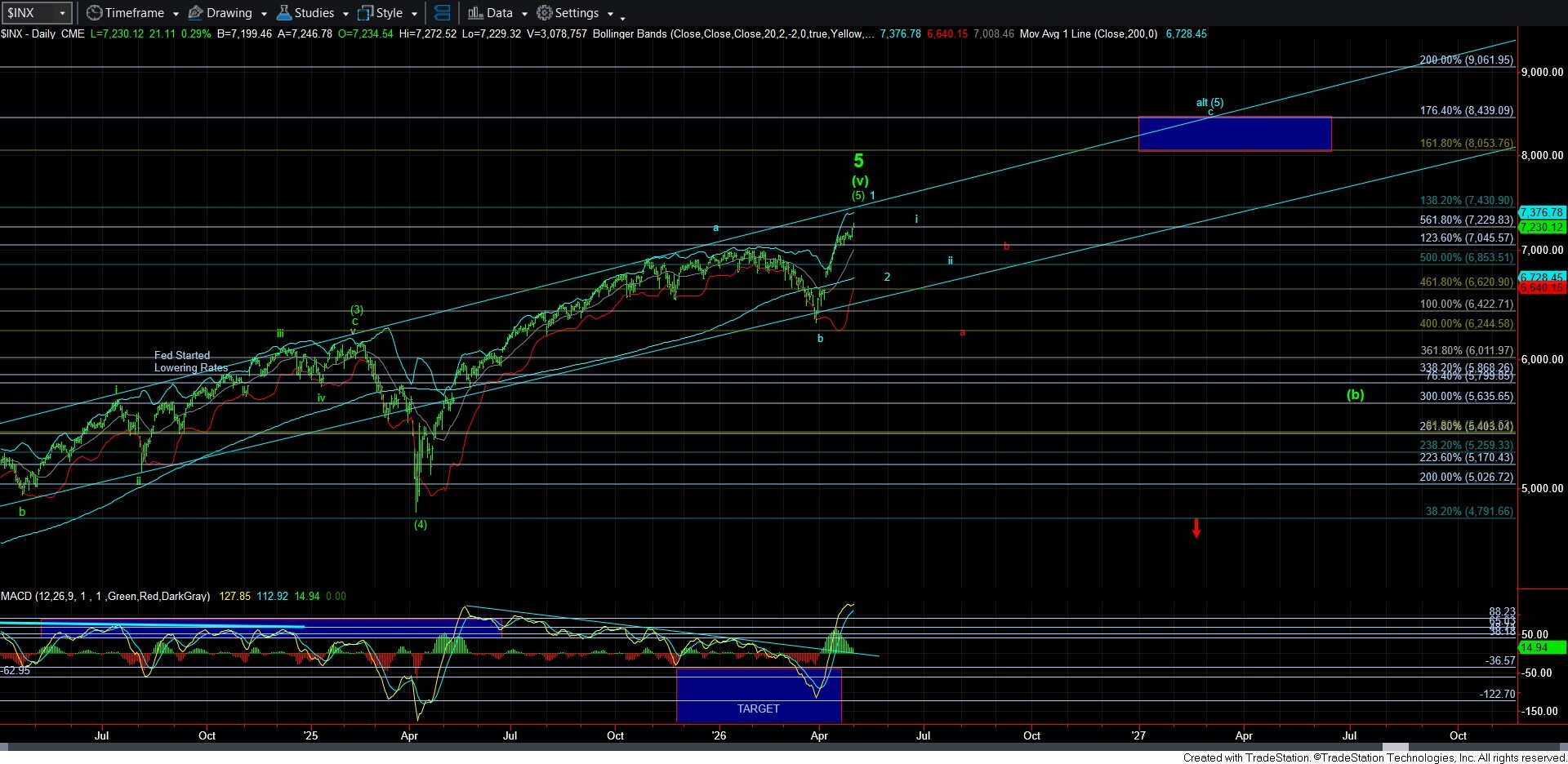
While the market can clearly extend further before it does form – as per the blue wave count alternative, you still must be cognizant of the environment in which you are trading/investing and the rising risks of completing a very long-term 3rd wave cycle. Again, keep in mind the “perversity of risk” principal outlined by Howard Marks. It is for this reason that I have personally become much more conservative in my own investing. And, I have not made it a secret and have been very transparent about my more conservative stance so you can appropriately gauge and adjust your perspective and approach with my view.
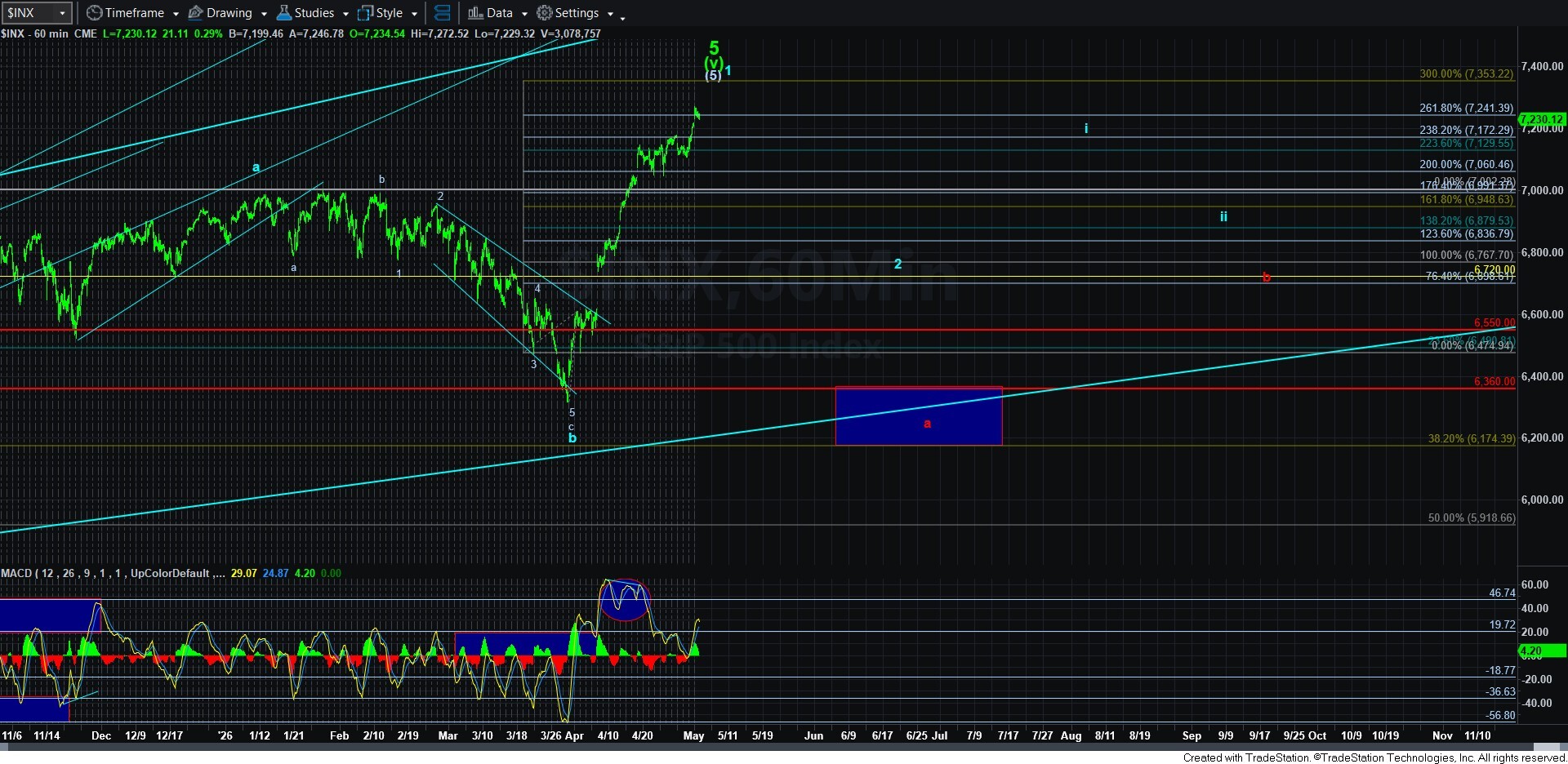
So, as we rally into the completion of a 5-wave structure to new all-time highs, I am raising a “tornado warning.” Of course, if the blue path develops in the coming weeks, then the tornado warning will be withdrawn, and we will have a nice 5-wave rally structure to trade to the upside. But, until that happens, I think it is appropriate to maintain that tornado warning signal.
So, let’s discuss what we are seeing and what we need to see for that warning signal to turn into an alarm or whether we can turn that signal off for now.
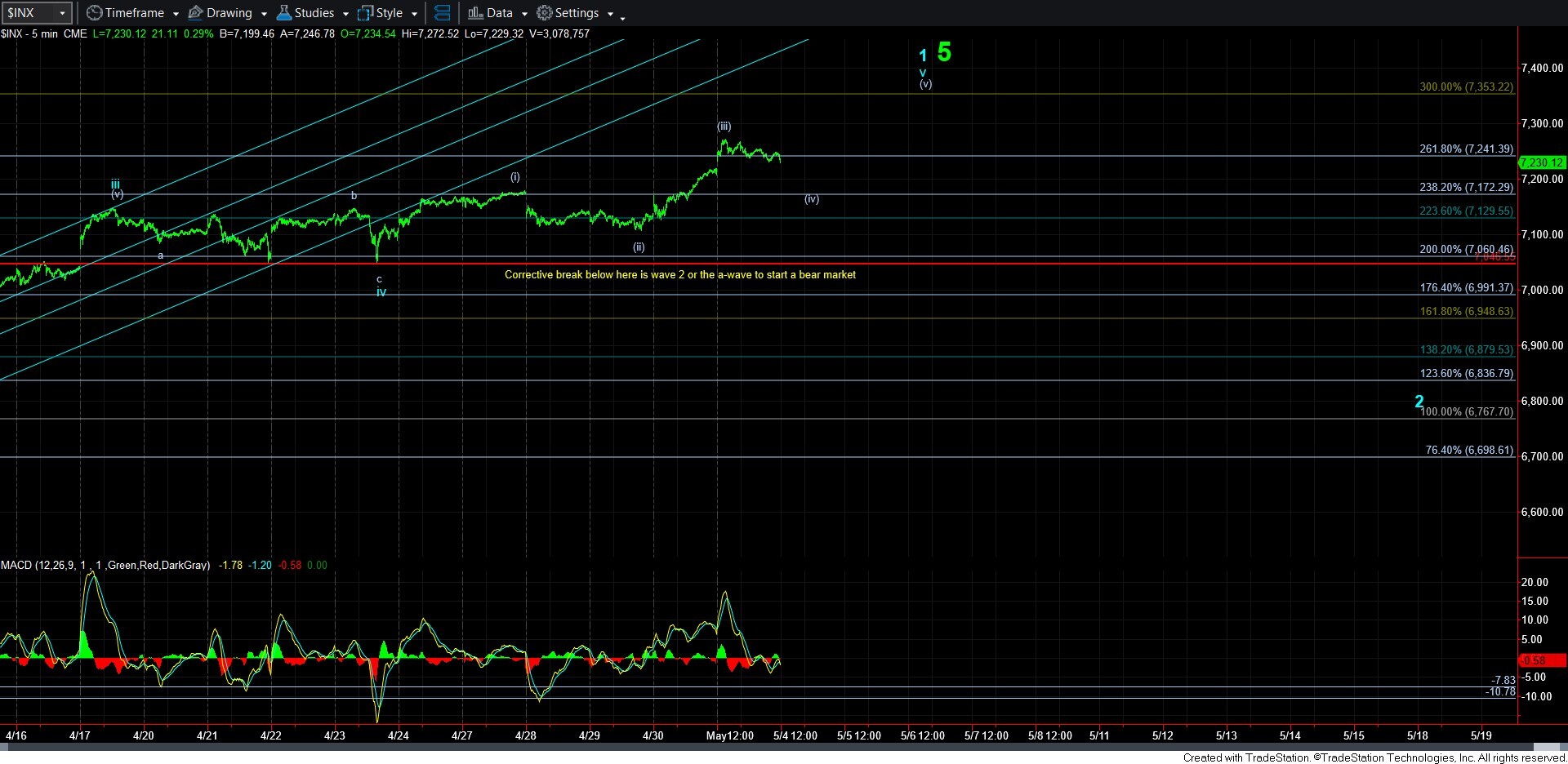
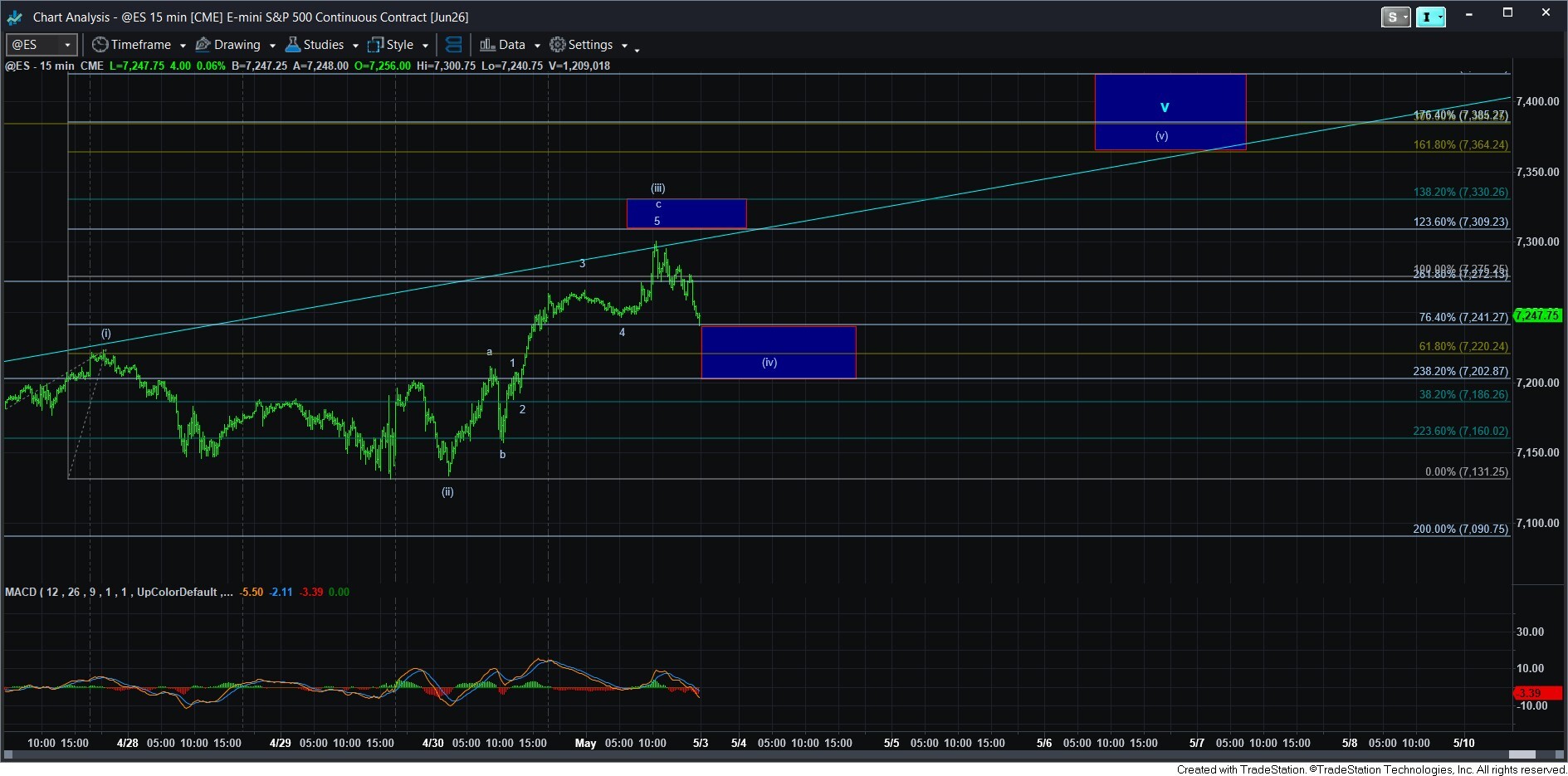
As I outlined in one of my early updates this past week, while the initial move off the blue wave iv support seemed relatively small to be all of the 5th wave, I was outlining the potential to see an extension set up by a (i)(ii) structure within wave v. That extension is what we experienced as we came into the end of the week.
Now, due to all the overlap, which is clearly seen in the ES chart, I have been counting this last segment as an ending diagonal. Again, I want to remind you of the words of Ralph Nelson Elliott that an ending diagonal occurs at a point where the prior rally “has gone too far, too fast.” And, within an ending diagonal, we have slightly different targets than a standard Fib Pinball structure, in addition to the fact that all sub-waves are 3-wave structures.
Within an ending diagonal, wave (iii) usually targets the 1.236 extension of waves (i)(ii) (for which we came up a few points shy on Friday). Thereafter, wave (iv) will most often overlap with wave (i), followed by wave (v) which will usually target the 1.618-.1.764 extensions of waves (i)(ii). Therefore, it seems we still have waves (iv) and (v) to complete early in the coming week.
Let’s move up one wave degree, and assume we complete this current 5-wave structure either as wave v of 1 in blue, or a very long-term and fully completed 3rd wave off the 1932 2nd wave low in the coming week. And, yes, both potentials are the two highest probability structures on my chart at this time.
In last weekend’s update, I outlined the difference in these two paths, so rather than re-writing that analysis and making this update even longer, I am simply going to link to that update:
https://www.elliottwavetrader.net/trading-room/post/10202405
So, in summary, we have again come to a point wherein I have to put out the tornado warning signal. While this is not a signal that a bear market has indeed begun, it is a warning that the environment is ripe for one to begin, especially as we complete a 5-wave rally into a high.
Of course, should the market present us with the 1-2, i-ii structure in the coming weeks instead, then we can take the warning down, and trade to the long side for the next 5-wave structure in the blue c-wave. That is the simplest manner in which I can summarize my perspective of the current environment, and I believe the most prudent approach considering where we are in the long-term cycle.
.SPX - Macro
5minSPX
15minES
60minSPX
SPX-Daily
SPX-Monthly
About the author
