
Treasury yields keep rising on a steep ascent, and it is the steepness and speed of their trajectory that riles the astronomically overpriced stock market even more than the significant altitudes individual high-tech stocks have already reached.
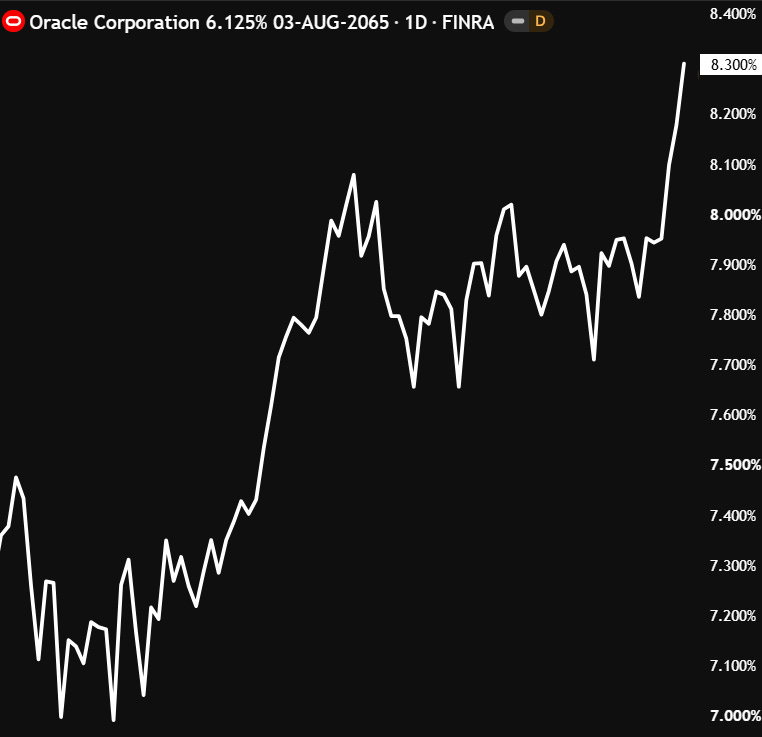
Stocks continued their fall as Oracle’s credit risk hit another record. With its credit now at a yield of 8.3% and its dependency on that credit out-of-this-world in scale, the emergence of credit troubles could precipitate a crash in high-tech stocks as the fall of Oracle’s rocket from the night sky would paralyze investors.
It’s not happening yet, but Oracle’s situation keeps looking more and more precarious; and, again, it is the steepness of the rise in its interest rates due to rising risk and its growing need of more debt to keep fueling its climb that is most troubling. It’s a rocket ride at the end of a relentless, strained rise in its cost of perpetual financing:
As I wrote about over the weekend, these situations are looking like Ponzi schemes where it takes endless new money coming in—mostly by way of expanding credit—to keep fueling the upward path that makes these stocks enviably hot. If the endless cash influx stops, such as by credit drying up, the whole scheme falls.
With many tech companies’ “profits” now being made from capital gains on their holdings of other corporate stocks, “earnings” are also starting to look like highly leveraged trades with this kind of corporate debt as the source of cash for buying those stocks. What could go wrong with a wobbling rocket ride like that?
I described what could go wrong back in July, “CALAMITY COMES: Mammoth AI Bust and General Stock Collapse Forecasted”:
40% of the growth in AI earnings in the first quarter was actually from gains on stock investments made by one AI company into another company’s AI stock on a mark-to-market basis. Those aren’t real AI earnings from doing their own AI business. They’re just more speculation in what looks like an incestuous circle. It presents an extremely fragile situation when a company’s expenditures are already gapping far above their earnings but those “earnings” are also largely gains made off of stock speculations (buying the stocks of the AI companies or software companies that a corporation wants their AI or software company to be in bed with). These earnings are just circular deals on each other’s stocks, which means the earnings plummet when the stock speculation turns down.
Yet, it’s worse than that:
If this one-of-a-kind “earnings bubble,” as [Fred Hickey] calls it, collapses, that can be a 40% vortex down in earnings that are already way overstretched by historic comparisons….
Yet, it’s worse than that:
In Hickey’s final analysis, all of the massive spending (beyond any CAPEX spending ever seen) on AI data centers by numerous corporations was never based AT ALL on earning’s studies. It was all, to put it bluntly, based on proving the size of the CEO’s balls. It was all egos of corporate executives wanting to end up being the one who could say he had the biggest and best AI on the planet. It was a space race to the moon. And they overshot far beyond what any revenue model can possibly deliver….
That means when that incestuous stock speculation that makes up 40% of the “earnings” reported by high-tech collapses into its own black hole, all of these stocks are in a precarious position and are likely to join the vortex down as margin calls force sales. They’re all just chasing the growth in each other’s stocks.
Yet it’s worse than that … because even those corporate “earnings” we just talked about that are fleshed out with speculative stock bets are often bets made with debt. So, it’s all a rickety scaffold standing over a cavern of debt….
Hickey cannot predict when the great collapse will be fully under way, but what a rush it will be!
As we wait for the first meteoric fall of a tech stock from the sky to begin, wondering what could be the spark that triggers the rocket’s explosion or when its fuel will run out before it escapes Earth’s gravity, meaning that it can survive and thrive off its real earnings derived solely from the things and services it actually produces, war threats have become more menacing and not just from Trump.
Iran just announced that, if Trump does start another round of intense fighting as he keeps threatening to do, Iran will now escalate to sinking US navy ships—a step it has avoided until now because it certainly will take both nations to all-out war. So far, we have seen Iran make no empty threats. Iran did fire some shots over the bow of a US aircraft carrier to demonstrate its capability, but this will be a massive escalation step if they start trying to actually hit those ships and succeed.
About the author


David Haggith is the publisher/editor-in-chief of The Daily Doom.
Economic, Social and Political News of Our Troubled Times -- a non-partisan daily collection of the most consequential stories about our complex times from multiple sources around the world plus daily editorials like the one you read here.
Liked it? Take a second to support David Haggith by subscribing on Substack!