
Don’t let the stealth recession fool you. Just a quick look at the Atlanta Fed’s GDPNow indicator shows how false were the hopes that Trump’s “golden era” would start to dawn with its shimmering halo emerging above the morning horizon during the spring of 2026. The Fed’s own projections for second-quarter real GDP growth just took a suicide leap off a huge, bubble-busting cliff:
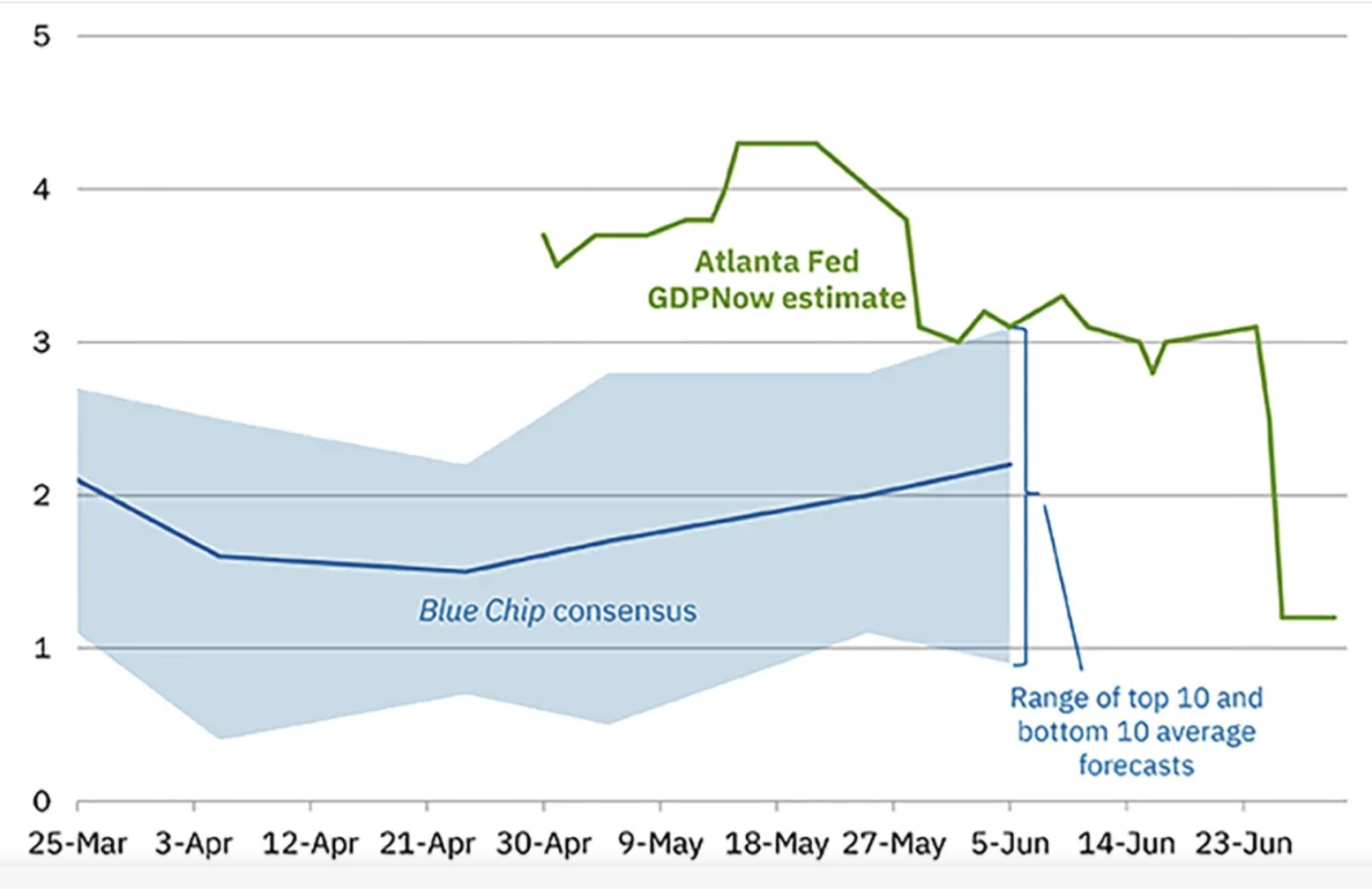
That looks more like the golden sun took an unexpected plunge toward the sunset horizon to me.
The Fed’s GDPNow forecast tends to become more accurate at the end of the quarter as more real data starts to come in. While the Fed was posting ludicrous estimates in the face of a massive oil crisis that inflation-adjusted GDP would arrive in a hot-to-scorching range by US standards of 3-4% growth, the number just got real. It is, of course, still not fully real, even at this low level, because the government never factors out all inflation (for reasons I’ve covered repeatedly so won’t go into). So, the real, real number is negative.
Watch the videos below, and you’ll see major caverns opening up under the US economy right now that are sucking that downward:
-
A huge revelation of the true state of the US labor market, which is deeply in recession for reasons that don’t show on the surface, helping to keep the stealth recession fully cloaked. (I plan to lay that out in a Deeper Dive at the end of the week because there are a lot of complexities to unravel there.)
-
The now absolutely certain impact this summer of the largest energy crisis in history. One video and an article lay out what I’ve been saying about how critical the level of US oil reserves have become.
Trump declares imminent food “emergency”
If you don’t believe the energy crisis is as bad as the video below reports or as I’ve been saying it is because it hasn’t happened yet (even though I’ve been saying it would not happen yet), then look at the national emergency that President Donald J. Trump just declared:
I, Donald J. Trump […] do hereby declare an emergency TO EXIST with respect to the threats to the availability of sufficient supplies of fertilizers to meet expected agricultural demand. [My emphasis.]
If you’ve been reading The Daily Doom, you’ve seen the fertilizer emergency coming from a long way off. You know why it is a true emergency because it forebodes a food crisis, and you know why it is happening. So, it’s no surprise and should have been dealt with months ago. The president now says a food crisis is coming if we don’t take emergency action right away.
Within the president’s sudden declaration of a state of emergency, which he says demands “immediate” action, we find admission to troubles created by his tariffs as well as a big clue to the size and imminence of the overall energy crisis. You see, the cause of the fertilizer crisis is two-fold: The unavailability of phosphates, which the declaration addresses directly, is an artificially created tariff trouble. The unavailability due to “conflicts” that the president brings up refers to natural gas for producing the nitrogen component of commercial fertilizers. This immediate emergency is a bellwether for the full-on energy crisis.
The fact that the shortages are serious enough to get Trump to drop his tariff on a key fertilizer component from a major supplying nation in order to open the market up more is testimony to the destructive effect of tariffs on the US economy. He prizes his tariffs, so he doesn’t drop them easily, and he surely knows any time he does have to drop them looks like an argument against the tariffs.
The fact that Trump is doing this to help get the cost of fertilizers down for farmers is also testimony to a fact that he has perpetually denied, which is that American businesses (and ultimately consumers) pay for the tariffs. American farmers have become so strapped by rising costs due to tariffs and the oil crisis that the president is having to back off a tariff on phosphates to help get the price of fertilizers back down to earth.
The US Farm Bureau has reported that 70% of farmers cannot afford the amount of fertilizer they normally go through during the summer.
The president’s declaration acknowledges the severity of the problem, but attempts to deflect the blame by putting it vaguely on “disruptions” from conflicts and “trade actions” of other countries:
[The acknowledgement] “Fertilizers are an essential component of agriculture and food production. Producers of corn, soybeans, wheat, and a variety of other crops need phosphate fertilizers to ensure strong crop yields to feed the population. Food production is critical to human health, farm security, and to the function of major sectors of the economy, and even isolated interruptions in food production can have serious health and economic consequences. Robust and reliable food production is therefore critical to the economic and national security of the United States….
[The deflection] “Global supply chains for phosphate fertilizer and fertilizer inputs, including imports of such products into the United States, have been disrupted in recent months by, among other things, conflicts in fertilizer-producing regions as well as trade actions taken by major fertilizer-producing countries.”
Yes, the conflict that Trump has created with Iran on top of the conflict Russia has created with Ukraine, both cutting off a lot of Natural Gas and the nitrogen made from NatGas are disrupting one major component of commercial fertilizer; but he cannot do anything to reduce that cost because it is already an established shortage due to the war. As for those “trade actions,” which affect phosphates extracted from mined rock, let me note that the “trade actions” Trump is removing are his own. Other countries do not charge our farmers tariffs on the fertilizer resources they have to sell and are normally more than happy to sell all they can. We charge our importers, and that cost gets placed on farmers.
Even if it were other countries taking action against the US, it would be their retaliatory response to the tariffs the US first imposed on US importers of the products those nations are shipping to the US. Adding tariffs to import prices reduces the extent to which American companies are willing or able to buy those resources. That is the whole point supposedly—to reduce imports from other nations to right the imbalances in trade. So goes the argument for tariffs. The result is shortages in the US, which I warned about a number of times last year as a trouble we’d see created by tariffs.
So, we’re getting a double-whammy from Trump’s tariff wars and his war in Iran, cutting off key ingredients—phosphates and nitrogen—that are essential major components in commercial fertilizers. His declaration continues:
For example, the United States’ largest foreign source of phosphate fertilizer has experienced supply chain disruption, placing additional pressure on the farm economy and the production of certain categories of domestic food. Persistent threats to the global fertilizer supply chain, which create rapid price increases and procurement challenges, require the United States to procure phosphate fertilizer from diversified foreign sources to mitigate the significant risk of harm to the agricultural food production of the United States.
“[…] Therefore, I, Donald J. Trump […] do hereby declare an emergency to exist with respect to the threats to the availability of sufficient supplies of fertilizers to meet expected agricultural demand.“
Yes, the supply-chain disruption, in the case of phosphates, is due to Trump’s own tariffs. In the case of nitrogen, the supply disruptions are primarily from the Trump-Israel Iran war. Trump doesn't have any control right now over the nitrogen shortages caused by his war because Iran is still throttling traffic through the Strait of Hormuz, and when it finally does fully open, it will take time to rebuild production—time we no longer have.
However, he can easily control the cost increases for phosphates because he caused them. By completely eliminating his tariffs on the mineral coming out of Morocco, as he has just done, he can reduce costs and eliminate the shortage issue in short order. So, one component of fertilizer will go down, reducing the price some. The other (nitrogen) will remain up, assuring the price stays a lot higher than it was before the war and the Trump tariffs.
Here is where this is a bellwether for the bursting of other bubbles I’ll talk about below: The President of the United States, by declaring an existing fertilizer crisis, is tacitly admitting to the genuine dangers of a full-on oil crisis. That is because the same thing is happening in crude oil as has been happening in natural gas. So, as I’ve been predicting, the same price increases and shortages will be coming for fuel that we have seen for fertilizer made from NatGas.
And, remember, just as the US produces more crude oil than it needs, it produces more natural gas than it needs. It does not, however, produce the kind of crude it needs for key distillates that go into some fuels, and, apparently, it does not have the full nitrogen extraction facilities it needs to meet all of its nitrogen requirements because we throw away a lot of natural gas. It has become used to buying some of those fertilizer products already refined and processed into granular fertilizer components in other nations.
This is the King of Chaos scrambling now to undo the damage his policies are creating without admitting directly that he is the cause, which is something we’ll never see; but he is admitting directly that trade-related shortages now do threaten an imminent food shortage for the United States if emergency actions are not immediately taken.
It is imperative to immediately facilitate importation of phosphate fertilizers from the Kingdom of Morocco to mitigate the significant risk to the agricultural food production of the United States, to safeguard the economic and national security of the United States, and to ensure a stable domestic food supply.
This is why I’ve given all my readers this simple recipe for stocking up on food by buying double the amount of foods with long shelf lives that they buy each week at the grocery store. Put half of that in storage in the basement, garage, a back closet, wherever it will be clear it is not your operational stock, but your overstock that you leave alone until needed (and because your kitchen won’t likely have enough room for significant overstock). The other half goes in your kitchen as normal operational supply.
When the supply in the kitchen cupboards runs out, go buy double the amount again, and put half of that in storage … again. Don’t give in to using the emergency overstock. Keep doing that until you have a good supply of overstock. Doing it this way automatically makes sure you are only adding stock of foods you regularly eat and in proportion to the amount you usually go through without having to figure it all out. It won’t save you in a famine, but it will get you through sporadic food shortages or buy you time to figure something out in the case of prolonged ones.
This method of mine helps minimize the cash flow and assures you are only stocking up on kinds of food you actually like to eat and know you will eat just in case the shortages don’t appear. So, worst case scenario, you saved on inflation down the road. You’re not spending extra money on special prepped foods, or buying things where you think, God forbid I ever have to eat all this dehydrated stuff.
At some point, you need to start rotating through your overstock before the use-by dates expire, so set it up to make rotating older stuff of any one kind of item to the front easy, such as columns running to the back for each single kind of item that you can reach over to stuff new stuff in behind or bins you can pull out that are loaded the same way with room for expanding the supply in each bin or dated bins. Whatever works easiest for you.
Do the same with non-food supplies that have a long life, such as toilet paper, buying, just doubling what you normally buy each time you buy it, in order to keep the amounts proportional to the way you actually go through the them.
I warned of shortages to develop here at The Daily Doom due to tariffs throughout the past year. Now we see it is an imminent enough food crisis to merit an “immediate” presidential elimination of phosphate tariffs with the nation that can supply a lot of phosphates. Expect to see more and more of these kinds problems with shortages emerging over time as both tariffs and the energy crisis rip like claws into the flesh of the US economy, which means into your flesh if you live in the US. However, the rest of the world is suffering the oil & gas crisis along with us as well as taking their own major economic hits from Trump’s tariffs or their retaliatory tariffs. So, what I write applies to everyone.
The chaos just keeps coming.
Don’t stock up on stocks
If the huge erosion of jobs I’ll be talking about in my weekend Deeper Dive doesn’t collapse the foundation of the economy, the crash of the stock bubble will certainly do so. Even MarketWatch, in a headline to an article you can only read with a MarketWatch subscription warns, “If the stock market’s double bubble bursts, it could usher in the next crash.”
The double bubble they note is AI stocks and the seasonally adjusted Price/Earnings ratio. Everyone knows stock prices are outrageously elevated, so stocks are a bubble in their own right, but defensive claims against that risk are that forward earnings are strong, keeping the P/E ratio anchored somewhat to reality. (However, they are nowhere near that strong because forward doesn’t look as good as they are deceiving themselves into believing.)
One of those bubbles is now showing some suddenly serious bubble trouble. Rebellion is undermining the enormous AI buildout that has been driving the AI bubble in stocks. The biggest AI project in the world was struggling under the protests of locals who don’t want the center anywhere near them. As the troubles grew, the center’s largest investor just pulled out:
World’s Largest Data Center Project On Verge Of Collapse After Blackstone Unexpectedly Pulls Out
Up until now, when it comes to real estate, Blackstone was best known in recent years for dumping many of its trophy office properties - which in the aftermath of work from home never recovered their projected cash flow potential - at a huge discount. Now, it may be pulling a page from its old, pre-Lehman playbook by calling the top in yet another commercial real estate segment: data centers.
Two days ago we reported that Blackstone was selling its stakes in a trio of data centers across Northern Virginia for $3.5 billion, cashing out of part of a bet it made less than three years ago….
We said that “the question is why did Blackstone decide to pull the cord now, just as fresh doubts are creeping [as to] whether the Mag 7s will continue funding the AI expansion with virtually unlimited capex.”
Two days later we have an answer.
The digital ink is barely dry on its Virginia data center sales, and we learn that Blackstone’s QTS (QTS Realty Trust) is again quietly fading its AI exposure by walking away from plans to build its portion (which at this point is the only portion left after its partner already pulled out days ago) of a 2,100-acre data center campus in Virginia - also known as Prince William Digital Gateway which would house as many as 37 data-center buildings - handing a win to residents who fought for years to topple the project.
The data center developer [for Blackstone’s portion?] had planned to transform more than 800 acres in Northern Virginia’s Prince William County, a project that would have spanned 22 million square feet, making it the largest data center campus in the world. Located on the edge of an historic Civil War battlefield and on what used to be land protected from development, the project ignited strong pushback from homeowners and has been stalled by lawsuits.
So, the protests against these megawatt-sucking behemoths is not falling on deaf ears. It’s growing to be as loud as the background humming of all those generators, cooling fans and AC pumps.
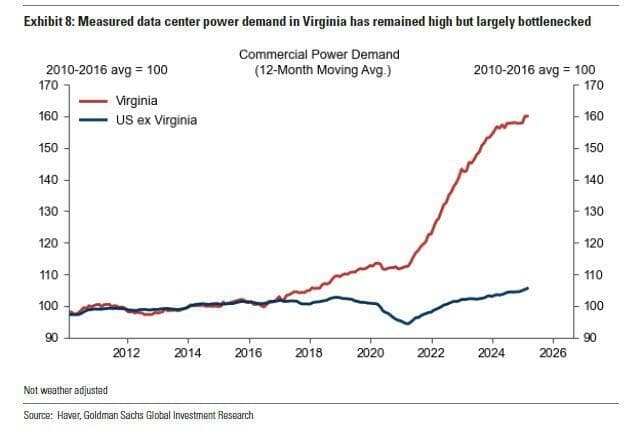
As part of Wall Street’s broader push into data centers, investment has poured into Northern Virginia, which is considered the country’s largest data center market, and is better known as “Data Center Alley”
You can see here what an enormous portion of the AI buildout Virginia constitutes:
We already saw in an article I wrote a month ago how Kevin O’Leary decided to scale back one of the other largest data centers in the world that was going to be built in Utah because of protests. (See “Past the Point of No Return: The Economic Collapse Is Happening!”)
So, resistance is not futile because so many people of all political stripes are enraged about what the enormous data centers do to their communities with noise pollution, light pollution, their enormous ugly footprint on the rural landscape, their impact on real-estate prices, actual (and substantial) heating up of the surrounding climate or streams, especially if built in valleys, and, most of all, electrical rates, though some are now being required to generate all their own electricity, but that just increases all those other categories of complaint. AI data-center rebellion seems to be the one thing most people can agree on.
But in a strategic U-turn, in recent days QTS executives decided that it isn’t worth pressing forward in court [against the protests], the Bloomberg sources said. The firm’s attorneys plan to inform the court of their decision as soon as this week, the people said, asking not to be named discussing non-public information.
QTS’s rapid growth has made it a poster child of how private equity has fueled the data center industry’s breakneck expansion. Those ambitions are colliding with public anxiety over strains to electricity grids and home prices from AI data centers.
The retreat may be the final blow to Virginia’s “Digital Gateway” project, a mega site roughly twice the size of New York’s Central Park with city-sized power needs. The initiative was supposed to bring in some $100 billion in spending and create one of the world’s largest technology corridors. Not any more.
The project had sparked contentious, drawn-out public hearings. A clerical blunder related to a key zoning meeting created setbacks for developers. Already, Brookfield-backed Compass Datacenters, which was supposed to build on more than 800 acres at the site, had pulled out in May.
The U-turns by both firms, Bloomberg writes, amount to one of the most dramatic retreats by developers from a data center project.
You can get a lot more details in the article, but that is the gist of the growing troubles for AI.
Another article says that the US Treasury has an internal report warning of the the dangers from an AI bubble. You can read that article below. The article notes in the lead that “Privately, some of its analysts are weighing AI against the dotcom bust,” which is how I’ve said all along the present bull market will finally end. It also notes that the Treasury report is “a significant departure from the Trump administration’s public tone.”
AI firms are more deeply entrenched in the U.S. economy than their dotcom predecessors and pose significant risk to the entire system if financial conditions change, productivity goals are missed or various choke points stymie growth.
Do you think that soaring cost for energy when the crisis breaks out full blown, as one of the videos below describes, could be one of those financial conditions that change … a lot … for an industry that is extremely energy hogging and already facing roadblocks because of that? Or how about that unexpected and large plunge that looks like it is forming in GDP now? (Not unexpected if you read here by any means, but unexpected by stock investors and the mainstream financial media and, until the latest report, the Fed, which thought we were homing in 4% GDP growth.)
A downturn in the AI market would send shockwaves throughout the entire economic ecosystem, the analysts wrote.
Well, then, hang on.
Red light flashing
As for the other bubble with trouble, P/E ratios by one metric have just triggered a record alarm. It is not an alarm that is great for timing, but it is one where the size of the alarm is resoundingly indicative of the size of the crash to come whenever it does hit. And, like an earthquake, the longer this fault builds up pressure, the worse the rip.
One of the market’s most reliable long-term indicators is flashing red
The overvaluation of US stocks has now surpassed the level that brought the stock market crashing down in 1929. At a rating more than double that of their British and European counterparts, and the highest since the peak of the dotcom bubble, US equities are in for a hairy decade.
That is the finding of a major investment bank….
This new analysis notes that the US S&P 500 stock index trades on 41 times earnings, based on Robert Shiller’s cyclically adjusted price-earnings (Cape) calculation. This is the highest valuation for US equities, using this tool, since the peak of the technology, media and telecoms (TMT) bubble of 2000 and exceeds the valuations reached at the highs of 1929 and 1901, both of which preceded seismic crashes.
The 41-times rating is also more than double the UK and European equivalent multiple, the widest gap ever seen….
Earnings, the denominator in the ratio, can fall suddenly, leaving the ratio top-heavy, as we have seen in past major busts:
Sharp falls in earnings in 2001 and 2007-09 punctured any “new era” thinking, and instead of a golden era of prosperity, investors were treated to a pair of devastating bear markets, as earnings disappointments left lofty valuations looking exposed on the downside. And it is the Shiller Cape study which raises the red flag on valuation.
Cape takes the stock index level and divides it by the average of the past 10 years’ inflation-adjusted earnings.
Adherents like it because this analysis takes a long-term view, looks at a company’s or index’s trend earnings power and considers cyclical highs and lows. Sceptics hate it because it is backwards-looking. They will also argue the US, and the West, are no longer reliant on capital-intensive manufacturing industries but asset-light ones, such as social media networks, software and AI.
How on earth is AI “asset light” with its requirements of enormous power facilities and enormous data centers? It’s as capital-intensive as building automobile production plants!
While this CAPE ratio has, even going by Schiller’s own words about it, not been good at predicting the timing of huge crashes, it has been very good at predicting the scale of the earthquake to come when ever the fault finally does tear open.
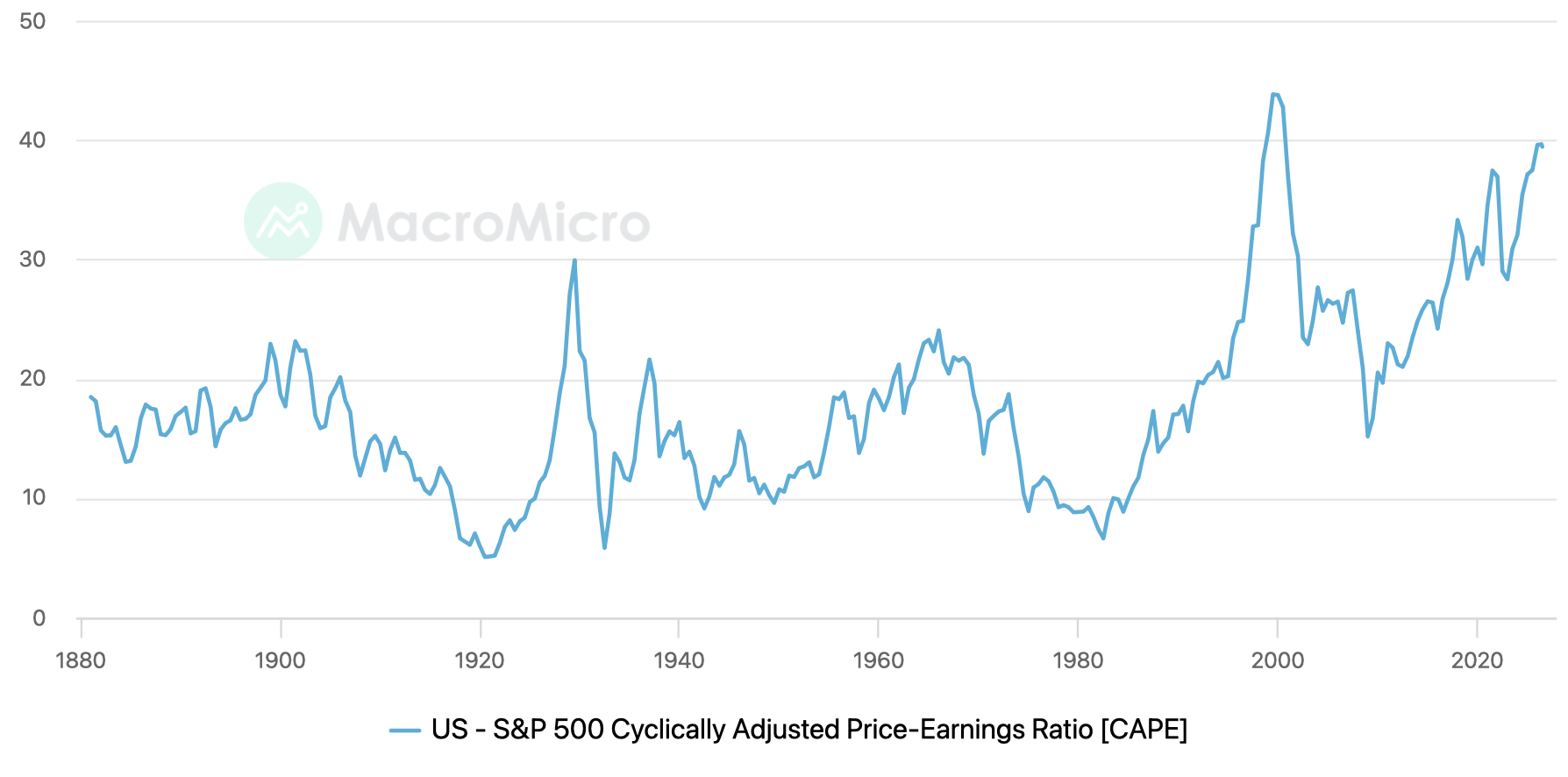
You can see we have been above the ’29 crash level for a long time, but you can also see that crashes that has happened up in this stratosphere have been cataclysmic.
If jobs are falling as badly as I anticipate reporting once I digest the data and if AI data centers continue to fail to build out all that they have promised their investors, earnings could tank in a hurry. Now, let me just note that the latest plunge in the GDPNow forecast was calculated/reported a day before the latest torrential jobs data that I plan (barring even worse news to emerge this week) to lay out in my weekend Deeper Dive for paying subscribers only.
And all those inflation-causing shortages in natural gas, fertilizers, crude oil and fuels, and maybe food shortages hitting right when GDP growth is going to the floor, mean one thing: serious stagflation just like we had during the OPEC oil crisis—the very thing I’ve been warning about for months. Only this time may be worse because the oil crisis is historically the worst ever and it hits right when the stock market is primed, based on historic metrics, for a massive scale crash as soon as the right triggers fire.
About the author


David Haggith is the publisher/editor-in-chief of The Daily Doom.
Economic, Social and Political News of Our Troubled Times -- a non-partisan daily collection of the most consequential stories about our complex times from multiple sources around the world plus daily editorials like the one you read here.
Liked it? Take a second to support David Haggith by subscribing on Substack!