
The three most overinflated bubbles in history are all about to break at the same time. Stocks, primarily due to AI stocks, have never been priced so high above the stratosphere to where one analyst says they are clear up in the “thermosphere.” They are at a level above total GDP that has never been seen before. Housing is priced higher above wages than at any time in history, dwarfing even the huge housing bubble that busted us all into the Great Recession, bringing down banks around the world. And the biggest bond market in world history is now blowing out interest rates all across the bond spectrum at a highly unusual velocity of rising rates while containing the largest national debt ever seen and while funding a huge part of that stock bubble.
It’s all going to blow up when the Big Bond Bubble explodes, and that is the one that is already fracturing all over its surface.
US budget deficit jumps to nearly $2 trillion
WASHINGTON—The U.S. budget deficit climbed to nearly $2 trillion in the fiscal year that ended Sept. 30, according to the Congressional Budget Office, deepening the federal government’s persistent red-ink trend.
The $1.993 trillion deficit was 12% above the 2025 level in nominal dollars, reaching the highest level since 2021. The U.S. spent $7.4 trillion last year, up 6%, and it collected $5.4 trillion in revenue, up 3%.
The US deficit has been on track with the trend of recent years. The only times we ever ran notably bigger deficits were during the historically massive bailouts of the Great Recession, and the even larger bailouts required by the ill-conceived economic lockdowns of the Covidcrisis when Trump and then Biden forced most of the US population to stop working and, so, stop producing. So did most of the rest of the world.
We pretty well run on crisis budgets now:
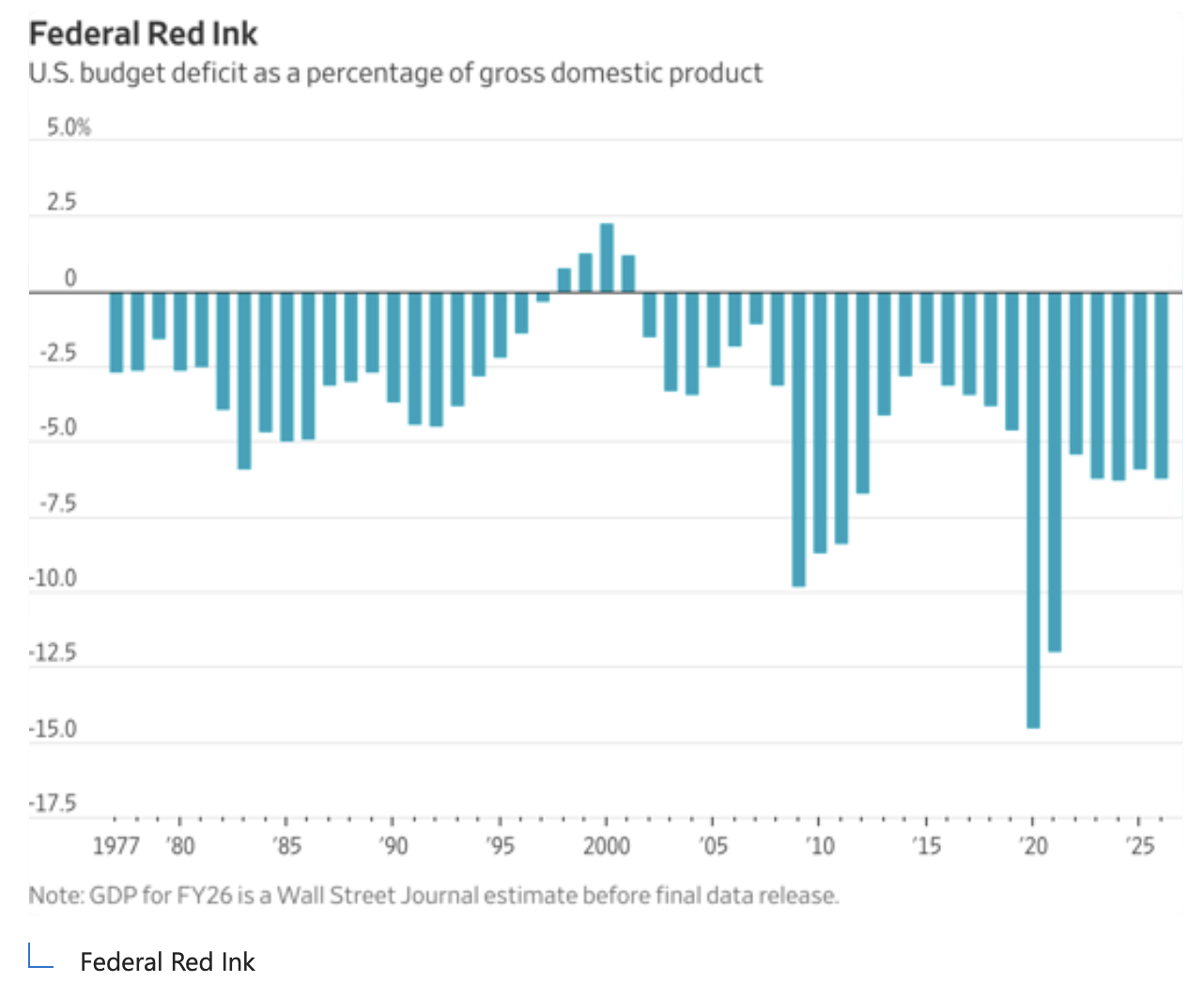
The anomalous budget surplus years were the Clinton-Gingrich years, which George Bush entirely destroyed with his Bush Tax Cuts that saved lots of money for the wealthy and a little bit for the rest of us by choosing not to pay for what we were buying, but to go back to letting future generations buy it for us. That tax-cut bill caused years of deficits under Bush and then years of massive deficits from bailing out the failed economy, which began in Bush’s final year. Those huge deficits were approved and scheduled during Bush’s final term to continue under Obama, which they did; and Obama, then, added extensions to those programs. We finally got down to more “normal” deficits but then blew that up entirely during all the Covid economic lunacy that started under Trump and continued with Biden.
It makes no difference which side of the Uniparty is in charge of government, except that we do marginally better when neither side is fully in charge, so that, at least, they are fighting each other, as happened in the Clinton-Gingrich years. Under either party’s full control, we choose to run massively irresponsible deficits until now we have a total national debt that is wobbling around like a drunkard, ready to do a face plant on the pavement.
The wobbling can be seen in the speed at which interest rates are rising on the debt to add more and more new buyers and steps that the debt has taken down in credit ratings.
Republicans increased deficits by expanding immigration-enforcement spending, extending expiring tax cuts and cutting taxes further….
“They could have blown it up worse, and they wanted to, some of them,” said Douglas Holtz-Eakin, the former CBO director who now runs the conservative American Action Forum. “They didn’t make any real progress, so we just wandered along.”
And that was after DOGE was supposed to help save us. Worse still, there is no hope for the immediate future from either totally irresponsible party:
Headed into the next month’s midterm elections, neither party has emphasized deficit reduction, and both have floated ideas that could increase deficits. Trump has promised $5,000 checks for adult U.S. citizens at a cost of more than $1 trillion—if voters keep Republicans in control of Congress. He also wants to boost military spending sharply. Democrats, meanwhile, are running on restoring healthcare spending cuts made by Republicans.
What a pack of idiots on both sides of the aisle to be talking such nonsense at a time when the debt is blowing up.
Trump has indicated he has “other ways” to handle the national debt than by raising taxes or lowering spending. Because he didn’t say what those other ways are, some writers speculated that he intends to let inflation run hot and inflate the debt away. I say, the more likely path he had in mind is the one he used in his own personal finance. In his own book, Trump wrote that bankruptcy is another form of finance; and he has deployed that form of finance more than once in his business life. If you have a lot of debt you cannot handle, pile it all into a failing project and then default on the whole project and let the banks and creditors eat all the debt, blaming them for being dumb enough to finance it in the first place.
I’m sure Trump would love to default on the US debt and flush the US dollar with it because he has already begun lining up crypto currency, particularly his own, to replace it. (Though his own stablecoin has nearly gone “bankrupt” on its own, so his plan isn’t working so well.)
What’s unusual about the present astronomical, two-trillion-dollar deficit is that it is happening at a time when Trump says the economy is strong and that we are headed into the golden era:
The continually high U.S. deficits—hovering around 6% of gross domestic product—are historically unusual outside of economic downturns and national emergencies.
“Running $2 trillion deficits in a growing economy with low unemployment and no major emergency situation going on is an unsustainable trend,” said Shai Akabas, vice president of economic policy at the Bipartisan Policy Center. It is “not what we should be doing when circumstances are relatively calm.”
I argue, however, that it is incredibly naive to think circumstances are relatively calm. The long-corrupted economy is, as I just wrote, reeling like a staggering drunkard. Its debt is showing signs of crumbling. The stock market that is the measure by which modern financial writers even say such dumb things as “the economy is strong” is all built on high-octane fumes, funded almost entirely by massive debt that is rapidly becoming too expensive to continue. It is not funded by profits; so, there is no strength under it. Even the reported corporate profits are, as I’ve reported here, mostly made from capital gains off other stocks corporations hold in the same high-octane club. So, when the fumes blow away, the entire enterprise will crumble, which is what we’ll be looking at today.
The debt bubble is undulating as a large bubble does when it is ready to burst. Some of the high-rollers with the best experience in predicting crashes are saying the big AI bust is looking imminent and that the crash from that bust will be immense. Interest on the national debt is climbing rapidly, and the Fed and feds seem unable to do anything to stop it. The bond market has taken that decision out of their hands and is running the train now. Inflation is rising more and more rapidly. The war that is driving it is still spiraling out of control with the Houthis becoming more aggressive against Saudi Arabia internally, blowing up commercial airports and blowing up the east-west pipeline again. This week, Pakistan joined the war in Saudi Arabia’s defense, and Iran has promised to expand the circumference of the theater of war to where tankers are back to blowing up, but now even beyond the Strait of Hormuz. Trump is planning for a larger military operations.
None of the usual idiots in congress have either the brains, the independent thinking or the fiber to do anything about it. They continue to offer their usual intransigent and calcified ideas. The Republicans want Dem’s to accept the spending cuts the Dem’s hate while not cutting anything the Republicans love to spend on, such as Trump’s bigger-than-ever, imperial military budget.
Dem’s want only tax increases, but you don’t hear them saying, “Let’s save Social Security by eliminating the cap on the income of our wealthy donors.” You don’t hear Republicans saying that either. They all pretend that can’t happen. Nobody is willing to do large spending cuts and significant tax increases as happened in the battle between Gingrich and Clinton that actually balanced the budget in order to start deflating the enormous bond bubble before it simply blows to bits.
“Nobody” includes most of the citizens of this country who are fully wedded to the ideas of the party they support, but who also cannot afford the government’s new inflation that is driving up interest on the debt, much less tax increases. The only place to start, of course, would be exclusively with eliminating all the tax welfare to the rich that gives them lower tax rates on their capital gains and lower social security tax on their income by sparing most of their income entirely. That’s not hitting the rich. That’s just ending their welfare—the tax shielding the 10% get, which is barely ever experienced by the 90%.
Republicans may consider a one-party budget bill to implement the military spending increase sought by the Trump administration. Johnson said he is eyeing changes to reduce fraud in federal programs alongside that.
Big deal. Thinking that going after fraud will do anything to balance the budget while expanding military spending, is the same fool nonsense Republicans have done over and over since the Reagan days that has ALWAYS resulted in higher deficits. ALWAYS. Military spending has already been increased tremendously under Trump, and now Ron Johnson promises to expand it more because Republicans have always loved that kind of deficit spending.
Cutting out fraud and waste as the solution is pie in the sky that is no different than the dodgy dreams of DOGE that already claimed they’d find so much government waste that they would help reduce the deficit. It didn’t reduce! It grew! Much of what they cut had to be put back in because it did damage by cutting government employees who turned out to be actually doing things like managing air traffic, that is expected of the government.
What they did save just got piled into bigger spending, so there was no deficit reduction; and Elon and the boys (literally just boys) found a whole lost less fraud than they initially promised they would—less than half of what they promised to cut. They mostly created a government mess and got unbridled corporate access to all kinds of private citizen information that they still have. To what end, we don’t know.
You could start taking air out of the Big Bond Bubble by sticking a knife in Big Beautiful Bill’s enormous gut; but now Trump has already promised more than a trillion additional dollars in stimulus checks to be dolled out to every voting American if we put his team fully back in office. You want to talk about eliminating fraud? Let’s talk about blatantly using government funds to buy votes specifically for just one party. It’s just political game playing all the time! And, of course, it is always dressed in a rationale by the party gamesters that claims to justify it.
The deficits are unsustainable, said Rep. Brendan Boyle (D., Pa.), who is likely to lead the Budget Committee if Democrats take control of the House in next month’s election.
“While Republicans have been completely hypocritical on the debt issue, that doesn’t make the problem of a massive deficit any less real,” he said. “Any serious plan must include finally making billionaires shoulder more of the burden.”
The problem that Democrats have never resolved it either. If Clinton didn’t have Gingrich forcing massive federal cuts, there would never have been surplus. But the same can be said if Gingrich didn’t have Clinton forcing significant tax hikes. They forced each other to the sweet spot.
Let’s see if Democrats will cut 100% of the welfare for the billionaires, including particularly, the caps that shield their income from Social Security tax. Completely eliminate the special tax rates on capital gains that have done nothing for decades but fuel a huge casino in stock trades by giving lower tax rates to easy money made from those gains, which usually produces nothing but a higher round of stock trades in an endless cycle since that’s where the low taxes hang out. Even corporations just play the wheel of fortune. Why invest to produce stuff and make money the hard way. Just buy each other’s stocks. That is what most AI companies are making their actual revenue off of right now. It’s a giant Ponzi scheme.
That money has NEVER trickled down as promised. I’ve shown that with graphs many times over the past years. But is either party REALLY GOING TO DO THAT? The Dems talk a good game here when they are not in power, just as the Republicans did about balancing the budget repealing and replacing Obamacare, etc. until they were fully in power and delivered almost nothing but a lot more debt via Big Bloated Bill, but the Dems never move to do that in the end either because the same big corporate entities have their hands deep in Democratic campaign pockets, too.
Some of the effects of Republicans’ 2025 “one big, beautiful bill” started to show up in the fiscal 2026 budget data. Corporate tax revenue decreased by $70 billion, or 16%, though they rebounded some in September.
The decline came because Congress gave companies some retroactive research tax breaks. It is also because Congress expanded accelerated deductions for factories and equipment, including servers for the data-center build-out. Those changes reduce tax revenue now and should yield corporate tax collections in the future when companies are profitable.
The promised improvements for the rich that damage the deficit are always right now, while the improvements to average Americans or the improvements to the budget are always well down the road….AND THEY NEVER MATERIALIZE AS PROMISED. SO, DON’T FALL FOR THAT FAKE AGAIN. MAKE SURE EVERYTHING CONGRESS DOES HELPS THE AVERAGE PERSON ONLY RIGHT NOW, AND PROMISE THE TRICKLE DOWN TO THE RICH IN THE FUTURE. THEY AN AFFORD TO BE THE ONES WHO WAIT.
Other changes, including reductions in projected Medicaid spending, haven’t kicked in yet.
And guess who will be hurt by the reductions in Medicaid spending when it comes. Will it be the rich? Of course not. It will be the disabled and those who are retired with very meager retirements who don’t have expensive private insurance and cannot even afford Medicare Supplemental.
Because we have never faced the problem, we now face …
The soaring cost of rising national debts
The national debts of the world’s wealthiest countries are rising in cost as the debts of emerging markets are shrinking. Look at how the risk premium paid by emerging-market nations on their national debt is shrinking as the risk premium for the wealthiest nations has been rising:
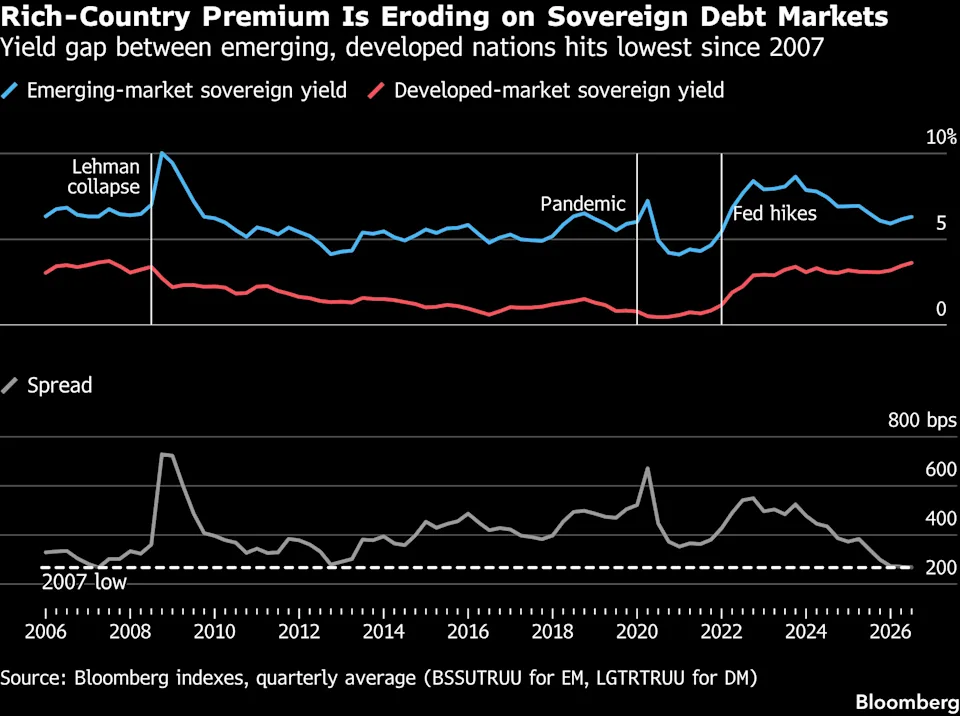
Rich Countries Are Now on Front Lines as World’s Risk Map Shifts…
Governments in America, Europe and Japan have seen their borrowing costs soar to multi-decade highs as the US war on Iran drives inflation up. That means they have to shell out more to service historically large debts – which in turn pushes them to borrow even more. It threatens to become a vicious circle.
It does not threaten to BECOME a vicious circle! It has ALREADY become a vicious circle. The vicious circle is FULLY in play! This is because borrowing costs for the rich nations are rising due to their longterm profligacy in how they extended and pretended with their debts that the time to pay the piper for that soaring mountain of debt would never arrive while the amount they are piling onto their debt is rising in order to pay the interest:
Earlier in the Iran war she was emphasizing the world’s resilience, but lately the combo of rising energy prices, inflation and interest rates has gotten her sounding rattled. “In normal times, that would not be a giant problem,” [IMF chief Kristalina Georgieva] said last month. “But these are not normal times, because we have debt levels in advanced economies at historic highs.”
It was not hard to see those historic highs coming. They just all pretended it couldn’t happen. Of course, an oil war would drive up inflation! Of course, the massive increase in debt spending over the past two decades raised the burden of finance astronomically. Of course, the rising inflation has driven up the interest on that hugely expanded burden of debt because people loaning money over time down’t want to lose their investment gains due to anticipated inflation. There was no mystery in where this was going. None whatsoever. Just denial. That is why I kept declaring where it is going all along the way—to keep trying to crack the denial with statements of the obvious.
What’s more, the IMF chief warned, governments that have to pay bigger interest bills will struggle to afford other things, like helping their citizens with the high cost of living. “We should prepare for people being more unhappy,” she concluded. “Maybe on the street.”
Well, that, of course, is why I and others have also reported on how all those financially shielded billionaires with privileged tax status and undue political influence have been using their wealth to build billioniare bunkers. They are well aware that their privileged protection as the 1% is going to lead to some “trouble on the street.” Their highly paid international bankster heads like Kristalina Georgieva need to worry about this.
The problem is so do the rest of us because when social unrest comes, as we’ve seen in France, which invited its problems through unrestrained European immigration that included literally millions of people who hate Western/French civilization, it is the people on the street without the bunkers who pay the price of the social breakdown.
Even before the latest leg of the bond selloff, rich-world governments were paying over $3.3 trillion in annual interest — more than global spending on defense or AI — the Institute of International Finance reported. It noted a parallel with “debt-distressed” emerging markets of the past.
Those bills are a legacy of trillions borrowed in the cheap-money era that followed the Global Financial Crisis, and the now-higher cost of refinancing.
And the worse news is that rising interest begets more rising interest because, yes, the vicious circle is happening:
There’s a “precarious loop” at work, says Frederic Neumann, chief Asia economist at HSBC Holdings Plc, with “the rise in debt-service costs leading investors to push up interest rates further still….”
Some economists don’t buy the notion that such countries are on the brink of a debt crisis, or that their budgets and bonds are the world’s most pressing problem.
“Debt servicing costs rise, which means deficits are a bit bigger — but so what?” says Dario Perkins, managing director at TS Lombard. Loose budgets aren’t really what’s driving yields up, he says — “to me, it’s a simple oil/monetary policy story” — and inflation should come back down when energy prices stabilize.
It is by that sort of thinking that the profligacy of the richer nations always continues…always arrogantly believing their economies are indefinitely immune or that tough times cannot last long enough to take them down, so irresponsible fiscal management keeps happening. If stability is found, someone like George Bush finds a reason to blow up the stable situation just established in order to give more candy to voters and vastly greater wealth protection to his cronies. No political can long resit putting the surplus toward big programs, instead of paying down the debt for an even more prosperous future.
Call it a “vicious circle” or a “precarious loop,” you’re talking about the same thing. Bond interest is now driving bond interest higher as the US government (and other governments) finance their rapidly rising interest bills, adding all of that to the debt at a new higher interest rate, and as credit agencies downgrade national debt that looks more problematic under rapidly rising interest, triggering even higher interest due to the downgrade, and as inflation keeps pushing investors to demand more interest to compensate for the inflation. Both the vicious circle and the new inflation from oil and tariffs are feeding into the rising rates, and the new inflation from oil and tariffs is unlikely to end soon.
With the arrival of the national debt problem clearly in focus, let’s look at what others say about the calamity that is now emerging from years of over-juiced markets and poor fiscal policies—the big triple collapse of this ever-more-stupidly-run, greedily-controlled, once-great enterprise called America.
A contrarian billionaire speaks
I’m going to start with one of the well-known billionaire voices who is one of the few in the billionaire crowd who has long warned a time of great turning is coming. Ray Dalio has been warning of the coming doom loop for years. The problem is that he has said so often that it could happen in 2-3 years and then been wrong. Eventually, he will be able to say he predicted it and he was right … like the broken clock that is right twice day.
Though we may have to look elsewhere for timing, I think he is right about the problem with the current funding dynamic:
Dalio Says We’re Nearing Point Where AI Bubble May Burst
Billionaire Ray Dalio warned that artificial intelligence is a “classic bubble” that is nearing a bursting point thanks to rising interest rates and the need to turn wealth into cash.
Right off, you can see he ties the problem to these rising interest rates for an obvious reason. As I would put it, the stock Ponzi scheme requires a source of endless incoming funds to keep paying gains on investments that are not paying with profits. That new money is coming from bond issuances where the cost of the finance is now being driven upward by rising interest on national debt, which was long held very low. All interest rates corporations pay to finance AI are priced in one way or another off of Treasury interest as the benchmark (“risk free”) low rate. We just saw strong Treasury auctions that I reported this past week, but both auctions had a robust level of buyers only because they offered at issuance the highest interest in more than twenty years.
The AI bubble is not primarily financing itself with cash from its operations revenue, nor even just with stock issuances. It is largely financing itself with debt where it competes in the bond market with the national debt (Treasury bonds). The combination of the nation running a massive deficit that needs new funding plus the costs of servicing a massive debt from all the past deficits with the new pile-on of massive funding demands from the insanely rapid expansion of AI data centers far beyond what their profits will be able to justify for years to come, is driving up everyone’s interest. Dalio says that will soon become an unsolvable exponential rise that collapses like a volcano caldera that has belched out all its stored energy and collapses into its empty former magma reservoir.
OK, that’s my way of wording it; here is his:
Dalio said that a huge amount of debt is being taken out to fund AI. As rates continue to climb, that is a point at which the bubble begins to pop.
“We’re in the part of the cycle that is before that but approaching that,” the Bridgewater founder said. “I think we’re close to that.”
His timing is a bit vague. However …
His comments come as technology giants spend hundreds of billions of dollars on AI, increasingly financed with debt, and as market gains concentrate in a handful of stocks. Bond yields around the world have surged to the highest in decades, increasing the cost of funding the enormous investment needed to build AI infrastructure.
Still, equity valuations continue to rise, with optimism over technology earnings propelling the S&P 500 and Nasdaq 100 indexes to record highs this week.
While his timing is vague, the exponential dynamics of the funding problem here are readily apparent. Ponzi schemes break when you can no longer find a round of new investors large enough to pay off previous investors because those seeking returns outnumber in their monetary demands the new money being poured in that is not coming from any profits. I look at those surging Treasury yields that happened at Treasury auctions this past week as a clear sign that it is getting harder and harder to find a large enough round of new Treasury investors so more and more enticement has to be added to increase the size of the pool.
They added a lot of enticement last week—enough to put the US back to offering as much interest on its Treasuries as it last did during the dot-com bust when interest rates were still descending form years of fighting high inflation. Problem is right now we are not descending from an inflation fight. We’re just beginning the ascent into a fierce coming inflation fight.
So, now I’ll turn to another person ringing the alarm on the collapse of this stock Ponzi scheme that is coming due to the concurrent Big Bond Bust that I am really talking about here:
The worst crash in decades
As you’ll see in the first argument, the crash of the stock market is being tied to the serious problem that is happening with the financing of national debts.
The head of market strategy at a London investment bank has a stark warning for investors: the artificial-intelligence trade may soon be over in what could trigger the most severe market crash since the global financial crisis….
Hyperscalers’ free cash flows are largely depleted, while the cost of debt is rising quickly and becoming prohibitive for these firms, he said.
Here is the timing he gives for the crash and the extent of the decline:
About the author


David Haggith is the publisher/editor-in-chief of The Daily Doom.
Economic, Social and Political News of Our Troubled Times -- a non-partisan daily collection of the most consequential stories about our complex times from multiple sources around the world plus daily editorials like the one you read here.
Liked it? Take a second to support David Haggith by subscribing on Substack!