
Distinct Qualities Support the Metal’s Enduring Allure & Value
With gold once again topping $5,200 an ounce, I thought it a good time to look back in time and ask: Where did this coveted metal comes from and why has it retained its universal appeal though the ages?
In a world fraught with financial fraud, investment scams and greed-driven schemes, gold—in its pure, physical form—is far more than a clever, get-rich gimmick or monetary flash in the pan. It’s an esteemed metallic substance of ethereal origin with a venerable history that dates to the dawn of creation.
Based on ancient beliefs, sacred texts and scientific hypothesis, the shiny yellow metal either is the dominion of the gods, the brilliant brainchild and deliberate handiwork of divine alchemy, or the byproduct of an astronomical blast or colossal smash in the cosmos.
Take your pick.
To me, gold is a God-given gift of natural beauty and brilliance bestowed upon the Earth as a superior form of money, a universal medium of exchange and a morality test for mortals, even if the almighty creator ordered the cosmic collision or detonated the stellar explosion that produced the long treasured and sought-after metal.
Despite endless and ongoing efforts, gold can’t be practically—or profitably—created or replicated by the sharpest scientific minds on the planet, much less average earthlings like me, which is why the glorious metal reigns supreme as regal jewelry, sound money and an enduring store of value.
Since the dawn of humanity, diverse and isolated cultures around the globe have revered the amber-colored metal for its luminous luster, rarity, sacred symbolism and monetary attributes.
That’s not a coincidence. It’s confirmation of gold’s masterful and purposeful creation.
Ancient Cultures Associated Gold with the Gods
Gold long has been associated with the sacred and godliness. The precious metal held religious and spiritual significance for at least five millennia before it was used as coined money.
Since its discovery and original refinement, gold has served as a symbol of eternity, power, purity and sanctity for various civilizations and societies, which associated the gleaming metal with the life-giving sun and immortal heavenly deities.
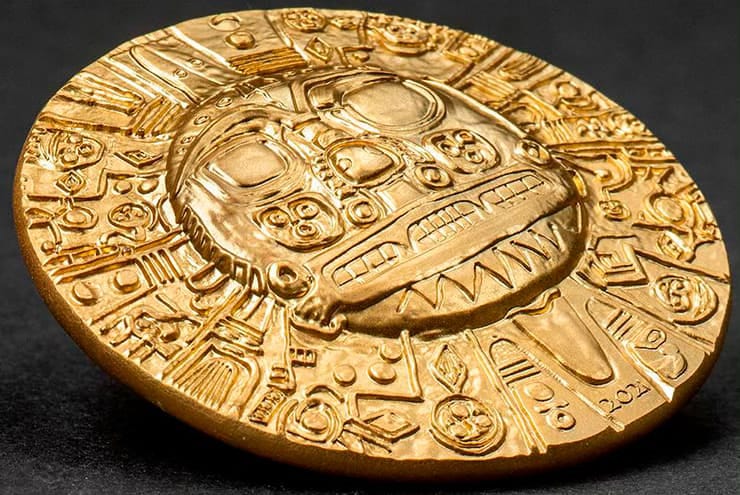
An ancient amulet depicts the sun god Inti, who based on Incan lore perspired gold .
In ancient Egypt, gold was venerated as the flesh of the gods, particularly the sun god Ra. The Inca of South America revered the shiny metal as the sweat of Inti, the sun god. And, as they have for thousands of years, the Buddhists and Hindu of Asia continue to associate gold with divinity, enlightenment, purity and prosperity.
Gold was central in Greek mythology, too. The precious metal was considered the dominion of the gods and immortals. Golden fluid, it was written, flowed through the veins of the gods, who donned gold armor and attire, feasted from golden platters and vessels, and resided in gold-paved palaces on Mount Olympus. Gold also is featured in the cautionary tale of King Midas, whose wish to turn everything he touched into gold proved to be a curse, which signified the punishment for greed in ancient Greek lore.
Gold’s chemical symbol is Au. The symbol is derived from the Latin word aurum, which means gold. Aurum evolved from an earlier word that denotes the glowing or shining dawn. Aurum is related to the Roman goddess of dawn, Aurora, whose rousing light illuminated the sky each morning, heralding the Sun’s rise and giving birth to a new day.
Gold was and remains esteemed for its exceptional qualities. The radiant, reflective mineral in its pure, unadulterated form doesn’t corrode, rust or tarnish like most other metals, which affirms its distinctiveness and permanence. It doesn’t decay and can’t be destroyed like most manmade materials. Gold, like God, is eternal.
Scientists Theorize a Celestial Big Bang Created Gold
Atheists and disbelieving scientists might challenge the divine origins of gold in the universe, attributing the mineral’s formation to a high-energy stellar collision or the explosion of a supernova, which sent heavy metal-bearing meteorites hurtling toward Earth. But they can’t dispute gold’s extraordinary properties and powerful creation, which are of heavenly genesis even among most agnostics and nonbelievers.
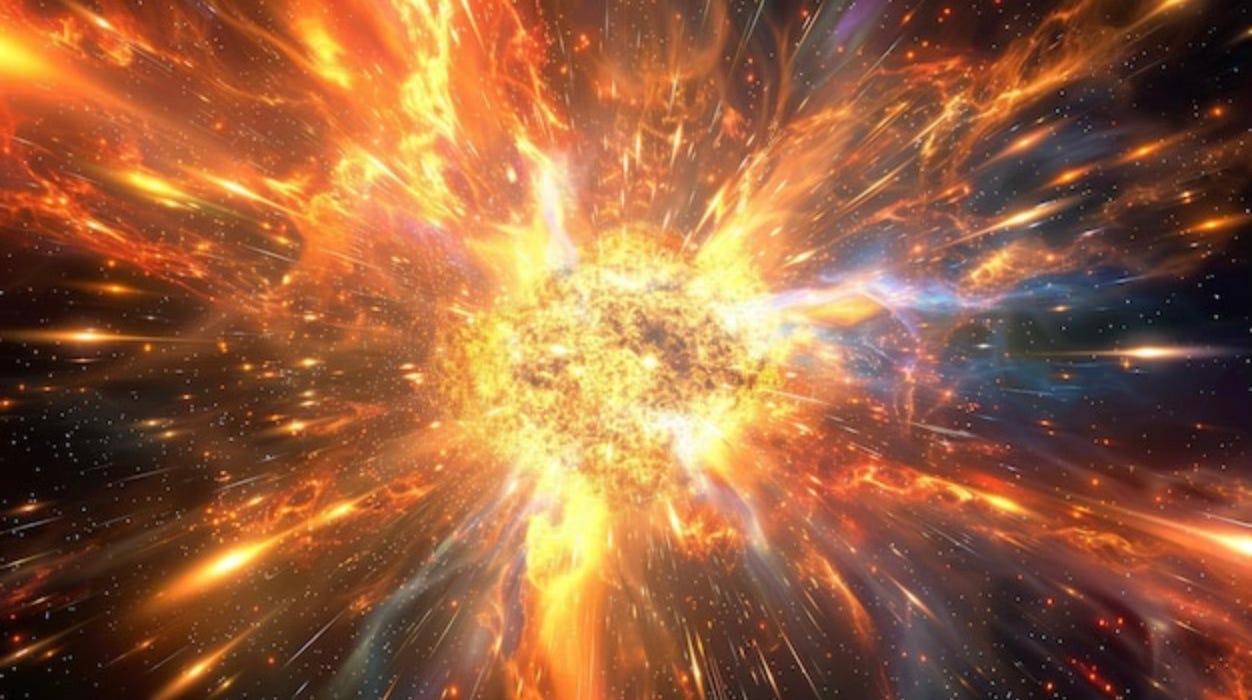 A powerful cosmic event is believed to be the source of the universe’s gold.
Driven by the reverence and value of gold, alchemists and scientists through the ages have tried to create the coveted metal in their workshops and laboratories. Despite repeated attempts and the enormous expense of energy- and time-consuming experiments, wannabe Rumpelstiltskins have yet to produce gold in economical or eternal quantities.
In 1980, researchers at the Lawrence Berkeley National Laboratory in California created a microscopic amount of atomic (and radioactive) gold by bombarding the base metal bismuth with high-energy carbon and neon nuclei in the lab’s Bevalac particle accelerator. The gold-producing process, however, wasn’t economically viable given the vast amount of electricity used to conduct the experiment.
“It would cost more than one quadrillion dollars per ounce to produce gold by [his] experiment,” Nobel Prize-winning chemist Glenn Seaborg told the Associated Press at the time, when gold was about $560 an ounce.
But with gold above $5,000 an ounce, scientists likely will keep trying, particularly after physicists in Geneva, Switzerland, reported creating gold ions for microseconds while smashing lead ions together in the Large Hadron Collider during four experiments between 2015 and 2018. The circular, 16.8-mile collider is owned and operated by the European Organization for Nuclear Research, also known as CERN.
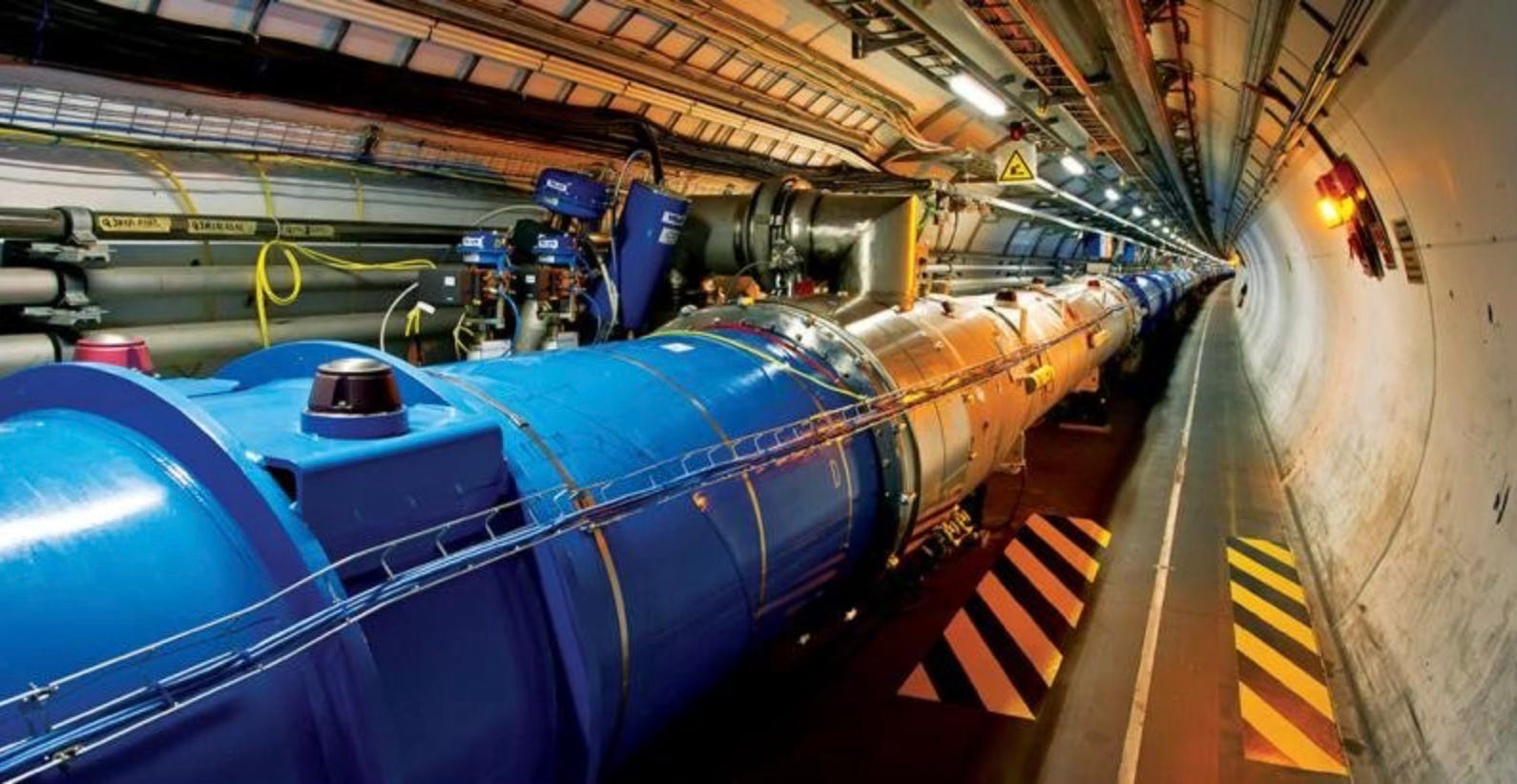
Lead was transmuted into gold for microseconds during four experiments at the Large Hadron Collider in Switzerland during the last decade.
“CERN researchers achieved the feat by aiming beams of lead at each other at close to the speeds of light,” according to a 2025 Scientific American article. “The ions occasionally glance past each other, rather than hit head on. When this happens, the intense electromagnetic field around an ion can create a pulse of energy that triggers an oncoming lead nucleus to eject three protons—turning it into gold.”
Gold has 79 protons in its nucleus; lead has 82. The numerical designations indicate an element’s atomic number.
Unfortunately for the researchers, the expensive experiments to recreate a stellar collision in the world’s largest and most powerful particle accelerator didn’t produce profitable—or permanent—gold. Scientists may endeavor to play God or replicate an astral impact, but when it comes to gold, they’ve yet to perfect divine or celestial alchemy with their high-tech, high-speed atom smashers.
Gold Provides an Ideal Ethics and Morality Test
Biblically speaking, gold is viewed both positively and negatively. In Scripture, gold is considered a blessing when used in ways to honor God, but the precious metal also is symbolically associated with human sin, notably greed and the worship of wealth. In other words, gold—and money in general—can enable an abundance of generosity and good deeds or inspire sinful desires and evil acts.
In the Bible, God’s commandments are described as more precious than gold. “The law of the Lord is perfect, converting the soul . . . More to be desired are they than gold, even much fine gold,” reads a passage from Psalm 19:7-10.
Gold as a metaphor and precious substance seems to be is an ideal test of individual ethics and personal morality. As universal money and a measure of wealth, it’s designed—and intended—to help humans distinguish between virtues and vice.
While thieves and usurers defy God’s laws in their pursuit of money and riches, and fraudsters swindle unsuspecting fortune seekers with financial schemes and precious metal scams, the ownership and possession of gold itself isn’t devious or wicked, nor do human flaws and failings invalidate its monetary attributes of durability, scarcity and physical stability.
Gold advocates consider the metal the foundation of sound money because neither scientific geniuses, cunning central bankers nor profligate politicians can create it in infinite quantities like digital and paper currencies, which makes gold a reliable financial safe haven and hedge against monetary inflation. That’s the primary reason gold’s value keeps rising while debased fiat currencies continue to depreciate and lose purchasing power
God—or a powerful celestial bang—also created silver, which is to say nothing of the distinct attributes, industrial applications or value of poor man’s gold. But I’ll save silver’s story for another day.
© 2025 Stuart Englert. All rights reserved.
Englert is the author of “Rigged: Exposing the Largest Financial Fraud in History” and “Patient Millionaire: A Financial Memoir.”
About the author
