
Strengths
- The best-performing precious metal for the past week was silver, up0.63%. First quarter’s record-setting environment pushed average realized gold prices up 14% quarter over quarter, which should support strong revenue growth for miners in the first quarter of 2025. Even as spot gold pulls back from its highs, the quarterly average that drives gold company revenue remains at historically elevated levels, reflecting a market that spent most of the quarter at prices the industry has not seen before.
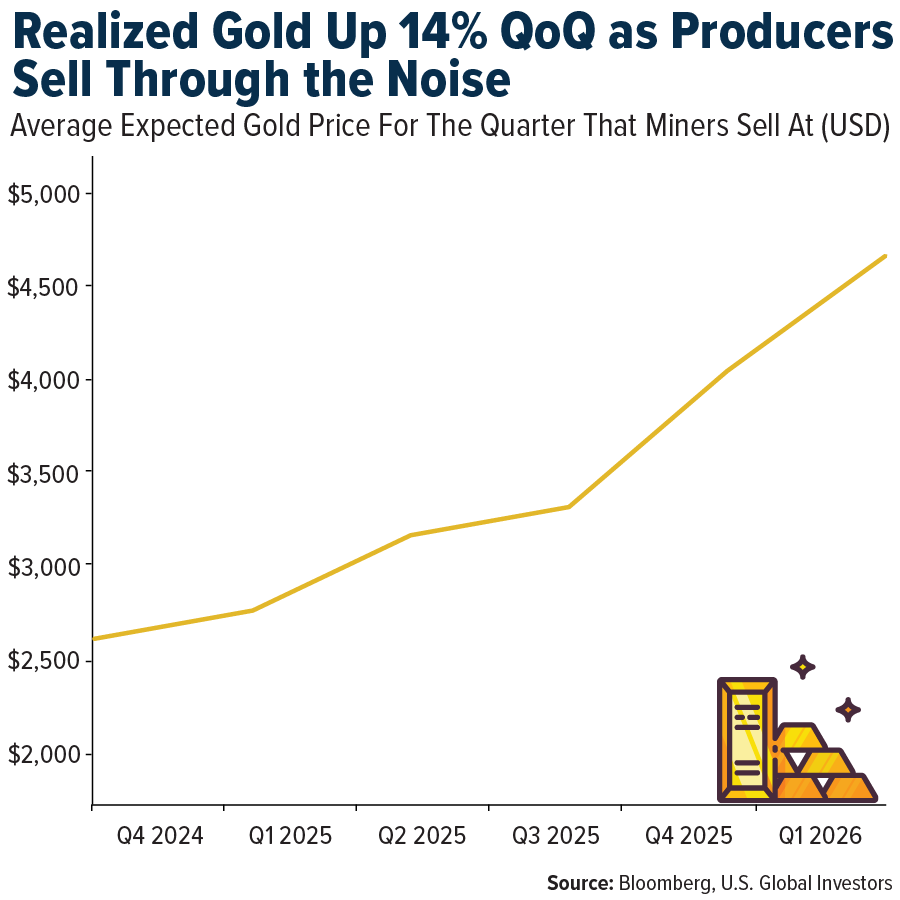

- Zijin Gold International reported FY25 net profit of $1.6 billion, up 233% year over year, at the upper end of its profit guidance. The strong performance was driven by higher gold prices, solid volume growth, and effective cost control. In FY25, gold prices rose 44%, lifting the company’s average selling price by 53% to $3,524 per ounce, according to Bank of America.
- Uzbekistan’s gold holdings rose to 13.1 million troy ounces as of March 1, up from 12.8 million a month earlier, according to the central bank. The value of reserves reached $67.7 billion, compared to $55.1 billion at the beginning of the year.
Weaknesses
- The worst-performing precious metal for the past week was platinum, down 5.95%. Platinum ETF holdings declined for a fifth consecutive session, shedding 1,521 troy ounces in the latest trading day, bringing the year-to-date decline to 7.3%.
- Turkey’s central bank reportedly sold or swapped about 60 tons of gold in the first two weeks of the U.S. attack on Iran. Some of the gold was sold outright, but most was used to secure foreign exchange or lira through swap agreements, according to Bloomberg. Turkish policy aims to maintain a stable or depreciating lira.
- Zhaojin guided 2026 gold production down to 16.5 tons, compared with 17.5 tons in 2025, and expects high-single-digit cost inflation, mainly due to a mine accident at Canzhuang. Management noted that Canzhuang accounts for about 1 ton of annual production, while the accident led to a broader suspension of nearby operations, according to UBS.
Opportunities
- DoubleLine Capital CEO Jeffrey Gundlach is calling the recent correction in precious metals a strategic entry point, urging investors to view the current “revaluation phase” as a chance to increase exposure. Despite a slide from recent highs near $5,500 down to the $4,400 level, Gundlach remains confident in his long-term thesis.
- Gold’s latest pullback may appear like just another leg lower, but the technical setup is showing signs of potential strength. Momentum has weakened to its lowest level in over a year, with the relative strength index slipping into oversold territory for the first time since 2023, according to Benzinga Newswire. Although gold futures were down this week, spot gold looks set to finish the week with a 0.5% gain, marking the first weekly increase in the past three weeks.
- Singapore is positioning itself as a major Asian gold-trading hub by expanding vaulting services for foreign central banks and developing a clearing system for local OTC settlement. The working group includes JPMorgan, UBS, DBS, and ICBC Standard Bank. The initiative could attract nations seeking alternatives to London and New York, as central banks globally hold nearly 39,000 tons of bullion and increasingly look to diversify storage locations amid geopolitical uncertainty.
Threats
- Several Chinese banks, including Industrial & Commercial Bank of China, China Construction Bank, China Merchants Bank, and Bank of Jiangsu, plan to tighten rules for investing in gold accumulation products. These products allow regular or flexible small cash investments in gold. Retail participation has grown substantially in recent years, with many households using them as savings vehicles. Flows are reportedly not captured in ETF data. Given recent price volatility, banks are advising clients to “act rationally,” with some considering capping purchases or raising transaction fees.
- Russia has begun selling physical gold from its central bank reserves for the first time in 25 years, as the government seeks to offset a widening budget deficit driven by sustained military spending. The Central Bank of Turkey reported a $7.6 billion reduction in gold holdings over the past week, with $4.5 billion through swaps and the remainder likely sold outright, according to Bank of America. Russia could continue gold sales as Ukraine struck Russia’s Baltic oil ports twice this past week.
- With 88% of platinum group metal demand tied to consumer discretionary sectors, including autos and jewelry, demand tends to decline in recessionary environments. Reviewing the last three global slowdowns over the past 25 years, PGM demand fell 14–21%. In two of those cycles, the weighted average price basket declined significantly, by 32% in 2002 and 35% in 2009, according to UBS.
About the author
