
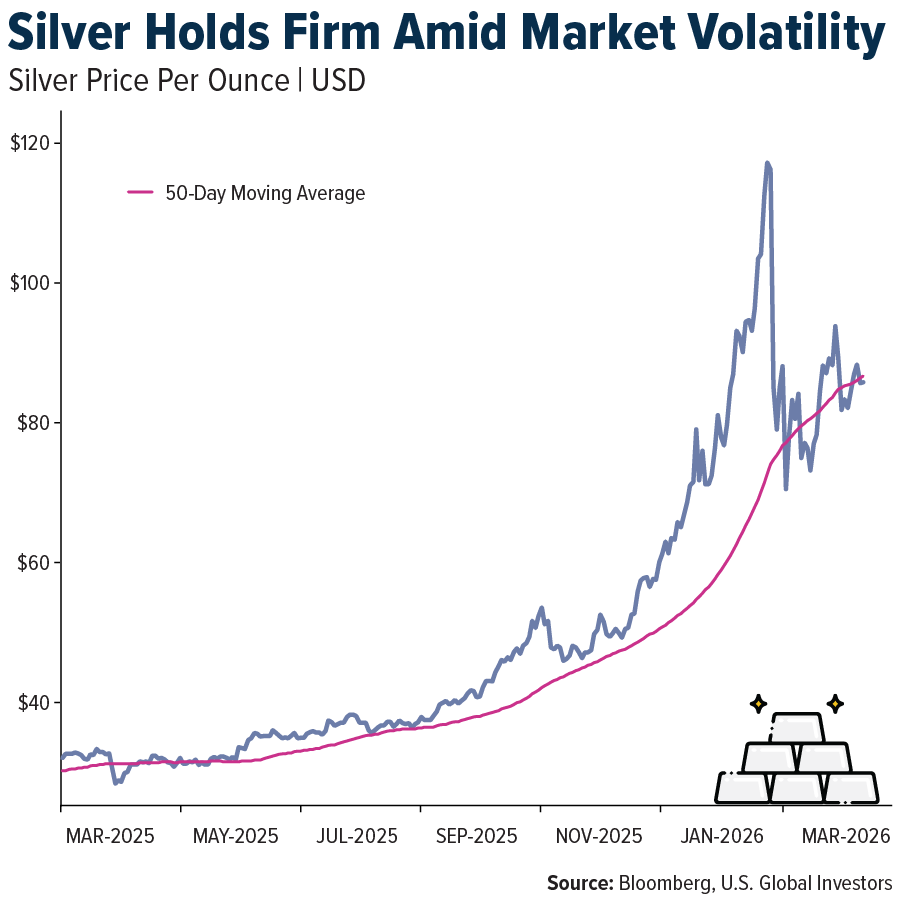
- The best-performing precious metal for the past week was gold, though it was still down 2.65%. Gold is pulling back for its second consecutive weekly decline, pressured by a stronger dollar and rising inflation expectations as the U.S.-Iran conflict keeps oil near $100 per barrel and reduces expectations for near-term Federal Reserve rate cuts. Silver has shown similar resilience — despite falling in the risk-off move, both metals remain well above their year-to-date bases. The broader pullback appears driven more by rising Treasury yields from safe-haven flows into bonds than by any fundamental change in the outlook for precious metals.

- Poland’s central bank governor, Adam Glapinski, signaled that his plan to use gold reserves to finance defense spending was effectively dead after the prime minister dismissed the proposal as politically motivated, according to Bloomberg.
- Franco-Nevada reported earnings per share of $1.85, ahead of Canaccord’s estimate of $1.64 and the consensus estimate of $1.67. Adjusted EBITDA of $540 million exceeded their estimate of $468 million by 16%. Franco-Nevada reported total gold equivalent ounces (GEOs) of 142,000, 12% above their estimate of 126,000 and up 2% quarter-over-quarter. The beat was largely driven by higher GEOs from Antamina, Antapaccay, South Arturo, and Hemlo, which more than offset lower oil and gas GEOs.
Weaknesses
- The worst-performing precious metal for the past week was palladium, down 5.86%. Palladium faced continued selling pressure as ETF holdings declined for the ninth consecutive session, according to Bloomberg, reflecting persistent outflows across the precious metals complex. Adding to the pressure, South Africa reported a 4.6% year-over-year rise in mining production in January, with platinum group metals output up 10.8%, pointing to stronger supply that weighed on the near-term price outlook.
- Although South Africa is the continent’s top exporter of mineral products, companies are investing less in exploring for new mines. Exploration spending has declined for the seventh consecutive year, falling 5.3% in 2025. The Minerals Council South Africa called the ongoing drop “deeply troubling for our sector” and warned it requires urgent attention, according to Bloomberg.
- Gold ETFs saw net outflows over the past week after three consecutive weeks of inflows, with North American investors driving the selling while European and Chinese investors continued to buy. Silver ETFs also saw net outflows, led by European investors, according to BMO.
Opportunities
- Pan African is acquiring Australian-listed Emmerson Resources. Each Emmerson shareholder will receive 0.1493 new Pan African shares, implying an offer price of A$0.45 per share and a fully diluted equity value of A$311 million, according to BMO. Pan African and Emmerson already have a joint venture at the Tennant Creek project in Australia, so the deal should eliminate the partnership structure and simplify ownership.
- Scotia expects the gold risk premium to remain elevated and volatile in 2026 and remains constructive on the gold price. Since 2000, the risk premium averaged 43% in 2012 and peaked at 53% in 2011. If those levels were reached again, it would imply gold prices of about $6,000 per ounce and $7,300 per ounce, respectively. A return to the historical average risk premium of 12% would imply a gold price of about $3,850 per ounce.
- Ed Yardeni, president of Yardeni Research, remains bullish on gold. He expects the metal to reach $6,000 per ounce by the end of the year and $10,000 by the end of the decade, adding that gold is a strong competitor to Bitcoin, according to Bloomberg.
Threats
- According to CLSA, Northern Star has issued another operational downgrade for fiscal year 2026, with gold output now expected to reach about 1.5 million ounces, below the latest guidance of 1.6–1.7 million ounces. The lower production is driven by variability at the KCGM mill and reduced mining productivity across several assets, particularly Jundee.
- Pantoro lowered its fiscal year 2026 production guidance to 86,000–92,000 ounces from 100,000–110,000 ounces, according to Goldman. The revision reflects the impact of heavy rainfall in February, as well as challenges related to transitioning to a single underground contractor and equipment availability.
- Ghana is planning legislation to replace its fixed gold-mining royalty with a price-linked system, as Africa’s top producer seeks to capture more revenue from rising bullion prices. Miners would pay a royalty between 5% and 12% of revenue depending on gold prices, replacing the current flat 5% rate, according to Bloomberg.
About the author
